Event submissions
Published
This submission belongs to the session S5. Numerical and Experimental Methods, Data Analyses, Digital Twin, IoT Machine Learning and AI in Water Sciences of the event The 8th International Electronic Conference on Water Sciences
Published date
11 Oct, 2024
Academic Editor
'%3e%3cpath%20d='M12.6657%2010.9104C12.4185%2010.325%2012.0599%209.79327%2011.6097%209.34482C11.1609%208.89508%2010.6293%208.5365%2010.0442%208.28888C10.0389%208.28626%2010.0337%208.28495%2010.0285%208.28233C10.8446%207.69279%2011.3752%206.73249%2011.3752%205.64904C11.3752%203.8542%209.92103%202.39999%208.1262%202.39999C6.33136%202.39999%204.87715%203.8542%204.87715%205.64904C4.87715%206.73249%205.40774%207.69279%206.22393%208.28364C6.21869%208.28626%206.21345%208.28757%206.20821%208.29019C5.62129%208.5378%205.09463%208.89284%204.64265%209.34613C4.1929%209.79493%203.83432%2010.3266%203.58671%2010.9117C3.34345%2011.4845%203.21226%2012.0987%203.20023%2012.7209C3.19988%2012.7349%203.20233%2012.7488%203.20744%2012.7619C3.21255%2012.7749%203.22022%2012.7867%203.22998%2012.7968C3.23975%2012.8068%203.25142%2012.8147%203.26431%2012.8202C3.2772%2012.8256%203.29105%2012.8284%203.30504%2012.8284H4.09109C4.14874%2012.8284%204.19459%2012.7825%204.1959%2012.7262C4.2221%2011.7148%204.62823%2010.7676%205.34617%2010.0497C6.08899%209.30683%207.0755%208.89808%208.1262%208.89808C9.17689%208.89808%2010.1634%209.30683%2010.9062%2010.0497C11.6242%2010.7676%2012.0303%2011.7148%2012.0565%2012.7262C12.0578%2012.7838%2012.1037%2012.8284%2012.1613%2012.8284H12.9474C12.9613%2012.8284%2012.9752%2012.8256%2012.9881%2012.8202C13.001%2012.8147%2013.0126%2012.8068%2013.0224%2012.7968C13.0322%2012.7867%2013.0398%2012.7749%2013.0449%2012.7619C13.0501%2012.7488%2013.0525%2012.7349%2013.0522%2012.7209C13.0391%2012.0947%2012.9094%2011.4855%2012.6657%2010.9104ZM8.1262%207.9024C7.52486%207.9024%206.9589%207.6679%206.53312%207.24211C6.10733%206.81633%205.87283%206.25037%205.87283%205.64904C5.87283%205.0477%206.10733%204.48174%206.53312%204.05596C6.9589%203.63018%207.52486%203.39567%208.1262%203.39567C8.72753%203.39567%209.29349%203.63018%209.71927%204.05596C10.1451%204.48174%2010.3796%205.0477%2010.3796%205.64904C10.3796%206.25037%2010.1451%206.81633%209.71927%207.24211C9.29349%207.6679%208.72753%207.9024%208.1262%207.9024Z'%20fill='%235D1EE1'/%3e%3c/g%3e%3c/svg%3e) Junye Wang
Junye WangCitation
Ruzimurod Sattorivich Jurayev, Bekzod Ravshan o’g’li Eshqulov, A PHYSICO-CHEMICAL ANALYSIS OF GROUNDWATER IN THE CASE OF THE RURAL AREA KOSON IN UZBEKISTAN, in Proceedings of The 8th International Electronic Conference on Water Sciences, 14 October–16 October 2024, MDPI: Basel, Switzerland
Share
Email
Facebook
Twitter
LinkedIn
A PHYSICO-CHEMICAL ANALYSIS OF GROUNDWATER IN THE CASE OF THE RURAL AREA KOSON IN UZBEKISTAN

Ruzimurod Sattorivich Jurayev 1

Bekzod Ravshan o’g’li Eshqulov 2
1. Department of “Chemical Engineering and Quality Management”, Shakhrisabz Branch of Tashkent Institute of Chemical Technology, 20, Shahrisabz str., Shakhrisabz 181306, Uzbekistan;
2. Shakhrisabz Branch of Tashkent Institute of Chemical Technology, 20, Shahrisabz str., Shakhrisabz 181306, Uzbekistan
Abstract
In the study of the aquatic environment, determining the chemical makeup and governing elements of groundwater is crucial. This study provides a thorough physico-chemical examination of the groundwater in Uzbekistan's Koson district. A vital resource for the area, the groundwater supports agricultural practices and supplies the locals with drinkable water. Key physico-chemical parameters, such as pH, electrical conductivity, total dissolved solids (TDSs), and hardness, as well as the concentrations of major ions like calcium, magnesium, sodium, potassium, bicarbonates, chlorides, sulfates, and nitrates, were measured in samples taken from various sites throughout the district in order to evaluate the water quality. The results show that both anthropogenic activities and naturally occurring geological formations significantly influence the geographical variability in groundwater quality. Elevated TDS and nitrate levels were found in a number of samples, suggesting that insufficient waste management techniques and agricultural runoff may have contaminated the area. This study also pinpointed regions where problems with water hardness exist, creating difficulties for both industrial and household uses. Through the distribution mapping of various indicators, we offer a comprehensive comprehension of the Koson groundwater quality. The results emphasize the necessity of focused management plans to safeguard and enhance groundwater supplies. Implementing sustainable farming methods, improving the infrastructure for waste treatment, and conducting routine monitoring are among the suggestions made to guarantee the long-term security and supply of groundwater for the district's requirements. This study supports Uzbekistan's efforts to protect its water resources and offers insightful information on regional water quality challenges.
Keywords
groundwater
hydrochemistry
total dissolved solids (TDS)
geological formations
anthropogenic activities
control factors
Poster
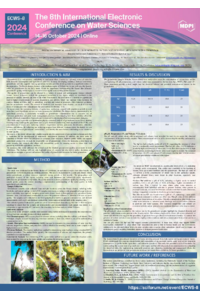
Poster template.pdf
Numerical Models for Groundwater Flows: Key in Construction
Field-Based Measurements of Soil Infiltration: Implications for Water Resource Management in Gaya District, India