Event submissions
Published
This submission belongs to the session S5. Numerical and Experimental Methods, Data Analyses, Digital Twin, IoT Machine Learning and AI in Water Sciences of the event The 8th International Electronic Conference on Water Sciences
Published date
11 Oct, 2024
Academic Editor
'%3e%3cpath%20d='M12.6657%2010.9104C12.4185%2010.325%2012.0599%209.79327%2011.6097%209.34482C11.1609%208.89508%2010.6293%208.5365%2010.0442%208.28888C10.0389%208.28626%2010.0337%208.28495%2010.0285%208.28233C10.8446%207.69279%2011.3752%206.73249%2011.3752%205.64904C11.3752%203.8542%209.92103%202.39999%208.1262%202.39999C6.33136%202.39999%204.87715%203.8542%204.87715%205.64904C4.87715%206.73249%205.40774%207.69279%206.22393%208.28364C6.21869%208.28626%206.21345%208.28757%206.20821%208.29019C5.62129%208.5378%205.09463%208.89284%204.64265%209.34613C4.1929%209.79493%203.83432%2010.3266%203.58671%2010.9117C3.34345%2011.4845%203.21226%2012.0987%203.20023%2012.7209C3.19988%2012.7349%203.20233%2012.7488%203.20744%2012.7619C3.21255%2012.7749%203.22022%2012.7867%203.22998%2012.7968C3.23975%2012.8068%203.25142%2012.8147%203.26431%2012.8202C3.2772%2012.8256%203.29105%2012.8284%203.30504%2012.8284H4.09109C4.14874%2012.8284%204.19459%2012.7825%204.1959%2012.7262C4.2221%2011.7148%204.62823%2010.7676%205.34617%2010.0497C6.08899%209.30683%207.0755%208.89808%208.1262%208.89808C9.17689%208.89808%2010.1634%209.30683%2010.9062%2010.0497C11.6242%2010.7676%2012.0303%2011.7148%2012.0565%2012.7262C12.0578%2012.7838%2012.1037%2012.8284%2012.1613%2012.8284H12.9474C12.9613%2012.8284%2012.9752%2012.8256%2012.9881%2012.8202C13.001%2012.8147%2013.0126%2012.8068%2013.0224%2012.7968C13.0322%2012.7867%2013.0398%2012.7749%2013.0449%2012.7619C13.0501%2012.7488%2013.0525%2012.7349%2013.0522%2012.7209C13.0391%2012.0947%2012.9094%2011.4855%2012.6657%2010.9104ZM8.1262%207.9024C7.52486%207.9024%206.9589%207.6679%206.53312%207.24211C6.10733%206.81633%205.87283%206.25037%205.87283%205.64904C5.87283%205.0477%206.10733%204.48174%206.53312%204.05596C6.9589%203.63018%207.52486%203.39567%208.1262%203.39567C8.72753%203.39567%209.29349%203.63018%209.71927%204.05596C10.1451%204.48174%2010.3796%205.0477%2010.3796%205.64904C10.3796%206.25037%2010.1451%206.81633%209.71927%207.24211C9.29349%207.6679%208.72753%207.9024%208.1262%207.9024Z'%20fill='%235D1EE1'/%3e%3c/g%3e%3c/svg%3e) Junye Wang
Junye WangCitation
Ana C. Afonso, Jack Botting, Inês B. Gomes, Maria José Saavedra, Lúcia C. Simões, Jun Liu, Manuel Simões, Exploring bacterial coaggregation in aquatic systems using advanced physicochemical and imaging techniques, in Proceedings of The 8th International Electronic Conference on Water Sciences, 14 October–16 October 2024, MDPI: Basel, Switzerland
Share
Email
Facebook
Twitter
LinkedIn
Exploring bacterial coaggregation in aquatic systems using advanced physicochemical and imaging techniques
'%3e%3cpath%20d='M12.6647%2010.9104C12.4176%2010.325%2012.0589%209.7933%2011.6088%209.34485C11.16%208.89511%2010.6283%208.53653%2010.0432%208.28891C10.038%208.28629%2010.0327%208.28498%2010.0275%208.28236C10.8437%207.69282%2011.3743%206.73252%2011.3743%205.64907C11.3743%203.85423%209.92005%202.40002%208.12522%202.40002C6.33038%202.40002%204.87618%203.85423%204.87618%205.64907C4.87618%206.73252%205.40677%207.69282%206.22296%208.28367C6.21772%208.28629%206.21248%208.2876%206.20724%208.29022C5.62031%208.53783%205.09365%208.89287%204.64167%209.34616C4.19192%209.79496%203.83334%2010.3266%203.58573%2010.9117C3.34247%2011.4846%203.21128%2012.0987%203.19925%2012.721C3.1989%2012.735%203.20135%2012.7489%203.20646%2012.7619C3.21157%2012.7749%203.21924%2012.7868%203.22901%2012.7968C3.23877%2012.8068%203.25045%2012.8148%203.26334%2012.8202C3.27623%2012.8256%203.29007%2012.8284%203.30406%2012.8284H4.09012C4.14776%2012.8284%204.19362%2012.7825%204.19493%2012.7262C4.22113%2011.7148%204.62726%2010.7676%205.34519%2010.0497C6.08802%209.30686%207.07452%208.89811%208.12522%208.89811C9.17592%208.89811%2010.1624%209.30686%2010.9052%2010.0497C11.6232%2010.7676%2012.0293%2011.7148%2012.0555%2012.7262C12.0568%2012.7839%2012.1027%2012.8284%2012.1603%2012.8284H12.9464C12.9604%2012.8284%2012.9742%2012.8256%2012.9871%2012.8202C13%2012.8148%2013.0117%2012.8068%2013.0214%2012.7968C13.0312%2012.7868%2013.0389%2012.7749%2013.044%2012.7619C13.0491%2012.7489%2013.0515%2012.735%2013.0512%2012.721C13.0381%2012.0947%2012.9084%2011.4856%2012.6647%2010.9104ZM8.12522%207.90243C7.52388%207.90243%206.95792%207.66793%206.53214%207.24215C6.10636%206.81636%205.87185%206.2504%205.87185%205.64907C5.87185%205.04773%206.10636%204.48177%206.53214%204.05599C6.95792%203.63021%207.52388%203.3957%208.12522%203.3957C8.72655%203.3957%209.29252%203.63021%209.7183%204.05599C10.1441%204.48177%2010.3786%205.04773%2010.3786%205.64907C10.3786%206.2504%2010.1441%206.81636%209.7183%207.24215C9.29252%207.66793%208.72655%207.90243%208.12522%207.90243Z'%20fill='%235D1EE1'/%3e%3c/g%3e%3c/svg%3e)
Ana C. Afonso 1
Jack Botting 2,3

Inês B. Gomes 1

Maria José Saavedra 4

Lúcia C. Simões 5
Jun Liu 2,3

Manuel Simões 1
1. ALiCE-LEPABE, Faculty of Engineering, University of Porto, Porto, Portugal
2. Department of Microbial Pathogenesis, Yale School of Medicine, New Haven, CT 06536, United States
3. New Haven Microbial Sciences Institute, Yale University, West Haven, CT 06516, United States
4. CITAB, University of Trás-os-Montes e Alto Douro, Vila Real, Portugal
5. CEB-LABBELS, School of Engineering, University of Minho, Braga, Portugal
Abstract
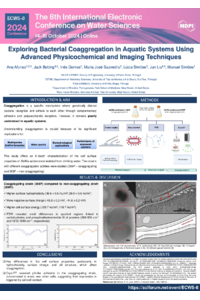
Coaggregation is a specific interaction mechanism where genetically distinct bacteria recognize and adhere to each other via complementary protein adhesins and polysaccharide receptors. Despite its critical role in biofilm formation and extensive studies in oral environments, coaggregation remains poorly understood in aquatic systems. Understanding coaggregation is crucial due to its significant implications, including its role in multispecies biofilm formation, water quality effects, impacts on engineered systems' performance, and potential biotechnological applications. This study offers an in-depth characterization of the cell surface properties of Delftia acidovorans isolated from drinking water (DW). Two strains showing different coaggregation abilities were selected (005P—coaggregating and 009P—non-coaggregating). The coaggregating 005P strain demonstrated higher surface hydrophobicity and more negative surface charge compared to the non-coaggregating 009P strain. Additionally, 005P showed higher cell surface and co-adhesion energies. Chemical analysis using Fourier-transform infrared spectroscopy revealed subtle differences in the bacterial surfaces, particularly in spectral regions associated with carbohydrates and proteins (860-930 cm-1 and 1212-1240 cm-1). Cryo-electron tomography highlighted distinct differences in pili structures between the strains. The pili in 005P were identified as pili-like adhesins. This research represents the first comprehensive characterization of a coaggregating strain from DW, employing a combination of advanced analytical techniques to provide new insights into the mechanisms driving bacterial coaggregation in aquatic systems.
Keywords
Biofilm formation
Cell-cell interaction
Cryo-ET
Drinking water systems
FTIR
Poster
Ana-Afonso-sciforum-097593.pdf
EVALUATING TRENDS IN GROUNDWATER DISCHARGES FUNCTIONING THROUGH MACHINE LEARNING TOOLS APPLIED TO SPRINGS IN KARSTIC AQUIFERS: RESULTS OBTAINED IN LAS LORAS UNESCO GLOBAL GEOPARK (SPAIN)
Alleviating Health Risks for Water Safety: A Systematic Review on artificial intelligence-assisted modelling of proximity-dependent Emerging Pollutants in Aquatic Systems