Event submissions
Published
This submission belongs to the session S2. Hydrodynamics, Hydraulic Transients, Hydropower and Pumped Storage in Water-Energy Nexus of the event The 8th International Electronic Conference on Water Sciences
Published date
11 Oct, 2024
Academic Editor
'%3e%3cpath%20d='M12.6657%2010.9104C12.4185%2010.325%2012.0599%209.79327%2011.6097%209.34482C11.1609%208.89508%2010.6293%208.5365%2010.0442%208.28888C10.0389%208.28626%2010.0337%208.28495%2010.0285%208.28233C10.8446%207.69279%2011.3752%206.73249%2011.3752%205.64904C11.3752%203.8542%209.92103%202.39999%208.1262%202.39999C6.33136%202.39999%204.87715%203.8542%204.87715%205.64904C4.87715%206.73249%205.40774%207.69279%206.22393%208.28364C6.21869%208.28626%206.21345%208.28757%206.20821%208.29019C5.62129%208.5378%205.09463%208.89284%204.64265%209.34613C4.1929%209.79493%203.83432%2010.3266%203.58671%2010.9117C3.34345%2011.4845%203.21226%2012.0987%203.20023%2012.7209C3.19988%2012.7349%203.20233%2012.7488%203.20744%2012.7619C3.21255%2012.7749%203.22022%2012.7867%203.22998%2012.7968C3.23975%2012.8068%203.25142%2012.8147%203.26431%2012.8202C3.2772%2012.8256%203.29105%2012.8284%203.30504%2012.8284H4.09109C4.14874%2012.8284%204.19459%2012.7825%204.1959%2012.7262C4.2221%2011.7148%204.62823%2010.7676%205.34617%2010.0497C6.08899%209.30683%207.0755%208.89808%208.1262%208.89808C9.17689%208.89808%2010.1634%209.30683%2010.9062%2010.0497C11.6242%2010.7676%2012.0303%2011.7148%2012.0565%2012.7262C12.0578%2012.7838%2012.1037%2012.8284%2012.1613%2012.8284H12.9474C12.9613%2012.8284%2012.9752%2012.8256%2012.9881%2012.8202C13.001%2012.8147%2013.0126%2012.8068%2013.0224%2012.7968C13.0322%2012.7867%2013.0398%2012.7749%2013.0449%2012.7619C13.0501%2012.7488%2013.0525%2012.7349%2013.0522%2012.7209C13.0391%2012.0947%2012.9094%2011.4855%2012.6657%2010.9104ZM8.1262%207.9024C7.52486%207.9024%206.9589%207.6679%206.53312%207.24211C6.10733%206.81633%205.87283%206.25037%205.87283%205.64904C5.87283%205.0477%206.10733%204.48174%206.53312%204.05596C6.9589%203.63018%207.52486%203.39567%208.1262%203.39567C8.72753%203.39567%209.29349%203.63018%209.71927%204.05596C10.1451%204.48174%2010.3796%205.0477%2010.3796%205.64904C10.3796%206.25037%2010.1451%206.81633%209.71927%207.24211C9.29349%207.6679%208.72753%207.9024%208.1262%207.9024Z'%20fill='%235D1EE1'/%3e%3c/g%3e%3c/svg%3e) Vicente S. Fuertes-Miquel
Vicente S. Fuertes-MiquelCitation
Moses Kayanda Kiteto, Cleophas Achisa Mecha, Navigating the water – energy nexus: a mathematical approach, in Proceedings of The 8th International Electronic Conference on Water Sciences, 14 October–16 October 2024, MDPI: Basel, Switzerland
Share
Email
Facebook
Twitter
LinkedIn
Navigating the water – energy nexus: a mathematical approach
'%3e%3cpath%20d='M12.6647%2010.9104C12.4176%2010.325%2012.0589%209.7933%2011.6088%209.34485C11.16%208.89511%2010.6283%208.53653%2010.0432%208.28891C10.038%208.28629%2010.0327%208.28498%2010.0275%208.28236C10.8437%207.69282%2011.3743%206.73252%2011.3743%205.64907C11.3743%203.85423%209.92005%202.40002%208.12522%202.40002C6.33038%202.40002%204.87618%203.85423%204.87618%205.64907C4.87618%206.73252%205.40677%207.69282%206.22296%208.28367C6.21772%208.28629%206.21248%208.2876%206.20724%208.29022C5.62031%208.53783%205.09365%208.89287%204.64167%209.34616C4.19192%209.79496%203.83334%2010.3266%203.58573%2010.9117C3.34247%2011.4846%203.21128%2012.0987%203.19925%2012.721C3.1989%2012.735%203.20135%2012.7489%203.20646%2012.7619C3.21157%2012.7749%203.21924%2012.7868%203.22901%2012.7968C3.23877%2012.8068%203.25045%2012.8148%203.26334%2012.8202C3.27623%2012.8256%203.29007%2012.8284%203.30406%2012.8284H4.09012C4.14776%2012.8284%204.19362%2012.7825%204.19493%2012.7262C4.22113%2011.7148%204.62726%2010.7676%205.34519%2010.0497C6.08802%209.30686%207.07452%208.89811%208.12522%208.89811C9.17592%208.89811%2010.1624%209.30686%2010.9052%2010.0497C11.6232%2010.7676%2012.0293%2011.7148%2012.0555%2012.7262C12.0568%2012.7839%2012.1027%2012.8284%2012.1603%2012.8284H12.9464C12.9604%2012.8284%2012.9742%2012.8256%2012.9871%2012.8202C13%2012.8148%2013.0117%2012.8068%2013.0214%2012.7968C13.0312%2012.7868%2013.0389%2012.7749%2013.044%2012.7619C13.0491%2012.7489%2013.0515%2012.735%2013.0512%2012.721C13.0381%2012.0947%2012.9084%2011.4856%2012.6647%2010.9104ZM8.12522%207.90243C7.52388%207.90243%206.95792%207.66793%206.53214%207.24215C6.10636%206.81636%205.87185%206.2504%205.87185%205.64907C5.87185%205.04773%206.10636%204.48177%206.53214%204.05599C6.95792%203.63021%207.52388%203.3957%208.12522%203.3957C8.72655%203.3957%209.29252%203.63021%209.7183%204.05599C10.1441%204.48177%2010.3786%205.04773%2010.3786%205.64907C10.3786%206.2504%2010.1441%206.81636%209.7183%207.24215C9.29252%207.66793%208.72655%207.90243%208.12522%207.90243Z'%20fill='%235D1EE1'/%3e%3c/g%3e%3c/svg%3e)
Moses Kayanda Kiteto 1
Cleophas Achisa Mecha 2
1. Renewable Energy, Environment, Nanomaterials and Water Research Group, Department of Chemical and Process Engineering Moi University, P.O. Box 3900-30100, Eldoret, Kenya
2. University of Arizona, USA
Abstract
As the demand for water and energy increases, the interdependency between these two resources, known as the water-energy nexus, becomes a pressing concern. Energy is required for water treatment and distribution, while virtually all energy production processes require significant amounts of water. Renewable energy sources now make up nearly 38% of the world's total energy consumption, indicating a sharp increase in recent years driven by the growing awareness of the depletion of non-renewable energy and the destructive impact of fossil fuels. However, these energy plants require substantial amount of water, primarily for cooling, stressing the already limited water resources. Conversely, the emergence of new persistent contaminants has necessitated the use of advanced, energy-intensive water treatment methods. Coupled with the energy demands of water distribution, this has significantly strained the already limited energy resources. Therefore, it is important to understand both the water footprint of renewable energy technologies as well as the energy consumption associated with water treatment and distribution. Regrettably, no straightforward, universal model exists for estimating water usage and energy consumption in power and water treatment plants respectively. Current approaches rely on data from direct surveys of plant operators, which is often unreliable and incomplete. This study evaluates the potential of mathematical modeling and simulation in the water-energy nexus. We formulate a mathematical framework and subsequent simulation in Java programming to estimate the water use in hydroelectric power and geothermal energy and the energy consumption of the advanced water treatment processes, particularly the advanced oxidation processes (AOPs) and membrane separation processes and water distribution considering the hydrodynamics and hydraulic transients. The paper also addresses the challenges and prospects of actualizing mathematical modeling and simulation to the water-energy nexus. The findings of this study demonstrate mathematical modeling and simulation as reliable approach in navigating the complexities of the water-energy nexus.
Keywords
water – energy nexus
renewable energy
water footprint
water treatment
energy consumption
Poster
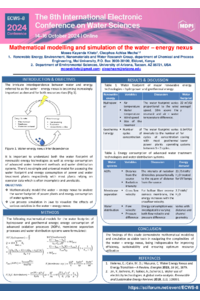
Moses and Cleophas_Water conference poster_041024.pdf
Hydrogen and pumped energy storage impact in hybrid systems for small communities: Marruge case study
Optimizing Water Resources for Enhanced Electricity Production: A Case Study in Croatia's Karst Region