Event submissions
Published
This submission belongs to the session S1. Animal Diversity of the event The 3rd International Electronic Conference on Diversity
Published date
11 Oct, 2024
Academic Editor
'%3e%3cpath%20d='M12.6657%2010.9104C12.4185%2010.325%2012.0599%209.79327%2011.6097%209.34482C11.1609%208.89508%2010.6293%208.5365%2010.0442%208.28888C10.0389%208.28626%2010.0337%208.28495%2010.0285%208.28233C10.8446%207.69279%2011.3752%206.73249%2011.3752%205.64904C11.3752%203.8542%209.92103%202.39999%208.1262%202.39999C6.33136%202.39999%204.87715%203.8542%204.87715%205.64904C4.87715%206.73249%205.40774%207.69279%206.22393%208.28364C6.21869%208.28626%206.21345%208.28757%206.20821%208.29019C5.62129%208.5378%205.09463%208.89284%204.64265%209.34613C4.1929%209.79493%203.83432%2010.3266%203.58671%2010.9117C3.34345%2011.4845%203.21226%2012.0987%203.20023%2012.7209C3.19988%2012.7349%203.20233%2012.7488%203.20744%2012.7619C3.21255%2012.7749%203.22022%2012.7867%203.22998%2012.7968C3.23975%2012.8068%203.25142%2012.8147%203.26431%2012.8202C3.2772%2012.8256%203.29105%2012.8284%203.30504%2012.8284H4.09109C4.14874%2012.8284%204.19459%2012.7825%204.1959%2012.7262C4.2221%2011.7148%204.62823%2010.7676%205.34617%2010.0497C6.08899%209.30683%207.0755%208.89808%208.1262%208.89808C9.17689%208.89808%2010.1634%209.30683%2010.9062%2010.0497C11.6242%2010.7676%2012.0303%2011.7148%2012.0565%2012.7262C12.0578%2012.7838%2012.1037%2012.8284%2012.1613%2012.8284H12.9474C12.9613%2012.8284%2012.9752%2012.8256%2012.9881%2012.8202C13.001%2012.8147%2013.0126%2012.8068%2013.0224%2012.7968C13.0322%2012.7867%2013.0398%2012.7749%2013.0449%2012.7619C13.0501%2012.7488%2013.0525%2012.7349%2013.0522%2012.7209C13.0391%2012.0947%2012.9094%2011.4855%2012.6657%2010.9104ZM8.1262%207.9024C7.52486%207.9024%206.9589%207.6679%206.53312%207.24211C6.10733%206.81633%205.87283%206.25037%205.87283%205.64904C5.87283%205.0477%206.10733%204.48174%206.53312%204.05596C6.9589%203.63018%207.52486%203.39567%208.1262%203.39567C8.72753%203.39567%209.29349%203.63018%209.71927%204.05596C10.1451%204.48174%2010.3796%205.0477%2010.3796%205.64904C10.3796%206.25037%2010.1451%206.81633%209.71927%207.24211C9.29349%207.6679%208.72753%207.9024%208.1262%207.9024Z'%20fill='%235D1EE1'/%3e%3c/g%3e%3c/svg%3e) Luc Legal
Luc LegalCitation
Teodora Marius Teofilova, Fabian Boetzl, Enrico Migliaccio, Nikolay Kodzhabashev, New records for the ground beetle fauna of Bulgaria (Coleoptera: Carabidae), in Proceedings of The 3rd International Electronic Conference on Diversity, 15 October–17 October 2024, MDPI: Basel, Switzerland
Share
Email
Facebook
Twitter
LinkedIn
New records for the ground beetle fauna of Bulgaria (Coleoptera: Carabidae)

Teodora Marius Teofilova 1
'%3e%3cpath%20d='M12.6647%2010.9104C12.4176%2010.325%2012.0589%209.7933%2011.6088%209.34485C11.16%208.89511%2010.6283%208.53653%2010.0432%208.28891C10.038%208.28629%2010.0327%208.28498%2010.0275%208.28236C10.8437%207.69282%2011.3743%206.73252%2011.3743%205.64907C11.3743%203.85423%209.92005%202.40002%208.12522%202.40002C6.33038%202.40002%204.87618%203.85423%204.87618%205.64907C4.87618%206.73252%205.40677%207.69282%206.22296%208.28367C6.21772%208.28629%206.21248%208.2876%206.20724%208.29022C5.62031%208.53783%205.09365%208.89287%204.64167%209.34616C4.19192%209.79496%203.83334%2010.3266%203.58573%2010.9117C3.34247%2011.4846%203.21128%2012.0987%203.19925%2012.721C3.1989%2012.735%203.20135%2012.7489%203.20646%2012.7619C3.21157%2012.7749%203.21924%2012.7868%203.22901%2012.7968C3.23877%2012.8068%203.25045%2012.8148%203.26334%2012.8202C3.27623%2012.8256%203.29007%2012.8284%203.30406%2012.8284H4.09012C4.14776%2012.8284%204.19362%2012.7825%204.19493%2012.7262C4.22113%2011.7148%204.62726%2010.7676%205.34519%2010.0497C6.08802%209.30686%207.07452%208.89811%208.12522%208.89811C9.17592%208.89811%2010.1624%209.30686%2010.9052%2010.0497C11.6232%2010.7676%2012.0293%2011.7148%2012.0555%2012.7262C12.0568%2012.7839%2012.1027%2012.8284%2012.1603%2012.8284H12.9464C12.9604%2012.8284%2012.9742%2012.8256%2012.9871%2012.8202C13%2012.8148%2013.0117%2012.8068%2013.0214%2012.7968C13.0312%2012.7868%2013.0389%2012.7749%2013.044%2012.7619C13.0491%2012.7489%2013.0515%2012.735%2013.0512%2012.721C13.0381%2012.0947%2012.9084%2011.4856%2012.6647%2010.9104ZM8.12522%207.90243C7.52388%207.90243%206.95792%207.66793%206.53214%207.24215C6.10636%206.81636%205.87185%206.2504%205.87185%205.64907C5.87185%205.04773%206.10636%204.48177%206.53214%204.05599C6.95792%203.63021%207.52388%203.3957%208.12522%203.3957C8.72655%203.3957%209.29252%203.63021%209.7183%204.05599C10.1441%204.48177%2010.3786%205.04773%2010.3786%205.64907C10.3786%206.2504%2010.1441%206.81636%209.7183%207.24215C9.29252%207.66793%208.72655%207.90243%208.12522%207.90243Z'%20fill='%235D1EE1'/%3e%3c/g%3e%3c/svg%3e)
Fabian Boetzl 2
Enrico Migliaccio 3
Nikolay Kodzhabashev 4
1. Institute of Biodiversity and Ecosystem Research (IBER), Bulgarian Academy of Sciences (BAS), 1 Tsar Osvoboditel Blvd., 1000 Sofia, Bulgaria
2. Swedish University of Agricultural Sciences, Department of Ecology, Ulls väg 16, 75007 Uppsala, Sweden
3. Science Naturali ed Ambientali, 47 Via Duccio Galimberti, 00136 Roma, Italy
4. University of Forestry, Faculty of Forestry, Department of Hunting and Game Management, 10 Kliment Ohridski Blvd., 1756 Sofia, Bulgaria
Abstract
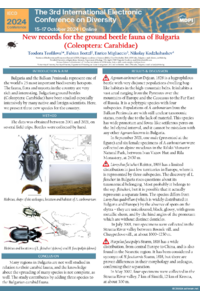
Bulgarian ground beetles (Coleoptera: Carabidae) have been studied intensively by many native and foreign scientists. Here, we present three new species for the country. The data were obtained between 2001 and 2021 on several field trips.
Agonum carbonarium Dejean, 1828 is a hygrophilous beetle with very disjunct populations dwelling in bog-like habitats in the high-mountain belts. It inhabits a vast area ranging from the Pyrenees over the mountains of Europe and the Caucasus to the Far East of Russia. It is a polytypic species with four subspecies. Populations of A. carbonarium from the Balkan Peninsula still have an unclear taxonomic status, mostly due to the lack of material. This species has wide pronotum and fovea-like setiferous pores on the third elytral interval, and it cannot be mistaken with any other Agonum known in Bulgaria.
Harpalus fuscipalpis Sturm, 1818 has a wide distribution, from central Europe to China, and is also found in the Nearctic region. It has been considered a synonym of Harpalus fuscicornis Sturm, 1818, but there are proven differences in their morphology and aedeagus, confirming their separation.
Lionychus fleischeri Reitter, 1908 has a limited distribution in just a few territories in Europe, where it is represented by three subspecies. The discovery of L. fleischeri in Bulgaria rasises questions about its taxonomical belonging. Most probably, it belongs to the ssp. fleischeri, but it is possible that it actually represents a separate form. The species differs from Lionychus quadrillum (which is widely distributed in Bulgaria and Europe) by the absence of spots on the elytra—they are unicoloured, black, glossy, with a green metallic sheen, and by the hind angles of the pronotum, which are without distinct denticles.
The first species was collected from 2450 m a.s.l. in the Rila Mts., while the other two species were collected from the Struma River valley.
Keywords
Agonum carbonarium
Harpalus fuscipalpis
Lionychus fleischeri
carabids
contribution
distribution
new records
Bulgaria
Poster
IECD poster_sciforum-100159__BG_new.pdf
A native potato collection from the geographical department of Amazonas (Peru)
DNA Barcoding of two insectivorous Bats Species from Punjab, Pakistan