Event submissions
Published
This submission belongs to the session S1. Animal Diversity of the event The 3rd International Electronic Conference on Diversity
Published date
11 Oct, 2024
Academic Editor
'%3e%3cpath%20d='M12.6657%2010.9104C12.4185%2010.325%2012.0599%209.79327%2011.6097%209.34482C11.1609%208.89508%2010.6293%208.5365%2010.0442%208.28888C10.0389%208.28626%2010.0337%208.28495%2010.0285%208.28233C10.8446%207.69279%2011.3752%206.73249%2011.3752%205.64904C11.3752%203.8542%209.92103%202.39999%208.1262%202.39999C6.33136%202.39999%204.87715%203.8542%204.87715%205.64904C4.87715%206.73249%205.40774%207.69279%206.22393%208.28364C6.21869%208.28626%206.21345%208.28757%206.20821%208.29019C5.62129%208.5378%205.09463%208.89284%204.64265%209.34613C4.1929%209.79493%203.83432%2010.3266%203.58671%2010.9117C3.34345%2011.4845%203.21226%2012.0987%203.20023%2012.7209C3.19988%2012.7349%203.20233%2012.7488%203.20744%2012.7619C3.21255%2012.7749%203.22022%2012.7867%203.22998%2012.7968C3.23975%2012.8068%203.25142%2012.8147%203.26431%2012.8202C3.2772%2012.8256%203.29105%2012.8284%203.30504%2012.8284H4.09109C4.14874%2012.8284%204.19459%2012.7825%204.1959%2012.7262C4.2221%2011.7148%204.62823%2010.7676%205.34617%2010.0497C6.08899%209.30683%207.0755%208.89808%208.1262%208.89808C9.17689%208.89808%2010.1634%209.30683%2010.9062%2010.0497C11.6242%2010.7676%2012.0303%2011.7148%2012.0565%2012.7262C12.0578%2012.7838%2012.1037%2012.8284%2012.1613%2012.8284H12.9474C12.9613%2012.8284%2012.9752%2012.8256%2012.9881%2012.8202C13.001%2012.8147%2013.0126%2012.8068%2013.0224%2012.7968C13.0322%2012.7867%2013.0398%2012.7749%2013.0449%2012.7619C13.0501%2012.7488%2013.0525%2012.7349%2013.0522%2012.7209C13.0391%2012.0947%2012.9094%2011.4855%2012.6657%2010.9104ZM8.1262%207.9024C7.52486%207.9024%206.9589%207.6679%206.53312%207.24211C6.10733%206.81633%205.87283%206.25037%205.87283%205.64904C5.87283%205.0477%206.10733%204.48174%206.53312%204.05596C6.9589%203.63018%207.52486%203.39567%208.1262%203.39567C8.72753%203.39567%209.29349%203.63018%209.71927%204.05596C10.1451%204.48174%2010.3796%205.0477%2010.3796%205.64904C10.3796%206.25037%2010.1451%206.81633%209.71927%207.24211C9.29349%207.6679%208.72753%207.9024%208.1262%207.9024Z'%20fill='%235D1EE1'/%3e%3c/g%3e%3c/svg%3e) Luc Legal
Luc LegalCitation
Zaira Ahmad, Muddasir Hassan Abbasi, Nadeem Sheikh, Sajid Rashid Ahmad, Hamid Ullah, DNA Barcoding of two insectivorous Bats Species from Punjab, Pakistan, in Proceedings of The 3rd International Electronic Conference on Diversity, 15 October–17 October 2024, MDPI: Basel, Switzerland
Share
Email
Facebook
Twitter
LinkedIn
DNA Barcoding of two insectivorous Bats Species from Punjab, Pakistan
'%3e%3cpath%20d='M12.6647%2010.9104C12.4176%2010.325%2012.0589%209.7933%2011.6088%209.34485C11.16%208.89511%2010.6283%208.53653%2010.0432%208.28891C10.038%208.28629%2010.0327%208.28498%2010.0275%208.28236C10.8437%207.69282%2011.3743%206.73252%2011.3743%205.64907C11.3743%203.85423%209.92005%202.40002%208.12522%202.40002C6.33038%202.40002%204.87618%203.85423%204.87618%205.64907C4.87618%206.73252%205.40677%207.69282%206.22296%208.28367C6.21772%208.28629%206.21248%208.2876%206.20724%208.29022C5.62031%208.53783%205.09365%208.89287%204.64167%209.34616C4.19192%209.79496%203.83334%2010.3266%203.58573%2010.9117C3.34247%2011.4846%203.21128%2012.0987%203.19925%2012.721C3.1989%2012.735%203.20135%2012.7489%203.20646%2012.7619C3.21157%2012.7749%203.21924%2012.7868%203.22901%2012.7968C3.23877%2012.8068%203.25045%2012.8148%203.26334%2012.8202C3.27623%2012.8256%203.29007%2012.8284%203.30406%2012.8284H4.09012C4.14776%2012.8284%204.19362%2012.7825%204.19493%2012.7262C4.22113%2011.7148%204.62726%2010.7676%205.34519%2010.0497C6.08802%209.30686%207.07452%208.89811%208.12522%208.89811C9.17592%208.89811%2010.1624%209.30686%2010.9052%2010.0497C11.6232%2010.7676%2012.0293%2011.7148%2012.0555%2012.7262C12.0568%2012.7839%2012.1027%2012.8284%2012.1603%2012.8284H12.9464C12.9604%2012.8284%2012.9742%2012.8256%2012.9871%2012.8202C13%2012.8148%2013.0117%2012.8068%2013.0214%2012.7968C13.0312%2012.7868%2013.0389%2012.7749%2013.044%2012.7619C13.0491%2012.7489%2013.0515%2012.735%2013.0512%2012.721C13.0381%2012.0947%2012.9084%2011.4856%2012.6647%2010.9104ZM8.12522%207.90243C7.52388%207.90243%206.95792%207.66793%206.53214%207.24215C6.10636%206.81636%205.87185%206.2504%205.87185%205.64907C5.87185%205.04773%206.10636%204.48177%206.53214%204.05599C6.95792%203.63021%207.52388%203.3957%208.12522%203.3957C8.72655%203.3957%209.29252%203.63021%209.7183%204.05599C10.1441%204.48177%2010.3786%205.04773%2010.3786%205.64907C10.3786%206.2504%2010.1441%206.81636%209.7183%207.24215C9.29252%207.66793%208.72655%207.90243%208.12522%207.90243Z'%20fill='%235D1EE1'/%3e%3c/g%3e%3c/svg%3e)
Zaira Ahmad 1
Muddasir Hassan Abbasi 2
Nadeem Sheikh 3
Sajid Rashid Ahmad 4
Hamid Ullah 5
1. Department of Environmental Science, Lahore College for Women University, Lahore, 54000, Pakistan
2. Department of Zoology, University of Okara, Okara, 56300, Punjab, Pakistan
3. Institute of Zoology, University of the Punjab, Lahore, 54590, Pakistan
4. College of Earth and Environmental Sciences, University of the Punjab, Lahore, 54590, Pakistan
5. Department of Zoology, Islamia University Bahawalpur (Bahawalnagar Campus), Bahawalnagar 63100, Pakistan
Abstract
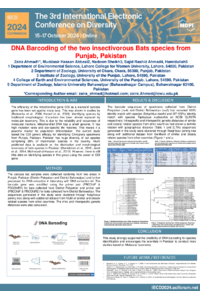
Species identification based on mitochondrial gene cytochrome c oxidase subunit I (COI) is now considered as a powerful marker in molecular taxonomy. The current study was conducted with the aim to test the efficacy of the COI gene in randomly collected bats specimens from two different areas of Punjab, Pakistan. The carcass bat samples were collected randomly from two areas in Punjab, Pakistan (District Pakpattan and District Bahawalpur) and further processed for DNA extraction in a laboratory with a DNA extraction kit. The barcode gene was amplified using the primer pair PBCOIdF and PBCOIdR1 for bats collected from District Pakpattan and primer pair PBCOIdF and PBCOIdR2 for bats collected from the Bahawalpur District. The barcode sequences of specimens collected from the Pakpattan District (n=4) and the Bahawalpur District (n=3) revealed a 100% identity match with the species Sotophilus heathii and a 97-100% identity match with species Taphozous nudiventris on NCBI BLASTN, respectively. The sequences generated in the study were clustered through a neighbour joining tree along with an additional dataset from GenBank of similar and closely related species from other countries. The intraspecific and interspecific genetic distances were also calculated, which showed a definite relation with the geographical distances of similar and closely related species from other locations. The sequences generated in the study were submitted to GenBank and can be used as a public database through assigned accession numbers.
This study strongly supports the credibility of DNA barcoding for species identification and encourages scientists in Pakistan to conduct more studies based on molecular taxonomy.
Keywords
Bats
DNA barcoding
Sotophilus heathii
Taphozous nudiventris
Pakistan
Punjab
Poster
IECD poster submission Zaira Ahmad.pdf
New records for the ground beetle fauna of Bulgaria (Coleoptera: Carabidae)
Microlestes maurus cordatulus (Reitter, 1901) (Insecta: Coleoptera: Carabidae) enters Bulgarian fauna