Event submissions
Published
This submission belongs to the session S1. Animal Diversity of the event The 3rd International Electronic Conference on Diversity
Published date
11 Oct, 2024
Academic Editor
'%3e%3cpath%20d='M12.6657%2010.9104C12.4185%2010.325%2012.0599%209.79327%2011.6097%209.34482C11.1609%208.89508%2010.6293%208.5365%2010.0442%208.28888C10.0389%208.28626%2010.0337%208.28495%2010.0285%208.28233C10.8446%207.69279%2011.3752%206.73249%2011.3752%205.64904C11.3752%203.8542%209.92103%202.39999%208.1262%202.39999C6.33136%202.39999%204.87715%203.8542%204.87715%205.64904C4.87715%206.73249%205.40774%207.69279%206.22393%208.28364C6.21869%208.28626%206.21345%208.28757%206.20821%208.29019C5.62129%208.5378%205.09463%208.89284%204.64265%209.34613C4.1929%209.79493%203.83432%2010.3266%203.58671%2010.9117C3.34345%2011.4845%203.21226%2012.0987%203.20023%2012.7209C3.19988%2012.7349%203.20233%2012.7488%203.20744%2012.7619C3.21255%2012.7749%203.22022%2012.7867%203.22998%2012.7968C3.23975%2012.8068%203.25142%2012.8147%203.26431%2012.8202C3.2772%2012.8256%203.29105%2012.8284%203.30504%2012.8284H4.09109C4.14874%2012.8284%204.19459%2012.7825%204.1959%2012.7262C4.2221%2011.7148%204.62823%2010.7676%205.34617%2010.0497C6.08899%209.30683%207.0755%208.89808%208.1262%208.89808C9.17689%208.89808%2010.1634%209.30683%2010.9062%2010.0497C11.6242%2010.7676%2012.0303%2011.7148%2012.0565%2012.7262C12.0578%2012.7838%2012.1037%2012.8284%2012.1613%2012.8284H12.9474C12.9613%2012.8284%2012.9752%2012.8256%2012.9881%2012.8202C13.001%2012.8147%2013.0126%2012.8068%2013.0224%2012.7968C13.0322%2012.7867%2013.0398%2012.7749%2013.0449%2012.7619C13.0501%2012.7488%2013.0525%2012.7349%2013.0522%2012.7209C13.0391%2012.0947%2012.9094%2011.4855%2012.6657%2010.9104ZM8.1262%207.9024C7.52486%207.9024%206.9589%207.6679%206.53312%207.24211C6.10733%206.81633%205.87283%206.25037%205.87283%205.64904C5.87283%205.0477%206.10733%204.48174%206.53312%204.05596C6.9589%203.63018%207.52486%203.39567%208.1262%203.39567C8.72753%203.39567%209.29349%203.63018%209.71927%204.05596C10.1451%204.48174%2010.3796%205.0477%2010.3796%205.64904C10.3796%206.25037%2010.1451%206.81633%209.71927%207.24211C9.29349%207.6679%208.72753%207.9024%208.1262%207.9024Z'%20fill='%235D1EE1'/%3e%3c/g%3e%3c/svg%3e) Luc Legal
Luc LegalCitation
Freerk Molleman, Priscila Mezzomo, Manidip Mandal, Martin Volf, Soumen Mallick, Martin Moos, Petr Vodrážka, Andreas Prinzing, Urszula L Walczak, Parasitoid communities in the understory of a forest in Poland vary with canopy species composition but show limited responses to herbivore-induced volatile emissions of oak saplings, in Proceedings of The 3rd International Electronic Conference on Diversity, 15 October–17 October 2024, MDPI: Basel, Switzerland
Share
Email
Facebook
Twitter
LinkedIn
Parasitoid communities in the understory of a forest in Poland vary with canopy species composition but show limited responses to herbivore-induced volatile emissions of oak saplings

Freerk Molleman 1
'%3e%3cpath%20d='M12.6647%2010.9104C12.4176%2010.325%2012.0589%209.7933%2011.6088%209.34485C11.16%208.89511%2010.6283%208.53653%2010.0432%208.28891C10.038%208.28629%2010.0327%208.28498%2010.0275%208.28236C10.8437%207.69282%2011.3743%206.73252%2011.3743%205.64907C11.3743%203.85423%209.92005%202.40002%208.12522%202.40002C6.33038%202.40002%204.87618%203.85423%204.87618%205.64907C4.87618%206.73252%205.40677%207.69282%206.22296%208.28367C6.21772%208.28629%206.21248%208.2876%206.20724%208.29022C5.62031%208.53783%205.09365%208.89287%204.64167%209.34616C4.19192%209.79496%203.83334%2010.3266%203.58573%2010.9117C3.34247%2011.4846%203.21128%2012.0987%203.19925%2012.721C3.1989%2012.735%203.20135%2012.7489%203.20646%2012.7619C3.21157%2012.7749%203.21924%2012.7868%203.22901%2012.7968C3.23877%2012.8068%203.25045%2012.8148%203.26334%2012.8202C3.27623%2012.8256%203.29007%2012.8284%203.30406%2012.8284H4.09012C4.14776%2012.8284%204.19362%2012.7825%204.19493%2012.7262C4.22113%2011.7148%204.62726%2010.7676%205.34519%2010.0497C6.08802%209.30686%207.07452%208.89811%208.12522%208.89811C9.17592%208.89811%2010.1624%209.30686%2010.9052%2010.0497C11.6232%2010.7676%2012.0293%2011.7148%2012.0555%2012.7262C12.0568%2012.7839%2012.1027%2012.8284%2012.1603%2012.8284H12.9464C12.9604%2012.8284%2012.9742%2012.8256%2012.9871%2012.8202C13%2012.8148%2013.0117%2012.8068%2013.0214%2012.7968C13.0312%2012.7868%2013.0389%2012.7749%2013.044%2012.7619C13.0491%2012.7489%2013.0515%2012.735%2013.0512%2012.721C13.0381%2012.0947%2012.9084%2011.4856%2012.6647%2010.9104ZM8.12522%207.90243C7.52388%207.90243%206.95792%207.66793%206.53214%207.24215C6.10636%206.81636%205.87185%206.2504%205.87185%205.64907C5.87185%205.04773%206.10636%204.48177%206.53214%204.05599C6.95792%203.63021%207.52388%203.3957%208.12522%203.3957C8.72655%203.3957%209.29252%203.63021%209.7183%204.05599C10.1441%204.48177%2010.3786%205.04773%2010.3786%205.64907C10.3786%206.2504%2010.1441%206.81636%209.7183%207.24215C9.29252%207.66793%208.72655%207.90243%208.12522%207.90243Z'%20fill='%235D1EE1'/%3e%3c/g%3e%3c/svg%3e)
Priscila Mezzomo 2,3
Manidip Mandal 1
Martin Volf 2,3
Soumen Mallick 4
Martin Moos 2
Petr Vodrážka 2
Andreas Prinzing 5
Urszula L Walczak 1
1. Department of Systematic Zoology, Institute of Environmental Biology, Faculty of Biology, Adam Mickiewicz University Poznań, Uniwersytetu Poznańskiego Str. 6, PL-61-614 Poznań, Poland
2. Biology Centre of the Czech Academy of Sciences, 37005 Ceske Budejovice, Czech Republic.
3. Faculty of Science, University of South Bohemia, 37005 Ceske Budejovice, Czech Republic
4. Field Station Fabrikschleichach, Department of Animal Ecology and Tropical Biology, Biocenter, University of Würzburg, Glashüttenstraße 5, 96181 Rauhenebrach, Germany
5. Research Unit « Ecosystemes, Biodiversité, Evolution », Université de Rennes 1, Centre National de la Recherche Scientifique, Campus Beaulieu, bâtiment 14 AF-35042 Rennes, France
Abstract
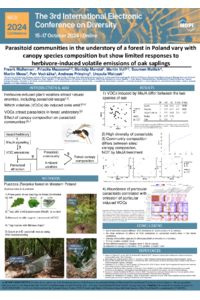
Information on how parasitoids of herbivorous insects use herbivore-induced volatile organic compounds (VOCs) to find potential hosts on saplings in forests with varying tree composition is scarce. Therefore, we performed an experiment where we placed pairs of oak saplings (Quercus robur or Q. petraea) in neighborhoods dominated by oak, beech, or pine trees in a forest in Poland. We treated one sapling in each pair with the phytohormone methyl jasmonate, which triggers induced responses in plants. We measured the VOC emissions of thirty-six saplings and placed Malaise traps with five of the pairs. We counted the parasitoids in the ten Malaise samples and identified them using DNA metabarcoding. The two oak species differed in both the proportions of VOCs and the specific VOCs that were elevated following the application of methyl jasmonate. The parasitoid community appeared hyper diverse: Our study included 1,129 individuals belonging to 344 species, and most species could not be linked to a named species using DNA metabarcoding. We did not detect any overall effects of treatment on parasitoid abundance or community composition. However, some parasitoid species appeared to be attracted to elevated emissions of specific induced VOCs. Parasitoid communities differed significantly between areas and showed marginally significant differences between neighborhoods. Overall, our results suggest that parasitoids in the understory are affected by tree composition, although the effects of VOC emissions were limited. Nevertheless, our study demonstrates how VOC-mediated insect–plant interactions can be effectively investigated under field conditions.
Keywords
DNA metabarcoding
Malaise trap
volatile organic compounds
tree diversity
parasitoid
Poster
DiversityVirtualParasitoids2024.pdf
Plasterer and leaf-cutter bees (Hymenoptera: Colletidae, Megachilidae) of a steppe community on the Balkan peninsula: floral hosts and diversity in a sub-Mediterranean dry grassland
Genetic diversity reveals a complex evolutionary history for the white-fringed weevils (Coleoptera, Curculionidae)