Event submissions
Published
This submission belongs to the session S2. Biodiversity Conservation of the event The 3rd International Electronic Conference on Diversity
Published date
11 Oct, 2024
Academic Editor
'%3e%3cpath%20d='M12.6657%2010.9104C12.4185%2010.325%2012.0599%209.79327%2011.6097%209.34482C11.1609%208.89508%2010.6293%208.5365%2010.0442%208.28888C10.0389%208.28626%2010.0337%208.28495%2010.0285%208.28233C10.8446%207.69279%2011.3752%206.73249%2011.3752%205.64904C11.3752%203.8542%209.92103%202.39999%208.1262%202.39999C6.33136%202.39999%204.87715%203.8542%204.87715%205.64904C4.87715%206.73249%205.40774%207.69279%206.22393%208.28364C6.21869%208.28626%206.21345%208.28757%206.20821%208.29019C5.62129%208.5378%205.09463%208.89284%204.64265%209.34613C4.1929%209.79493%203.83432%2010.3266%203.58671%2010.9117C3.34345%2011.4845%203.21226%2012.0987%203.20023%2012.7209C3.19988%2012.7349%203.20233%2012.7488%203.20744%2012.7619C3.21255%2012.7749%203.22022%2012.7867%203.22998%2012.7968C3.23975%2012.8068%203.25142%2012.8147%203.26431%2012.8202C3.2772%2012.8256%203.29105%2012.8284%203.30504%2012.8284H4.09109C4.14874%2012.8284%204.19459%2012.7825%204.1959%2012.7262C4.2221%2011.7148%204.62823%2010.7676%205.34617%2010.0497C6.08899%209.30683%207.0755%208.89808%208.1262%208.89808C9.17689%208.89808%2010.1634%209.30683%2010.9062%2010.0497C11.6242%2010.7676%2012.0303%2011.7148%2012.0565%2012.7262C12.0578%2012.7838%2012.1037%2012.8284%2012.1613%2012.8284H12.9474C12.9613%2012.8284%2012.9752%2012.8256%2012.9881%2012.8202C13.001%2012.8147%2013.0126%2012.8068%2013.0224%2012.7968C13.0322%2012.7867%2013.0398%2012.7749%2013.0449%2012.7619C13.0501%2012.7488%2013.0525%2012.7349%2013.0522%2012.7209C13.0391%2012.0947%2012.9094%2011.4855%2012.6657%2010.9104ZM8.1262%207.9024C7.52486%207.9024%206.9589%207.6679%206.53312%207.24211C6.10733%206.81633%205.87283%206.25037%205.87283%205.64904C5.87283%205.0477%206.10733%204.48174%206.53312%204.05596C6.9589%203.63018%207.52486%203.39567%208.1262%203.39567C8.72753%203.39567%209.29349%203.63018%209.71927%204.05596C10.1451%204.48174%2010.3796%205.0477%2010.3796%205.64904C10.3796%206.25037%2010.1451%206.81633%209.71927%207.24211C9.29349%207.6679%208.72753%207.9024%208.1262%207.9024Z'%20fill='%235D1EE1'/%3e%3c/g%3e%3c/svg%3e) Kevin Cianfaglione
Kevin CianfaglioneCitation
Ana Eugenia Atienza, Guillermo Luis Avalos, Ecological Role of Polybia ruficeps (Hymenoptera: Polistinae) in 'El Impenetrable' National Park, Chaco, Argentina, in Proceedings of The 3rd International Electronic Conference on Diversity, 15 October–17 October 2024, MDPI: Basel, Switzerland
Share
Email
Facebook
Twitter
LinkedIn
Ecological Role of Polybia ruficeps (Hymenoptera: Polistinae) in 'El Impenetrable' National Park, Chaco, Argentina

Ana Eugenia Atienza 1

Guillermo Luis Avalos 1
1. Universidad Nacional del Nordeste, Corrientes, Argentina, 3400
Abstract
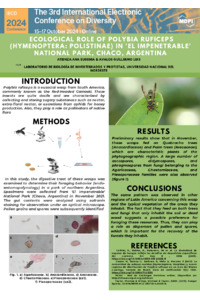
Introduction: Polybia ruficeps is a eusocial wasp from South America, commonly known as the Red-Headed Camoatí. These insects are quite docile and are characterized by collecting and storing sugary substances such as nectar, extra-floral nectar, or excretions from aphids for honey production. Also, they play a role as pollinators of native flora. Methods: In this study, the digestive tract of these wasps was examined to determine their foraging behavior (endo-entomopalynology) in a national park in northern Argentina. Specimens were collected from 'El Impenetrable' National Park (Chaco, Argentina) in November 2021. The gut contents were analyzed using safranin staining for observation under an optical microscope. Pollen grains and spores were subsequently identified. Results: Preliminary results show that in November, these wasps fed on Quebracho trees (Anacardiaceae) and Palm trees (Arecaceae), which are characteristic plants of the phytogeographic region. A large number of ascospores, didymospores, and phragmospores from fungi belonging to the Agaricaceae, Chaetomiaceae, and Pleosporaceae families were also observed. Conclusions: The same pattern was observed in other regions of Latin America concerning this wasp and the typical vegetation of the areas they inhabit. The fact that they feed on both trees and fungi that only inhabit the soil or dead wood suggests a possible preference for foraging these resources. Thus, they can play a role as dispersers of pollen and spores, which is important for the recovery of the forests that they inhabit.
Keywords
gut contents
pollen
spore
wasp
Poster
Rol Ecológico de Polybia ruficeps (Hymenoptera Polistinae) en el Parque Nacional El Impenetrable, Chaco, Argentina.pdf
Wildfire Influence on the Assemblage of Bees and Wasps (Hymenoptera) in El Impenetrable National Park
Color preferences of flower visitors in ‘El Impenetrable’ National Park, Chaco, Argentina