Event submissions
Published
This submission belongs to the session S2. Biodiversity Conservation of the event The 3rd International Electronic Conference on Diversity
Published date
11 Oct, 2024
Academic Editor
'%3e%3cpath%20d='M12.6657%2010.9104C12.4185%2010.325%2012.0599%209.79327%2011.6097%209.34482C11.1609%208.89508%2010.6293%208.5365%2010.0442%208.28888C10.0389%208.28626%2010.0337%208.28495%2010.0285%208.28233C10.8446%207.69279%2011.3752%206.73249%2011.3752%205.64904C11.3752%203.8542%209.92103%202.39999%208.1262%202.39999C6.33136%202.39999%204.87715%203.8542%204.87715%205.64904C4.87715%206.73249%205.40774%207.69279%206.22393%208.28364C6.21869%208.28626%206.21345%208.28757%206.20821%208.29019C5.62129%208.5378%205.09463%208.89284%204.64265%209.34613C4.1929%209.79493%203.83432%2010.3266%203.58671%2010.9117C3.34345%2011.4845%203.21226%2012.0987%203.20023%2012.7209C3.19988%2012.7349%203.20233%2012.7488%203.20744%2012.7619C3.21255%2012.7749%203.22022%2012.7867%203.22998%2012.7968C3.23975%2012.8068%203.25142%2012.8147%203.26431%2012.8202C3.2772%2012.8256%203.29105%2012.8284%203.30504%2012.8284H4.09109C4.14874%2012.8284%204.19459%2012.7825%204.1959%2012.7262C4.2221%2011.7148%204.62823%2010.7676%205.34617%2010.0497C6.08899%209.30683%207.0755%208.89808%208.1262%208.89808C9.17689%208.89808%2010.1634%209.30683%2010.9062%2010.0497C11.6242%2010.7676%2012.0303%2011.7148%2012.0565%2012.7262C12.0578%2012.7838%2012.1037%2012.8284%2012.1613%2012.8284H12.9474C12.9613%2012.8284%2012.9752%2012.8256%2012.9881%2012.8202C13.001%2012.8147%2013.0126%2012.8068%2013.0224%2012.7968C13.0322%2012.7867%2013.0398%2012.7749%2013.0449%2012.7619C13.0501%2012.7488%2013.0525%2012.7349%2013.0522%2012.7209C13.0391%2012.0947%2012.9094%2011.4855%2012.6657%2010.9104ZM8.1262%207.9024C7.52486%207.9024%206.9589%207.6679%206.53312%207.24211C6.10733%206.81633%205.87283%206.25037%205.87283%205.64904C5.87283%205.0477%206.10733%204.48174%206.53312%204.05596C6.9589%203.63018%207.52486%203.39567%208.1262%203.39567C8.72753%203.39567%209.29349%203.63018%209.71927%204.05596C10.1451%204.48174%2010.3796%205.0477%2010.3796%205.64904C10.3796%206.25037%2010.1451%206.81633%209.71927%207.24211C9.29349%207.6679%208.72753%207.9024%208.1262%207.9024Z'%20fill='%235D1EE1'/%3e%3c/g%3e%3c/svg%3e) Kevin Cianfaglione
Kevin CianfaglioneCitation
Ivan F. Belokobylskiy, Blood testing as a tool for the conservation of killer whales (Orcinus orca), in Proceedings of The 3rd International Electronic Conference on Diversity, 15 October–17 October 2024, MDPI: Basel, Switzerland
Share
Email
Facebook
Twitter
LinkedIn
Blood testing as a tool for the conservation of killer whales (Orcinus orca)

Ivan F. Belokobylskiy 1
1. Department of Marine Mammals, Rissian Federal Research Institute of Fisheries and Oceanography, Moscow 105187 Russia
Abstract
The species Orcinus orca is spread across the globe. As top predators, killer whales constitute an important part of global biodiversity. Currently, they are not hunted. However, killer whales sometimes strand, experience trauma, become stuck in the ice, etc. Human aid is essential to save them. A case of a female Springer who was successfully returned to the wild provides an encouraging example. Therefore, every effort to improve marine mammal medicine is valuable.
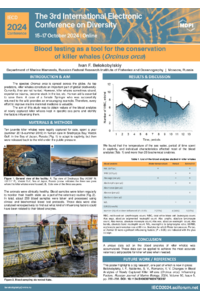
Ten juvenile killer whales spent a year (summer 2018–summer 2019) in human care in Srednyaya Bay, Vostok Gulf, in the Sea of Japan (Russia). The animals were clinically healthy. Blood samples were taken regularly to monitor their health state as a part of the veterinary routine. In total, about 250 blood samples were taken and processed using clinical and biochemical blood test protocols. These data were also analyzed retrospectively to find out what kind of influencing factors could have been related to their blood analytes.
In our results, we found that the temperature of the sea water, period of time spent in captivity, and individual characteristics affected most of the blood analytes, such as the red blood cell count; total white blood cell count; absolute segmented neutrophil count; absolute lymphocyte count; absolute eosinophil count; neutrophil-to-lymphocyte ratio; and more than 20 biochemical analytes.
Thus, a unique data set on their blood analytes was accumulated. These data can be applied to achieve the most accurate veterinary aid possible for killer whales when needed.
Keywords
orcinus orca
killer whale
blood analytes
biodiversity conservation
Poster
sciforum-097217 Belokobylskiy - IECD poster.pdf
TOXOPLASMA GONDII AS A CAUSE OF MULTI-ORGAN FAILURE IN THE CAT'S BODY
Assessment of oxidative damage in red blood cells of seabirds from Argentina