Event submissions
Published
This submission belongs to the session S2. Biodiversity Conservation of the event The 3rd International Electronic Conference on Diversity
Published date
11 Oct, 2024
Academic Editor
'%3e%3cpath%20d='M12.6657%2010.9104C12.4185%2010.325%2012.0599%209.79327%2011.6097%209.34482C11.1609%208.89508%2010.6293%208.5365%2010.0442%208.28888C10.0389%208.28626%2010.0337%208.28495%2010.0285%208.28233C10.8446%207.69279%2011.3752%206.73249%2011.3752%205.64904C11.3752%203.8542%209.92103%202.39999%208.1262%202.39999C6.33136%202.39999%204.87715%203.8542%204.87715%205.64904C4.87715%206.73249%205.40774%207.69279%206.22393%208.28364C6.21869%208.28626%206.21345%208.28757%206.20821%208.29019C5.62129%208.5378%205.09463%208.89284%204.64265%209.34613C4.1929%209.79493%203.83432%2010.3266%203.58671%2010.9117C3.34345%2011.4845%203.21226%2012.0987%203.20023%2012.7209C3.19988%2012.7349%203.20233%2012.7488%203.20744%2012.7619C3.21255%2012.7749%203.22022%2012.7867%203.22998%2012.7968C3.23975%2012.8068%203.25142%2012.8147%203.26431%2012.8202C3.2772%2012.8256%203.29105%2012.8284%203.30504%2012.8284H4.09109C4.14874%2012.8284%204.19459%2012.7825%204.1959%2012.7262C4.2221%2011.7148%204.62823%2010.7676%205.34617%2010.0497C6.08899%209.30683%207.0755%208.89808%208.1262%208.89808C9.17689%208.89808%2010.1634%209.30683%2010.9062%2010.0497C11.6242%2010.7676%2012.0303%2011.7148%2012.0565%2012.7262C12.0578%2012.7838%2012.1037%2012.8284%2012.1613%2012.8284H12.9474C12.9613%2012.8284%2012.9752%2012.8256%2012.9881%2012.8202C13.001%2012.8147%2013.0126%2012.8068%2013.0224%2012.7968C13.0322%2012.7867%2013.0398%2012.7749%2013.0449%2012.7619C13.0501%2012.7488%2013.0525%2012.7349%2013.0522%2012.7209C13.0391%2012.0947%2012.9094%2011.4855%2012.6657%2010.9104ZM8.1262%207.9024C7.52486%207.9024%206.9589%207.6679%206.53312%207.24211C6.10733%206.81633%205.87283%206.25037%205.87283%205.64904C5.87283%205.0477%206.10733%204.48174%206.53312%204.05596C6.9589%203.63018%207.52486%203.39567%208.1262%203.39567C8.72753%203.39567%209.29349%203.63018%209.71927%204.05596C10.1451%204.48174%2010.3796%205.0477%2010.3796%205.64904C10.3796%206.25037%2010.1451%206.81633%209.71927%207.24211C9.29349%207.6679%208.72753%207.9024%208.1262%207.9024Z'%20fill='%235D1EE1'/%3e%3c/g%3e%3c/svg%3e) Kevin Cianfaglione
Kevin CianfaglioneCitation
Anna Zinnovevna Brandorf, The introduction of honey bees for reducing the biodiversity of pollinators, in Proceedings of The 3rd International Electronic Conference on Diversity, 15 October–17 October 2024, MDPI: Basel, Switzerland
Share
Email
Facebook
Twitter
LinkedIn
The introduction of honey bees for reducing the biodiversity of pollinators

Anna Zinnovevna Brandorf 1
1. Rudnitsky Federal Agricultural Research Center of the North-East, Kirov, Russia, 150000
Abstract
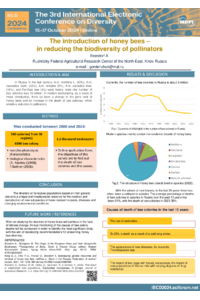
The gene pool of endemic honey bees ensures the conservation of the number of bee colonies. In Russia in the last century, A.m. mellifera L. (60%), A.m. caucasica Gorb. (12%), A.m. rempies (5%), A.m. carpatica Avet. (18%), and Far-East bee (5%) were mainly bred—the number of bee colonies was 10 million. In modern beekeeping, as a result of mass introduction, there as been a change in the gene pool of honey bees and an increase in the death of bee colonies, which entails a reduction in pollinators. This research was conducted between 2000 and 2024, in which a survey of 1.5 thousand beekeepers was conducted, and 560 apiaries from 56 regions were surveyed. The assessment of honey bees by morpho-phenotypic and biological characteristics was carried out according to Alpatov (1948) and Ruttner (2006). Currently, there are three million bee colonies in Russia: A.m. mellifera L. (4%), A.m. caucasica Gorb. (2%), A.m. carpatica Avet. (12%), Far-East bee (5%), new breeds of Carnica 66%, Bacfast 4%, and 11% bees of unknown origin. With the advent of new breeds, in the last 20 years there have often been collapses in apiaries. Reasons: 1. the use of pesticides; 2. up to 30% of death is as a result of a cold long winters; 3. the appearance of new diseases, for example, Tropilelapsosis; 4. the import of bee bags with broods, and the import of new populations of Varroa mite with varying degrees of drug resistance. The diversity of honey bee populations based on their genetic nature is a unique and irreplaceable resource for the creation and reproduction of new subspecies of bees resistant to pests, diseases, and changing environmental conditions.
Keywords
Honey bee
subspecies
collapse
endemics
introduction.
Poster
sciforum-097305 Brandorf_The introduction of honey bee15-17 Oct.2024.pdf
Revealing Participants of Amphibian and Reptile Mapping Citizen Science Project in Hungary
The Examination of Subfossil Cladocera Remains and environmental conditions in the case of lake Velencei, Hungary