Event submissions
Published
This submission belongs to the session S2. Biodiversity Conservation of the event The 3rd International Electronic Conference on Diversity
Published date
11 Oct, 2024
Academic Editor
'%3e%3cpath%20d='M12.6657%2010.9104C12.4185%2010.325%2012.0599%209.79327%2011.6097%209.34482C11.1609%208.89508%2010.6293%208.5365%2010.0442%208.28888C10.0389%208.28626%2010.0337%208.28495%2010.0285%208.28233C10.8446%207.69279%2011.3752%206.73249%2011.3752%205.64904C11.3752%203.8542%209.92103%202.39999%208.1262%202.39999C6.33136%202.39999%204.87715%203.8542%204.87715%205.64904C4.87715%206.73249%205.40774%207.69279%206.22393%208.28364C6.21869%208.28626%206.21345%208.28757%206.20821%208.29019C5.62129%208.5378%205.09463%208.89284%204.64265%209.34613C4.1929%209.79493%203.83432%2010.3266%203.58671%2010.9117C3.34345%2011.4845%203.21226%2012.0987%203.20023%2012.7209C3.19988%2012.7349%203.20233%2012.7488%203.20744%2012.7619C3.21255%2012.7749%203.22022%2012.7867%203.22998%2012.7968C3.23975%2012.8068%203.25142%2012.8147%203.26431%2012.8202C3.2772%2012.8256%203.29105%2012.8284%203.30504%2012.8284H4.09109C4.14874%2012.8284%204.19459%2012.7825%204.1959%2012.7262C4.2221%2011.7148%204.62823%2010.7676%205.34617%2010.0497C6.08899%209.30683%207.0755%208.89808%208.1262%208.89808C9.17689%208.89808%2010.1634%209.30683%2010.9062%2010.0497C11.6242%2010.7676%2012.0303%2011.7148%2012.0565%2012.7262C12.0578%2012.7838%2012.1037%2012.8284%2012.1613%2012.8284H12.9474C12.9613%2012.8284%2012.9752%2012.8256%2012.9881%2012.8202C13.001%2012.8147%2013.0126%2012.8068%2013.0224%2012.7968C13.0322%2012.7867%2013.0398%2012.7749%2013.0449%2012.7619C13.0501%2012.7488%2013.0525%2012.7349%2013.0522%2012.7209C13.0391%2012.0947%2012.9094%2011.4855%2012.6657%2010.9104ZM8.1262%207.9024C7.52486%207.9024%206.9589%207.6679%206.53312%207.24211C6.10733%206.81633%205.87283%206.25037%205.87283%205.64904C5.87283%205.0477%206.10733%204.48174%206.53312%204.05596C6.9589%203.63018%207.52486%203.39567%208.1262%203.39567C8.72753%203.39567%209.29349%203.63018%209.71927%204.05596C10.1451%204.48174%2010.3796%205.0477%2010.3796%205.64904C10.3796%206.25037%2010.1451%206.81633%209.71927%207.24211C9.29349%207.6679%208.72753%207.9024%208.1262%207.9024Z'%20fill='%235D1EE1'/%3e%3c/g%3e%3c/svg%3e) Kevin Cianfaglione
Kevin CianfaglioneCitation
ANTONIOS LOULAKIS, APOSTOLOS TRICHAS, DIMITRIOS KOLLAROS, PANAGIOTIS CHRYSOS, IOANNIS CHASOURAKIS, IOANNIS ZOGRAFAKIS, NIKOLAOS VOLAKAKIS, EMMANOUIL KAMBOURAKIS, Ant (Formicidae) diversity of olive orchard agroecosystems in Crete, Greece: The effect of agroecological zone, in Proceedings of The 3rd International Electronic Conference on Diversity, 15 October–17 October 2024, MDPI: Basel, Switzerland
Share
Email
Facebook
Twitter
LinkedIn
Ant (Formicidae) diversity of olive orchard agroecosystems in Crete, Greece: The effect of agroecological zone
'%3e%3cpath%20d='M12.6647%2010.9104C12.4176%2010.325%2012.0589%209.7933%2011.6088%209.34485C11.16%208.89511%2010.6283%208.53653%2010.0432%208.28891C10.038%208.28629%2010.0327%208.28498%2010.0275%208.28236C10.8437%207.69282%2011.3743%206.73252%2011.3743%205.64907C11.3743%203.85423%209.92005%202.40002%208.12522%202.40002C6.33038%202.40002%204.87618%203.85423%204.87618%205.64907C4.87618%206.73252%205.40677%207.69282%206.22296%208.28367C6.21772%208.28629%206.21248%208.2876%206.20724%208.29022C5.62031%208.53783%205.09365%208.89287%204.64167%209.34616C4.19192%209.79496%203.83334%2010.3266%203.58573%2010.9117C3.34247%2011.4846%203.21128%2012.0987%203.19925%2012.721C3.1989%2012.735%203.20135%2012.7489%203.20646%2012.7619C3.21157%2012.7749%203.21924%2012.7868%203.22901%2012.7968C3.23877%2012.8068%203.25045%2012.8148%203.26334%2012.8202C3.27623%2012.8256%203.29007%2012.8284%203.30406%2012.8284H4.09012C4.14776%2012.8284%204.19362%2012.7825%204.19493%2012.7262C4.22113%2011.7148%204.62726%2010.7676%205.34519%2010.0497C6.08802%209.30686%207.07452%208.89811%208.12522%208.89811C9.17592%208.89811%2010.1624%209.30686%2010.9052%2010.0497C11.6232%2010.7676%2012.0293%2011.7148%2012.0555%2012.7262C12.0568%2012.7839%2012.1027%2012.8284%2012.1603%2012.8284H12.9464C12.9604%2012.8284%2012.9742%2012.8256%2012.9871%2012.8202C13%2012.8148%2013.0117%2012.8068%2013.0214%2012.7968C13.0312%2012.7868%2013.0389%2012.7749%2013.044%2012.7619C13.0491%2012.7489%2013.0515%2012.735%2013.0512%2012.721C13.0381%2012.0947%2012.9084%2011.4856%2012.6647%2010.9104ZM8.12522%207.90243C7.52388%207.90243%206.95792%207.66793%206.53214%207.24215C6.10636%206.81636%205.87185%206.2504%205.87185%205.64907C5.87185%205.04773%206.10636%204.48177%206.53214%204.05599C6.95792%203.63021%207.52388%203.3957%208.12522%203.3957C8.72655%203.3957%209.29252%203.63021%209.7183%204.05599C10.1441%204.48177%2010.3786%205.04773%2010.3786%205.64907C10.3786%206.2504%2010.1441%206.81636%209.7183%207.24215C9.29252%207.66793%208.72655%207.90243%208.12522%207.90243Z'%20fill='%235D1EE1'/%3e%3c/g%3e%3c/svg%3e)
ANTONIOS LOULAKIS 1
APOSTOLOS TRICHAS 2
DIMITRIOS KOLLAROS 1
PANAGIOTIS CHRYSOS 1
IOANNIS CHASOURAKIS 1
IOANNIS ZOGRAFAKIS 1
NIKOLAOS VOLAKAKIS 1
EMMANOUIL KAMBOURAKIS 1
1. Olive, Vine and Agroecological Production Systems Lab (EOPS), Department of Agriculture, Hellenic Mediterranean University, Estavromenos str., 71004 Heraklion, Greece
2. Natural History Museum of Crete, University of Crete, Knossou Avenue, 71409 Heraklion, Greece.
Abstract
Ants are among the most abundant insects in natural and agricultural ecosystems. In this study, for the first time, we investigated the ant fauna of olive orchards in Crete (Greece). Ants were surveyed with pitfall traps, placed in six paired conventional and organic olive orchards. Specimens were collected from October 2021 to July 2022. Orchards were located in two agroecological zones (hilly and plain), three in hills and three in the plains. In each orchard, five traps were placed containing propylene glycol. Specimens were identified to the genus and species level using taxonomic keys. In total, 21 species and 14 genera were identified, out of a total of 28 recorded in Crete. The ants of Aphaenogaster were common and abundant in all the olive ochards, making this the most common genus. The species of the genus Monomorium also showed hign numbers and distribution in all orchards. The small number of specimens belonging to the genera Crematogaster, Lasius, Temnothorax and Solenopsis is due either to their rarity in the olive orchards or to the fact that they are mainly arboreal species. The hilly olive orchards had a higher abundance of ants than the plain ones. Ants in olive orchards show high diversity and are important for pest regulation, soil fertility and nutrient recycling. Further analysis on the species found and of the effect of each farming practice on the ant diversity is required to determine which practices are the most suitable for maintaining an olive orchard’s functional ant diversity and ecosystem services.
Keywords
Agroecology
Ant diversity
Olive orchards
Green infrastructure
Aphaenogaster
Monomorium
Poster
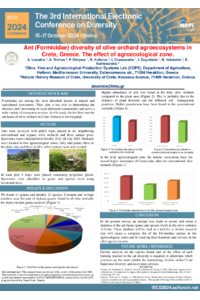
IECD Conference poster template Antonios Loulakis.pdf
The Examination of Subfossil Cladocera Remains and environmental conditions in the case of lake Velencei, Hungary
Paleolimnological reconstruction of Lake Vekeri—are cladocerans able to answer different utilization methods?