Event submissions
Published
This submission belongs to the session S2. Biodiversity Conservation of the event The 3rd International Electronic Conference on Diversity
Published date
11 Oct, 2024
Academic Editor
'%3e%3cpath%20d='M12.6657%2010.9104C12.4185%2010.325%2012.0599%209.79327%2011.6097%209.34482C11.1609%208.89508%2010.6293%208.5365%2010.0442%208.28888C10.0389%208.28626%2010.0337%208.28495%2010.0285%208.28233C10.8446%207.69279%2011.3752%206.73249%2011.3752%205.64904C11.3752%203.8542%209.92103%202.39999%208.1262%202.39999C6.33136%202.39999%204.87715%203.8542%204.87715%205.64904C4.87715%206.73249%205.40774%207.69279%206.22393%208.28364C6.21869%208.28626%206.21345%208.28757%206.20821%208.29019C5.62129%208.5378%205.09463%208.89284%204.64265%209.34613C4.1929%209.79493%203.83432%2010.3266%203.58671%2010.9117C3.34345%2011.4845%203.21226%2012.0987%203.20023%2012.7209C3.19988%2012.7349%203.20233%2012.7488%203.20744%2012.7619C3.21255%2012.7749%203.22022%2012.7867%203.22998%2012.7968C3.23975%2012.8068%203.25142%2012.8147%203.26431%2012.8202C3.2772%2012.8256%203.29105%2012.8284%203.30504%2012.8284H4.09109C4.14874%2012.8284%204.19459%2012.7825%204.1959%2012.7262C4.2221%2011.7148%204.62823%2010.7676%205.34617%2010.0497C6.08899%209.30683%207.0755%208.89808%208.1262%208.89808C9.17689%208.89808%2010.1634%209.30683%2010.9062%2010.0497C11.6242%2010.7676%2012.0303%2011.7148%2012.0565%2012.7262C12.0578%2012.7838%2012.1037%2012.8284%2012.1613%2012.8284H12.9474C12.9613%2012.8284%2012.9752%2012.8256%2012.9881%2012.8202C13.001%2012.8147%2013.0126%2012.8068%2013.0224%2012.7968C13.0322%2012.7867%2013.0398%2012.7749%2013.0449%2012.7619C13.0501%2012.7488%2013.0525%2012.7349%2013.0522%2012.7209C13.0391%2012.0947%2012.9094%2011.4855%2012.6657%2010.9104ZM8.1262%207.9024C7.52486%207.9024%206.9589%207.6679%206.53312%207.24211C6.10733%206.81633%205.87283%206.25037%205.87283%205.64904C5.87283%205.0477%206.10733%204.48174%206.53312%204.05596C6.9589%203.63018%207.52486%203.39567%208.1262%203.39567C8.72753%203.39567%209.29349%203.63018%209.71927%204.05596C10.1451%204.48174%2010.3796%205.0477%2010.3796%205.64904C10.3796%206.25037%2010.1451%206.81633%209.71927%207.24211C9.29349%207.6679%208.72753%207.9024%208.1262%207.9024Z'%20fill='%235D1EE1'/%3e%3c/g%3e%3c/svg%3e) Kevin Cianfaglione
Kevin CianfaglioneCitation
Ioannis Chasourakis, Emmanouil kabourakis, Ioannis Zografakis, Dimitrios Kollaros, Nikolaos Volakakis, Antonios Loulakis, Stiliani Antonaki, Apostolos Trichas, Panagiotis Xrisos, Carabidae diversity in olive orchards in Crete, Greece. The effect of agroecological zone and management system, in Proceedings of The 3rd International Electronic Conference on Diversity, 15 October–17 October 2024, MDPI: Basel, Switzerland
Share
Email
Facebook
Twitter
LinkedIn
Carabidae diversity in olive orchards in Crete, Greece. The effect of agroecological zone and management system
'%3e%3cpath%20d='M12.6647%2010.9104C12.4176%2010.325%2012.0589%209.7933%2011.6088%209.34485C11.16%208.89511%2010.6283%208.53653%2010.0432%208.28891C10.038%208.28629%2010.0327%208.28498%2010.0275%208.28236C10.8437%207.69282%2011.3743%206.73252%2011.3743%205.64907C11.3743%203.85423%209.92005%202.40002%208.12522%202.40002C6.33038%202.40002%204.87618%203.85423%204.87618%205.64907C4.87618%206.73252%205.40677%207.69282%206.22296%208.28367C6.21772%208.28629%206.21248%208.2876%206.20724%208.29022C5.62031%208.53783%205.09365%208.89287%204.64167%209.34616C4.19192%209.79496%203.83334%2010.3266%203.58573%2010.9117C3.34247%2011.4846%203.21128%2012.0987%203.19925%2012.721C3.1989%2012.735%203.20135%2012.7489%203.20646%2012.7619C3.21157%2012.7749%203.21924%2012.7868%203.22901%2012.7968C3.23877%2012.8068%203.25045%2012.8148%203.26334%2012.8202C3.27623%2012.8256%203.29007%2012.8284%203.30406%2012.8284H4.09012C4.14776%2012.8284%204.19362%2012.7825%204.19493%2012.7262C4.22113%2011.7148%204.62726%2010.7676%205.34519%2010.0497C6.08802%209.30686%207.07452%208.89811%208.12522%208.89811C9.17592%208.89811%2010.1624%209.30686%2010.9052%2010.0497C11.6232%2010.7676%2012.0293%2011.7148%2012.0555%2012.7262C12.0568%2012.7839%2012.1027%2012.8284%2012.1603%2012.8284H12.9464C12.9604%2012.8284%2012.9742%2012.8256%2012.9871%2012.8202C13%2012.8148%2013.0117%2012.8068%2013.0214%2012.7968C13.0312%2012.7868%2013.0389%2012.7749%2013.044%2012.7619C13.0491%2012.7489%2013.0515%2012.735%2013.0512%2012.721C13.0381%2012.0947%2012.9084%2011.4856%2012.6647%2010.9104ZM8.12522%207.90243C7.52388%207.90243%206.95792%207.66793%206.53214%207.24215C6.10636%206.81636%205.87185%206.2504%205.87185%205.64907C5.87185%205.04773%206.10636%204.48177%206.53214%204.05599C6.95792%203.63021%207.52388%203.3957%208.12522%203.3957C8.72655%203.3957%209.29252%203.63021%209.7183%204.05599C10.1441%204.48177%2010.3786%205.04773%2010.3786%205.64907C10.3786%206.2504%2010.1441%206.81636%209.7183%207.24215C9.29252%207.66793%208.72655%207.90243%208.12522%207.90243Z'%20fill='%235D1EE1'/%3e%3c/g%3e%3c/svg%3e)
Ioannis Chasourakis 1
Emmanouil kabourakis 1,2
Ioannis Zografakis 1,2
Dimitrios Kollaros 2
Nikolaos Volakakis 2
Antonios Loulakis 1
Stiliani Antonaki 1
Apostolos Trichas 3
Panagiotis Xrisos 1
1. Olive, Vine and Agroecological Production Systems Lab (EOPS), Department of Agriculture, Hellenic Mediterranean University, Estavromenos str., 71004 Heraklion, Greece
2. HMU
3. Natural History Museum of Crete, University of Crete, Knossou Avenue, 71409 Heraklion, Greece.
Abstract
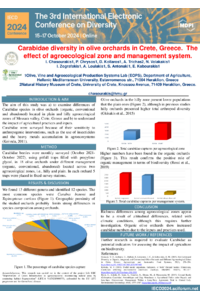
In the island of Crete (Greece), olive orchards are the most common tree crop. The microclimate, but also the landscape, has an overall effect in the functioning of the olive agroecosystem. Factors related to olive orchard management, climate and landscape contribute substantially to the diversity of indicator organisms such as coleoptera. Carabidae are one of the best bioindicators for the protection of ecosystems. Carabidae beetles are important, because they are sensitive to anthropogenic interventions, such as the use of insecticides and heavy metal accumulation in agroecosystems. Carabidae fauna of olive orchards was for the first time investigated in Crete. During the period of October 2021–October 2022, we surveyed carabidae beetles on a monthly basis, using pitfall traps, in 18 olive orchards under different management systems (organic, conventional, abandoned) located across two agroecological zones, i.e., hilly and plain. In each orchard, five traps were placed containing propylene glycol. We found 14 different genera and identified 12 species. The most common species were Carabus banoni and Tapinopterus creticus. Olive orchards in the hilly zone presented higher populations than the plain ones, while higher populations were found in the organic orchards. The differences in richness between agroecological zones appear to be a result of altitudinal differences in relation to air temperature and humidity, although this requires further investigation. The geographic proximity of the studied fields hampers strong differences in species composition. This is a first attempt to understand the impact of human (agricultural) activities on carabidae beetles in the Mediterranean region. We highlight the importance of organic olive orchards as sites of increased carabidae diversity. Further research is required to evaluate carabidae as potential indicators for assessing the impact of agriculture on biodiversity.
Keywords
diversity metrics
agroecosystems
carabidae
organic farming
human impact.
Poster
IECD Conference poster template Ioannis Chasourakis.pdf
Strategies for Conservation of Biodiversity: A Synergistic Approach in Designing Landscapes, Population Management and Reforestation
Investigating water level changes in Lake Balaton over the past 500 years