Event submissions
Published
This submission belongs to the session S2. Biodiversity Conservation of the event The 3rd International Electronic Conference on Diversity
Published date
11 Oct, 2024
Academic Editor
'%3e%3cpath%20d='M12.6657%2010.9104C12.4185%2010.325%2012.0599%209.79327%2011.6097%209.34482C11.1609%208.89508%2010.6293%208.5365%2010.0442%208.28888C10.0389%208.28626%2010.0337%208.28495%2010.0285%208.28233C10.8446%207.69279%2011.3752%206.73249%2011.3752%205.64904C11.3752%203.8542%209.92103%202.39999%208.1262%202.39999C6.33136%202.39999%204.87715%203.8542%204.87715%205.64904C4.87715%206.73249%205.40774%207.69279%206.22393%208.28364C6.21869%208.28626%206.21345%208.28757%206.20821%208.29019C5.62129%208.5378%205.09463%208.89284%204.64265%209.34613C4.1929%209.79493%203.83432%2010.3266%203.58671%2010.9117C3.34345%2011.4845%203.21226%2012.0987%203.20023%2012.7209C3.19988%2012.7349%203.20233%2012.7488%203.20744%2012.7619C3.21255%2012.7749%203.22022%2012.7867%203.22998%2012.7968C3.23975%2012.8068%203.25142%2012.8147%203.26431%2012.8202C3.2772%2012.8256%203.29105%2012.8284%203.30504%2012.8284H4.09109C4.14874%2012.8284%204.19459%2012.7825%204.1959%2012.7262C4.2221%2011.7148%204.62823%2010.7676%205.34617%2010.0497C6.08899%209.30683%207.0755%208.89808%208.1262%208.89808C9.17689%208.89808%2010.1634%209.30683%2010.9062%2010.0497C11.6242%2010.7676%2012.0303%2011.7148%2012.0565%2012.7262C12.0578%2012.7838%2012.1037%2012.8284%2012.1613%2012.8284H12.9474C12.9613%2012.8284%2012.9752%2012.8256%2012.9881%2012.8202C13.001%2012.8147%2013.0126%2012.8068%2013.0224%2012.7968C13.0322%2012.7867%2013.0398%2012.7749%2013.0449%2012.7619C13.0501%2012.7488%2013.0525%2012.7349%2013.0522%2012.7209C13.0391%2012.0947%2012.9094%2011.4855%2012.6657%2010.9104ZM8.1262%207.9024C7.52486%207.9024%206.9589%207.6679%206.53312%207.24211C6.10733%206.81633%205.87283%206.25037%205.87283%205.64904C5.87283%205.0477%206.10733%204.48174%206.53312%204.05596C6.9589%203.63018%207.52486%203.39567%208.1262%203.39567C8.72753%203.39567%209.29349%203.63018%209.71927%204.05596C10.1451%204.48174%2010.3796%205.0477%2010.3796%205.64904C10.3796%206.25037%2010.1451%206.81633%209.71927%207.24211C9.29349%207.6679%208.72753%207.9024%208.1262%207.9024Z'%20fill='%235D1EE1'/%3e%3c/g%3e%3c/svg%3e) Kevin Cianfaglione
Kevin CianfaglioneCitation
Andor Gergő Soltész, Enikő Katalin Magyari, Jázmin Jakab, Andrea Clara Böjthe, János Korponai, István Gyulai, Investigating water level changes in Lake Balaton over the past 500 years, in Proceedings of The 3rd International Electronic Conference on Diversity, 15 October–17 October 2024, MDPI: Basel, Switzerland
Share
Email
Facebook
Twitter
LinkedIn
Investigating water level changes in Lake Balaton over the past 500 years
'%3e%3cpath%20d='M12.6647%2010.9104C12.4176%2010.325%2012.0589%209.7933%2011.6088%209.34485C11.16%208.89511%2010.6283%208.53653%2010.0432%208.28891C10.038%208.28629%2010.0327%208.28498%2010.0275%208.28236C10.8437%207.69282%2011.3743%206.73252%2011.3743%205.64907C11.3743%203.85423%209.92005%202.40002%208.12522%202.40002C6.33038%202.40002%204.87618%203.85423%204.87618%205.64907C4.87618%206.73252%205.40677%207.69282%206.22296%208.28367C6.21772%208.28629%206.21248%208.2876%206.20724%208.29022C5.62031%208.53783%205.09365%208.89287%204.64167%209.34616C4.19192%209.79496%203.83334%2010.3266%203.58573%2010.9117C3.34247%2011.4846%203.21128%2012.0987%203.19925%2012.721C3.1989%2012.735%203.20135%2012.7489%203.20646%2012.7619C3.21157%2012.7749%203.21924%2012.7868%203.22901%2012.7968C3.23877%2012.8068%203.25045%2012.8148%203.26334%2012.8202C3.27623%2012.8256%203.29007%2012.8284%203.30406%2012.8284H4.09012C4.14776%2012.8284%204.19362%2012.7825%204.19493%2012.7262C4.22113%2011.7148%204.62726%2010.7676%205.34519%2010.0497C6.08802%209.30686%207.07452%208.89811%208.12522%208.89811C9.17592%208.89811%2010.1624%209.30686%2010.9052%2010.0497C11.6232%2010.7676%2012.0293%2011.7148%2012.0555%2012.7262C12.0568%2012.7839%2012.1027%2012.8284%2012.1603%2012.8284H12.9464C12.9604%2012.8284%2012.9742%2012.8256%2012.9871%2012.8202C13%2012.8148%2013.0117%2012.8068%2013.0214%2012.7968C13.0312%2012.7868%2013.0389%2012.7749%2013.044%2012.7619C13.0491%2012.7489%2013.0515%2012.735%2013.0512%2012.721C13.0381%2012.0947%2012.9084%2011.4856%2012.6647%2010.9104ZM8.12522%207.90243C7.52388%207.90243%206.95792%207.66793%206.53214%207.24215C6.10636%206.81636%205.87185%206.2504%205.87185%205.64907C5.87185%205.04773%206.10636%204.48177%206.53214%204.05599C6.95792%203.63021%207.52388%203.3957%208.12522%203.3957C8.72655%203.3957%209.29252%203.63021%209.7183%204.05599C10.1441%204.48177%2010.3786%205.04773%2010.3786%205.64907C10.3786%206.2504%2010.1441%206.81636%209.7183%207.24215C9.29252%207.66793%208.72655%207.90243%208.12522%207.90243Z'%20fill='%235D1EE1'/%3e%3c/g%3e%3c/svg%3e)
Andor Gergő Soltész 1
Enikő Katalin Magyari 2,3
Jázmin Jakab 1,4
Andrea Clara Böjthe 1,4

János Korponai 5,6
István Gyulai 1,7
1. Department of Hydrobiology, Faculty of Science and Technology, University of Debrecen, Egyetem tér 1,
H-4032 Debrecen, Hungary
2. ELTE Eötvös Loránd University, Institute of Geography and Earth Sciences, Department Environmental and Landscape Geography, Budapest H-1117, Hungary
3. ELKH-MTM-ELTE Research group for Paleonthology, Budapest H-1117, Hungary
4. Pál Juhász-Nagy Doctoral School of Biology and Environmental Sciences, University of Debrecen, Egyetem
tér 1, H-4032 Debrecen, Hungary
5. Department of Water Supply and Sewerage, Faculty of Water Sciences, University of Public Services,
Bajcsy-Zs. utca 12-14, H-6500 Baja, Hungary
6. National Laboratory for Water Science and Water Security, Faculty of Water Sciences, University of Public
Services, Bajcsy-Zs. utca 12-14, H-6500 Baja, Hungary
7. National Laboratory for Water Science and Water Security, Department of Hydrobiology, University of
Debrecen, Egyetem tér 1, H-4032 Debrecen, Hungary
Abstract
Abstract
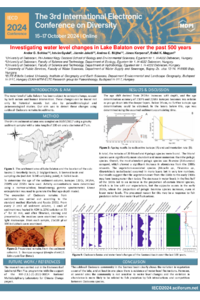
Climate change and anthropogenic disturbance on our water bodies cause rapid changes in aquatic ecosystems. The study of subfossil aquatic organisms can be used to track the history of various environmental changes, hydrological events, climate and human impacts. The aim of this study is to reconstruct historical water levels, water quality and predation changes in Lake Balaton, Hungary using subfossil cladoceran remains.
A 65-cm long sediment core was taken and analysed for cladocerans at 2 cm resolution using 1 cm3 subsamples. Cladocera remains preserved well in the sediment and can be identified at the species level. Relative frequency distribution and concentration of the cladocera assemblages were recorded for each depth and plotted along age and depth using the 210Pb and 137Cs based age-depth model for the last 200 years (0-30 cm) and linear extrapolation for the deeper layers (30-65 cm). So far, we found minor variation in species number, but major variation in total cladocera concentrations. Changes in subfossil Cladocera communities did not always show changes in water levels. Our results suggest that water level fluctuations in the Szemesi-basin of Lake Balaton cannot be determined with high confidence from changes in Cladocera communities alone, so we need to include other proxies in this type of studies.
Keywords
Keywords: Cladocera
sediment
subfossil
change
environment
Poster
Andor Gergő Soltész IECD poster 2024 pdf.pdf
Carabidae diversity in olive orchards in Crete, Greece. The effect of agroecological zone and management system
A comparison of filtrate and sediment samples of Cladocera in Hungarian shallow lakes to characterise the types of wetland