Event submissions
Published
This submission belongs to the session S2. Biodiversity Conservation of the event The 3rd International Electronic Conference on Diversity
Published date
11 Oct, 2024
Academic Editor
'%3e%3cpath%20d='M12.6657%2010.9104C12.4185%2010.325%2012.0599%209.79327%2011.6097%209.34482C11.1609%208.89508%2010.6293%208.5365%2010.0442%208.28888C10.0389%208.28626%2010.0337%208.28495%2010.0285%208.28233C10.8446%207.69279%2011.3752%206.73249%2011.3752%205.64904C11.3752%203.8542%209.92103%202.39999%208.1262%202.39999C6.33136%202.39999%204.87715%203.8542%204.87715%205.64904C4.87715%206.73249%205.40774%207.69279%206.22393%208.28364C6.21869%208.28626%206.21345%208.28757%206.20821%208.29019C5.62129%208.5378%205.09463%208.89284%204.64265%209.34613C4.1929%209.79493%203.83432%2010.3266%203.58671%2010.9117C3.34345%2011.4845%203.21226%2012.0987%203.20023%2012.7209C3.19988%2012.7349%203.20233%2012.7488%203.20744%2012.7619C3.21255%2012.7749%203.22022%2012.7867%203.22998%2012.7968C3.23975%2012.8068%203.25142%2012.8147%203.26431%2012.8202C3.2772%2012.8256%203.29105%2012.8284%203.30504%2012.8284H4.09109C4.14874%2012.8284%204.19459%2012.7825%204.1959%2012.7262C4.2221%2011.7148%204.62823%2010.7676%205.34617%2010.0497C6.08899%209.30683%207.0755%208.89808%208.1262%208.89808C9.17689%208.89808%2010.1634%209.30683%2010.9062%2010.0497C11.6242%2010.7676%2012.0303%2011.7148%2012.0565%2012.7262C12.0578%2012.7838%2012.1037%2012.8284%2012.1613%2012.8284H12.9474C12.9613%2012.8284%2012.9752%2012.8256%2012.9881%2012.8202C13.001%2012.8147%2013.0126%2012.8068%2013.0224%2012.7968C13.0322%2012.7867%2013.0398%2012.7749%2013.0449%2012.7619C13.0501%2012.7488%2013.0525%2012.7349%2013.0522%2012.7209C13.0391%2012.0947%2012.9094%2011.4855%2012.6657%2010.9104ZM8.1262%207.9024C7.52486%207.9024%206.9589%207.6679%206.53312%207.24211C6.10733%206.81633%205.87283%206.25037%205.87283%205.64904C5.87283%205.0477%206.10733%204.48174%206.53312%204.05596C6.9589%203.63018%207.52486%203.39567%208.1262%203.39567C8.72753%203.39567%209.29349%203.63018%209.71927%204.05596C10.1451%204.48174%2010.3796%205.0477%2010.3796%205.64904C10.3796%206.25037%2010.1451%206.81633%209.71927%207.24211C9.29349%207.6679%208.72753%207.9024%208.1262%207.9024Z'%20fill='%235D1EE1'/%3e%3c/g%3e%3c/svg%3e) Kevin Cianfaglione
Kevin CianfaglioneCitation
Panchali Sengupta, Can altitude effect the distribution of nymphalidae butterflies adjacent to protected regions in the Eastern Himalayan landscape of West Bengal, India?, in Proceedings of The 3rd International Electronic Conference on Diversity, 15 October–17 October 2024, MDPI: Basel, Switzerland
Share
Email
Facebook
Twitter
LinkedIn
Can altitude effect the distribution of nymphalidae butterflies adjacent to protected regions in the Eastern Himalayan landscape of West Bengal, India?

Panchali Sengupta 1
1. Department of Zoology, West Bengal State University, Berunanpukaria, Malikapur, Barasat, West Bengal, India
Abstract
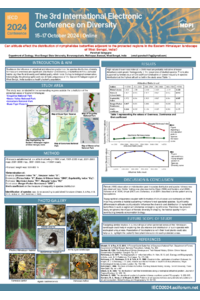
Studies on the diversity and distribution pattern of species must include not only an understanding of their specific ecological requirements, but also their geographical context, which in turn shapes their structure and dynamics. Studies on the influence of latitudinal and elevation gradients on species diversity, richness and evenness are significant. Interestingly, the physiographic and eco-climatic uniqueness of the Eastern Himalayan region of West Bengal, India, sustains a healthy butterfly population.
The present study attempts to document the altitudinal distribution of nymphalidae butterflies in surrounding regions outside the jurisdiction of the protected areas of Eastern Himalayas (Singalika National Park, Neora Valley National Park, Gorumara National Park and Buxa Tiger Reserve). Determination of diversity (Shannon Index “H´”, Simpson Index “D”), evenness (Pielou Index “E”, Buzas and Gibson Index “EBG”, Equitability Index “Eq”), richness (Menhinick Index “R1”, Margalef Index “R2”), dominance (Berger–Parker Dominance “DBP”) and Gini’s coefficient on the measure of inequality in species distribution was undertaken across six altitudinal belts (˂=1500 masl, 1501-2000 masl, 2001-2500 masl, 2501-3000 masl, 3001-3500 masl, ˃=3501 masl).
The highest values of diversity (H´=6.34) and species richness (R1=2.497; R2=12.01) were noted across 2501-3000 masl. However, evenness values (E=1.424; EBG=0.951; Eq=0.987) were greatest at ˃=3501 masl. On the contrary, Gini’s coefficient (G=0.264) and dominance values (DBP = 0.0469) were highest at ˂=1500 masl. The formation of a curve with a mid-elevation peak, depicting the high species richness and diversity seen across the study sites, is worth mentioning.
Topographical uniqueness, coupled with the formation of cloud cover at approximately 2000 masl, may provide a habitat sustaining montane forest specialist species. Significantly differences in altitude probably influence the diversity and distribution of nymphalid butterflies in such regions, with immense ecological significance. Therefore, the present study highlights the impact of floristic diversity on shaping habitat quality, in turn contributing to conservation biology.
Keywords
Altitude
butterflies
distribution
diversity
evenness
species richness
Poster
sciforum-095936 Sengupta-IECD2024 ppt.pdf
New data on earthworms in two nature conservation areas in Hungary
Is wild boar rooting a form of damage or an effect? Combined impacts of wild boar rooting and water erosion on some soil properties