Event submissions
Published
This submission belongs to the session S3. Optoelectronics and Optical Materials of the event The 1st International Online Conference on Photonics
Published date
14 Oct, 2024
Academic Editor
'%3e%3cpath%20d='M12.6657%2010.9104C12.4185%2010.325%2012.0599%209.79327%2011.6097%209.34482C11.1609%208.89508%2010.6293%208.5365%2010.0442%208.28888C10.0389%208.28626%2010.0337%208.28495%2010.0285%208.28233C10.8446%207.69279%2011.3752%206.73249%2011.3752%205.64904C11.3752%203.8542%209.92103%202.39999%208.1262%202.39999C6.33136%202.39999%204.87715%203.8542%204.87715%205.64904C4.87715%206.73249%205.40774%207.69279%206.22393%208.28364C6.21869%208.28626%206.21345%208.28757%206.20821%208.29019C5.62129%208.5378%205.09463%208.89284%204.64265%209.34613C4.1929%209.79493%203.83432%2010.3266%203.58671%2010.9117C3.34345%2011.4845%203.21226%2012.0987%203.20023%2012.7209C3.19988%2012.7349%203.20233%2012.7488%203.20744%2012.7619C3.21255%2012.7749%203.22022%2012.7867%203.22998%2012.7968C3.23975%2012.8068%203.25142%2012.8147%203.26431%2012.8202C3.2772%2012.8256%203.29105%2012.8284%203.30504%2012.8284H4.09109C4.14874%2012.8284%204.19459%2012.7825%204.1959%2012.7262C4.2221%2011.7148%204.62823%2010.7676%205.34617%2010.0497C6.08899%209.30683%207.0755%208.89808%208.1262%208.89808C9.17689%208.89808%2010.1634%209.30683%2010.9062%2010.0497C11.6242%2010.7676%2012.0303%2011.7148%2012.0565%2012.7262C12.0578%2012.7838%2012.1037%2012.8284%2012.1613%2012.8284H12.9474C12.9613%2012.8284%2012.9752%2012.8256%2012.9881%2012.8202C13.001%2012.8147%2013.0126%2012.8068%2013.0224%2012.7968C13.0322%2012.7867%2013.0398%2012.7749%2013.0449%2012.7619C13.0501%2012.7488%2013.0525%2012.7349%2013.0522%2012.7209C13.0391%2012.0947%2012.9094%2011.4855%2012.6657%2010.9104ZM8.1262%207.9024C7.52486%207.9024%206.9589%207.6679%206.53312%207.24211C6.10733%206.81633%205.87283%206.25037%205.87283%205.64904C5.87283%205.0477%206.10733%204.48174%206.53312%204.05596C6.9589%203.63018%207.52486%203.39567%208.1262%203.39567C8.72753%203.39567%209.29349%203.63018%209.71927%204.05596C10.1451%204.48174%2010.3796%205.0477%2010.3796%205.64904C10.3796%206.25037%2010.1451%206.81633%209.71927%207.24211C9.29349%207.6679%208.72753%207.9024%208.1262%207.9024Z'%20fill='%235D1EE1'/%3e%3c/g%3e%3c/svg%3e) Anna Lukowiak
Anna LukowiakCitation
Isaac Yorke, Lars Emil Gutt, Peter David Girouard, Michael Galili, Fast method for the measurement of dispersion of integrated waveguides utilizing Michelson interferometry effects, in Proceedings of The 1st International Online Conference on Photonics, 14 October–16 October 2024, MDPI: Basel, Switzerland
Share
Email
Facebook
Twitter
LinkedIn
Fast method for the measurement of dispersion of integrated waveguides utilizing Michelson interferometry effects
'%3e%3cpath%20d='M12.6647%2010.9104C12.4176%2010.325%2012.0589%209.7933%2011.6088%209.34485C11.16%208.89511%2010.6283%208.53653%2010.0432%208.28891C10.038%208.28629%2010.0327%208.28498%2010.0275%208.28236C10.8437%207.69282%2011.3743%206.73252%2011.3743%205.64907C11.3743%203.85423%209.92005%202.40002%208.12522%202.40002C6.33038%202.40002%204.87618%203.85423%204.87618%205.64907C4.87618%206.73252%205.40677%207.69282%206.22296%208.28367C6.21772%208.28629%206.21248%208.2876%206.20724%208.29022C5.62031%208.53783%205.09365%208.89287%204.64167%209.34616C4.19192%209.79496%203.83334%2010.3266%203.58573%2010.9117C3.34247%2011.4846%203.21128%2012.0987%203.19925%2012.721C3.1989%2012.735%203.20135%2012.7489%203.20646%2012.7619C3.21157%2012.7749%203.21924%2012.7868%203.22901%2012.7968C3.23877%2012.8068%203.25045%2012.8148%203.26334%2012.8202C3.27623%2012.8256%203.29007%2012.8284%203.30406%2012.8284H4.09012C4.14776%2012.8284%204.19362%2012.7825%204.19493%2012.7262C4.22113%2011.7148%204.62726%2010.7676%205.34519%2010.0497C6.08802%209.30686%207.07452%208.89811%208.12522%208.89811C9.17592%208.89811%2010.1624%209.30686%2010.9052%2010.0497C11.6232%2010.7676%2012.0293%2011.7148%2012.0555%2012.7262C12.0568%2012.7839%2012.1027%2012.8284%2012.1603%2012.8284H12.9464C12.9604%2012.8284%2012.9742%2012.8256%2012.9871%2012.8202C13%2012.8148%2013.0117%2012.8068%2013.0214%2012.7968C13.0312%2012.7868%2013.0389%2012.7749%2013.044%2012.7619C13.0491%2012.7489%2013.0515%2012.735%2013.0512%2012.721C13.0381%2012.0947%2012.9084%2011.4856%2012.6647%2010.9104ZM8.12522%207.90243C7.52388%207.90243%206.95792%207.66793%206.53214%207.24215C6.10636%206.81636%205.87185%206.2504%205.87185%205.64907C5.87185%205.04773%206.10636%204.48177%206.53214%204.05599C6.95792%203.63021%207.52388%203.3957%208.12522%203.3957C8.72655%203.3957%209.29252%203.63021%209.7183%204.05599C10.1441%204.48177%2010.3786%205.04773%2010.3786%205.64907C10.3786%206.2504%2010.1441%206.81636%209.7183%207.24215C9.29252%207.66793%208.72655%207.90243%208.12522%207.90243Z'%20fill='%235D1EE1'/%3e%3c/g%3e%3c/svg%3e)
Isaac Yorke 1,2
Lars Emil Gutt 2
Peter David Girouard 3
Michael Galili 2
1. Department of Engineering and Architecture, University of Parma, Parco Area delle Scienze 181/A I-43124 Parma, Italy
2. Department of Electrical and Photonics Engineering, Technical University of Denmark, Ørsteds Plads Bygning 3402800 Kongens Lyngby, Denmark
3. imec-NL, High Tech Campus 31, 5656 AE Eindhoven, Netherlands
Abstract
Introduction
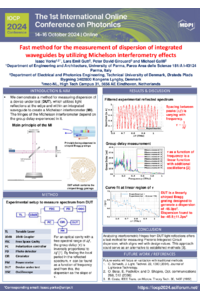
We demonstrate a method for measuring the dispersion of a device under test (DUT), which utilizes light reflections at the edge and within an integrated waveguide to create a Michelson interferometer. The interference fringes of the Michelson interferometer depend on the group delay experienced in it.
Methods
In the DUT, the reflected power is recorded during a single, fast laser sweep. For an optical cavity with a free spectral range of Δf, the group delay (τ) is inversely proportional to Δf [1]. By finding the local period in the reflected spectrum, τ can be found as a function of frequency, and from this, the dispersion as the slope of τ.
Results
The DUT is a linearly chirped Bragg grating designed to generate a dispersion of -45.9 ps2. We took nine different measurements of the same device. From the experimental data, τ was found to be noisy at low frequencies and only the linear portion of τ was considered. We found the dispersion to be (-45.5± 11.2) ps2.
Conclusion
Our step-by-step data analysis confirms that, analyzing interferometric fringes from DUT light reflections offers a fast method for measuring photonic iIntegrated circuit dispersion, which aligns well with design values. This approach could serve as an alternative to established methods [2], which we will further verify in the future.
References:
- Schwelb, J. Light. Technol. 22, 1380 (2004). Journal of Lightwave Technology.
- Costa, IEEE Trans. on Microw. Theory Tech. 30, 1497 (1982)
Keywords
Group Delay
Michelson Interferometer
Dispersion
Photonic Integrated Circuit
Poster
sciforum-100672.pdf
BLUE- AND GREEN-EMITTING CARBON DOTS EMBEDDED IN SiO2 AND SiO2–CaO MONOLITH GLASS: ANALYSYS OF OPTICAL PROPERTIES
Down-Conversion Mechanisms in Tb3+/Yb3+-Activated Silica–Hafnia Glass-Ceramic Films: Temperature and Excitation Power Dependence