Event submissions
Published
This submission belongs to the session S1. Biophotonics and Biomedical Optics of the event The 1st International Online Conference on Photonics
Published date
14 Oct, 2024
Academic Editor
'%3e%3cpath%20d='M12.6657%2010.9104C12.4185%2010.325%2012.0599%209.79327%2011.6097%209.34482C11.1609%208.89508%2010.6293%208.5365%2010.0442%208.28888C10.0389%208.28626%2010.0337%208.28495%2010.0285%208.28233C10.8446%207.69279%2011.3752%206.73249%2011.3752%205.64904C11.3752%203.8542%209.92103%202.39999%208.1262%202.39999C6.33136%202.39999%204.87715%203.8542%204.87715%205.64904C4.87715%206.73249%205.40774%207.69279%206.22393%208.28364C6.21869%208.28626%206.21345%208.28757%206.20821%208.29019C5.62129%208.5378%205.09463%208.89284%204.64265%209.34613C4.1929%209.79493%203.83432%2010.3266%203.58671%2010.9117C3.34345%2011.4845%203.21226%2012.0987%203.20023%2012.7209C3.19988%2012.7349%203.20233%2012.7488%203.20744%2012.7619C3.21255%2012.7749%203.22022%2012.7867%203.22998%2012.7968C3.23975%2012.8068%203.25142%2012.8147%203.26431%2012.8202C3.2772%2012.8256%203.29105%2012.8284%203.30504%2012.8284H4.09109C4.14874%2012.8284%204.19459%2012.7825%204.1959%2012.7262C4.2221%2011.7148%204.62823%2010.7676%205.34617%2010.0497C6.08899%209.30683%207.0755%208.89808%208.1262%208.89808C9.17689%208.89808%2010.1634%209.30683%2010.9062%2010.0497C11.6242%2010.7676%2012.0303%2011.7148%2012.0565%2012.7262C12.0578%2012.7838%2012.1037%2012.8284%2012.1613%2012.8284H12.9474C12.9613%2012.8284%2012.9752%2012.8256%2012.9881%2012.8202C13.001%2012.8147%2013.0126%2012.8068%2013.0224%2012.7968C13.0322%2012.7867%2013.0398%2012.7749%2013.0449%2012.7619C13.0501%2012.7488%2013.0525%2012.7349%2013.0522%2012.7209C13.0391%2012.0947%2012.9094%2011.4855%2012.6657%2010.9104ZM8.1262%207.9024C7.52486%207.9024%206.9589%207.6679%206.53312%207.24211C6.10733%206.81633%205.87283%206.25037%205.87283%205.64904C5.87283%205.0477%206.10733%204.48174%206.53312%204.05596C6.9589%203.63018%207.52486%203.39567%208.1262%203.39567C8.72753%203.39567%209.29349%203.63018%209.71927%204.05596C10.1451%204.48174%2010.3796%205.0477%2010.3796%205.64904C10.3796%206.25037%2010.1451%206.81633%209.71927%207.24211C9.29349%207.6679%208.72753%207.9024%208.1262%207.9024Z'%20fill='%235D1EE1'/%3e%3c/g%3e%3c/svg%3e) Maurizio Ferrari
Maurizio FerrariCitation
Gur Pyari, Himanshu Bansal, Sukhdev Roy, Low-Power Optogenetic Excitation and Suppression of Human Ventricular Cardiomyocytes Expressed with ChRmine and HcKCR1, in Proceedings of The 1st International Online Conference on Photonics, 14 October–16 October 2024, MDPI: Basel, Switzerland
Share
Email
Facebook
Twitter
LinkedIn
Low-Power Optogenetic Excitation and Suppression of Human Ventricular Cardiomyocytes Expressed with ChRmine and HcKCR1
'%3e%3cpath%20d='M12.6647%2010.9104C12.4176%2010.325%2012.0589%209.7933%2011.6088%209.34485C11.16%208.89511%2010.6283%208.53653%2010.0432%208.28891C10.038%208.28629%2010.0327%208.28498%2010.0275%208.28236C10.8437%207.69282%2011.3743%206.73252%2011.3743%205.64907C11.3743%203.85423%209.92005%202.40002%208.12522%202.40002C6.33038%202.40002%204.87618%203.85423%204.87618%205.64907C4.87618%206.73252%205.40677%207.69282%206.22296%208.28367C6.21772%208.28629%206.21248%208.2876%206.20724%208.29022C5.62031%208.53783%205.09365%208.89287%204.64167%209.34616C4.19192%209.79496%203.83334%2010.3266%203.58573%2010.9117C3.34247%2011.4846%203.21128%2012.0987%203.19925%2012.721C3.1989%2012.735%203.20135%2012.7489%203.20646%2012.7619C3.21157%2012.7749%203.21924%2012.7868%203.22901%2012.7968C3.23877%2012.8068%203.25045%2012.8148%203.26334%2012.8202C3.27623%2012.8256%203.29007%2012.8284%203.30406%2012.8284H4.09012C4.14776%2012.8284%204.19362%2012.7825%204.19493%2012.7262C4.22113%2011.7148%204.62726%2010.7676%205.34519%2010.0497C6.08802%209.30686%207.07452%208.89811%208.12522%208.89811C9.17592%208.89811%2010.1624%209.30686%2010.9052%2010.0497C11.6232%2010.7676%2012.0293%2011.7148%2012.0555%2012.7262C12.0568%2012.7839%2012.1027%2012.8284%2012.1603%2012.8284H12.9464C12.9604%2012.8284%2012.9742%2012.8256%2012.9871%2012.8202C13%2012.8148%2013.0117%2012.8068%2013.0214%2012.7968C13.0312%2012.7868%2013.0389%2012.7749%2013.044%2012.7619C13.0491%2012.7489%2013.0515%2012.735%2013.0512%2012.721C13.0381%2012.0947%2012.9084%2011.4856%2012.6647%2010.9104ZM8.12522%207.90243C7.52388%207.90243%206.95792%207.66793%206.53214%207.24215C6.10636%206.81636%205.87185%206.2504%205.87185%205.64907C5.87185%205.04773%206.10636%204.48177%206.53214%204.05599C6.95792%203.63021%207.52388%203.3957%208.12522%203.3957C8.72655%203.3957%209.29252%203.63021%209.7183%204.05599C10.1441%204.48177%2010.3786%205.04773%2010.3786%205.64907C10.3786%206.2504%2010.1441%206.81636%209.7183%207.24215C9.29252%207.66793%208.72655%207.90243%208.12522%207.90243Z'%20fill='%235D1EE1'/%3e%3c/g%3e%3c/svg%3e)
Gur Pyari 1
Himanshu Bansal 1
Sukhdev Roy 1
1. Department of Physics and Computer Science, Dayalbagh Educational Institute, Dayalbagh Agra, 282005, INDIA
Abstract
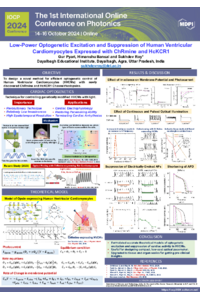
Low-power, high-fidelity optical excitation and the effective suppression of uncoordinated heartbeats are major challenges in cardiac optogenetics. Recently, a red-shifted, cation-conducting channelrhodopsin known as ChRmine, derived from the Rhodomonas lens (also attributed to the marine ciliate Tiarina fusus), has been discovered. ChRmine exhibits high light sensitivity and generates a large photocurrent for optical excitation. In addition, a potassium (K+)-conducting channelrhodopsin from Hyphochytrium catenoids (HcKCR1) has also been discovered. HcKCR1 exhibits a reversal potential close to the resting membrane potential of the targeted cardiac cells, making it suitable for optical suppression. In this paper, we present a theoretical model and a detailed analysis of optogenetic excitation and the suppression of cardiac activity using ChRmine and HcKCR1 in human ventricular cardiomyocytes (HVCMs). The present study shows that in ChRmine-expressing HVCMs, action potential (AP) can be triggered at 6 μW/mm2 on illuminatation with 10 ms light pulse, which enables deeper excitation up to ~ 8 mm from the pericardial surface at safe light irradiances. High-fidelity optical pacing with ChRmine-expressing HVCMs is achievable up to 2.5 Hz at 0.7 ms light pulse and 0.58 mW/mm2, which is an order of magnitude lower than the previously used opsins. HcKCR1 effectively suppresses action potentials by shunting the cell membrane potential to the resting state at a light irradiance of 1 mW/mm2. Furthermore, HcKCR1 enables precise shortening of the AP duration at a very low irradiance of 1 µW/mm2 on illuminating the cell during the repolarization phase. The present study highlights the advantages of the newly discovered ChRmine and HcKCR1 opsins for low-intensity optogenetic pacing and complete suppression of uncoordinated heartbeats. The results are useful for designing energy-efficient, light-induced cardiac pacemakers and for the effective treatment of cardioversion and tachycardia, as well as for extending the scale of cardiac optogenetics.
Keywords
Cardiac optogenetics
ChRmine
HcKCR1
Optical pacing
Tachycardia
Suppression
Poster
095930- Poster.pdf
LCSr-SeNet: A Super-resolution and segmentation network for lung cytopathological images
How to recognize the formation of lipid rafts in membranes: FTIR spectroscopy data