Event submissions
Published
This submission belongs to the session S1. Biophotonics and Biomedical Optics of the event The 1st International Online Conference on Photonics
Published date
14 Oct, 2024
Academic Editor
'%3e%3cpath%20d='M12.6657%2010.9104C12.4185%2010.325%2012.0599%209.79327%2011.6097%209.34482C11.1609%208.89508%2010.6293%208.5365%2010.0442%208.28888C10.0389%208.28626%2010.0337%208.28495%2010.0285%208.28233C10.8446%207.69279%2011.3752%206.73249%2011.3752%205.64904C11.3752%203.8542%209.92103%202.39999%208.1262%202.39999C6.33136%202.39999%204.87715%203.8542%204.87715%205.64904C4.87715%206.73249%205.40774%207.69279%206.22393%208.28364C6.21869%208.28626%206.21345%208.28757%206.20821%208.29019C5.62129%208.5378%205.09463%208.89284%204.64265%209.34613C4.1929%209.79493%203.83432%2010.3266%203.58671%2010.9117C3.34345%2011.4845%203.21226%2012.0987%203.20023%2012.7209C3.19988%2012.7349%203.20233%2012.7488%203.20744%2012.7619C3.21255%2012.7749%203.22022%2012.7867%203.22998%2012.7968C3.23975%2012.8068%203.25142%2012.8147%203.26431%2012.8202C3.2772%2012.8256%203.29105%2012.8284%203.30504%2012.8284H4.09109C4.14874%2012.8284%204.19459%2012.7825%204.1959%2012.7262C4.2221%2011.7148%204.62823%2010.7676%205.34617%2010.0497C6.08899%209.30683%207.0755%208.89808%208.1262%208.89808C9.17689%208.89808%2010.1634%209.30683%2010.9062%2010.0497C11.6242%2010.7676%2012.0303%2011.7148%2012.0565%2012.7262C12.0578%2012.7838%2012.1037%2012.8284%2012.1613%2012.8284H12.9474C12.9613%2012.8284%2012.9752%2012.8256%2012.9881%2012.8202C13.001%2012.8147%2013.0126%2012.8068%2013.0224%2012.7968C13.0322%2012.7867%2013.0398%2012.7749%2013.0449%2012.7619C13.0501%2012.7488%2013.0525%2012.7349%2013.0522%2012.7209C13.0391%2012.0947%2012.9094%2011.4855%2012.6657%2010.9104ZM8.1262%207.9024C7.52486%207.9024%206.9589%207.6679%206.53312%207.24211C6.10733%206.81633%205.87283%206.25037%205.87283%205.64904C5.87283%205.0477%206.10733%204.48174%206.53312%204.05596C6.9589%203.63018%207.52486%203.39567%208.1262%203.39567C8.72753%203.39567%209.29349%203.63018%209.71927%204.05596C10.1451%204.48174%2010.3796%205.0477%2010.3796%205.64904C10.3796%206.25037%2010.1451%206.81633%209.71927%207.24211C9.29349%207.6679%208.72753%207.9024%208.1262%207.9024Z'%20fill='%235D1EE1'/%3e%3c/g%3e%3c/svg%3e) Ambra Giannetti
Ambra GiannettiCitation
Ben Sicks, Florian Maiss, Christian Lingenfelder, Cornelia Wiegand, Martin Hessling, Comparison of different Far-UVC sources with regards to intensity stability, estimated antimicrobial efficiency and potential human hazard in comparison to a conventional UVC lamp, in Proceedings of The 1st International Online Conference on Photonics, 14 October–16 October 2024, MDPI: Basel, Switzerland
Share
Email
Facebook
Twitter
LinkedIn
Comparison of different Far-UVC sources with regards to intensity stability, estimated antimicrobial efficiency and potential human hazard in comparison to a conventional UVC lamp
'%3e%3cpath%20d='M12.6647%2010.9104C12.4176%2010.325%2012.0589%209.7933%2011.6088%209.34485C11.16%208.89511%2010.6283%208.53653%2010.0432%208.28891C10.038%208.28629%2010.0327%208.28498%2010.0275%208.28236C10.8437%207.69282%2011.3743%206.73252%2011.3743%205.64907C11.3743%203.85423%209.92005%202.40002%208.12522%202.40002C6.33038%202.40002%204.87618%203.85423%204.87618%205.64907C4.87618%206.73252%205.40677%207.69282%206.22296%208.28367C6.21772%208.28629%206.21248%208.2876%206.20724%208.29022C5.62031%208.53783%205.09365%208.89287%204.64167%209.34616C4.19192%209.79496%203.83334%2010.3266%203.58573%2010.9117C3.34247%2011.4846%203.21128%2012.0987%203.19925%2012.721C3.1989%2012.735%203.20135%2012.7489%203.20646%2012.7619C3.21157%2012.7749%203.21924%2012.7868%203.22901%2012.7968C3.23877%2012.8068%203.25045%2012.8148%203.26334%2012.8202C3.27623%2012.8256%203.29007%2012.8284%203.30406%2012.8284H4.09012C4.14776%2012.8284%204.19362%2012.7825%204.19493%2012.7262C4.22113%2011.7148%204.62726%2010.7676%205.34519%2010.0497C6.08802%209.30686%207.07452%208.89811%208.12522%208.89811C9.17592%208.89811%2010.1624%209.30686%2010.9052%2010.0497C11.6232%2010.7676%2012.0293%2011.7148%2012.0555%2012.7262C12.0568%2012.7839%2012.1027%2012.8284%2012.1603%2012.8284H12.9464C12.9604%2012.8284%2012.9742%2012.8256%2012.9871%2012.8202C13%2012.8148%2013.0117%2012.8068%2013.0214%2012.7968C13.0312%2012.7868%2013.0389%2012.7749%2013.044%2012.7619C13.0491%2012.7489%2013.0515%2012.735%2013.0512%2012.721C13.0381%2012.0947%2012.9084%2011.4856%2012.6647%2010.9104ZM8.12522%207.90243C7.52388%207.90243%206.95792%207.66793%206.53214%207.24215C6.10636%206.81636%205.87185%206.2504%205.87185%205.64907C5.87185%205.04773%206.10636%204.48177%206.53214%204.05599C6.95792%203.63021%207.52388%203.3957%208.12522%203.3957C8.72655%203.3957%209.29252%203.63021%209.7183%204.05599C10.1441%204.48177%2010.3786%205.04773%2010.3786%205.64907C10.3786%206.2504%2010.1441%206.81636%209.7183%207.24215C9.29252%207.66793%208.72655%207.90243%208.12522%207.90243Z'%20fill='%235D1EE1'/%3e%3c/g%3e%3c/svg%3e)
Ben Sicks 1
Florian Maiss 1
Christian Lingenfelder 2
Cornelia Wiegand 3
Martin Hessling 1
1. Technische Hochschule Ulm (University of Applied Science), Albert-Einstein-Allee 55, 89081 Ulm (Germany)
2. Zimmer MedizinSysteme GmbH, Junkersstraße 9, 89231 Neu-Ulm (Germany)
3. University Hospital Jena, Am Klinikum 1, 07747 Jena (Germany)
Abstract
The recently much-noticed Far-UVC spectral range offers the possibility of inactivating pathogens without necessarily posing a major danger to humans. Unfortunately, there are various Far-UVC sources that differ significantly in their longer wavelength UVC emission and, subsequently, in their risk potential. Therefore, a simple assessment method for Far-UVC sources is presented here. In addition, the temporal intensity stability of Far-UVC sources was examined in order to reduce possible errors in irradiation measurements. For this purpose, four far-UVC sources and a conventional Hg lamp were each spectrally measured over 60 h and mathematically evaluated for their antimicrobial effect and hazard potential using available standard data. Only two filtered KrCl lamps were found to emit at stable intensity after a warm-up time of 10 min. With regard to the antimicrobial effect, the radiation efficiencies of all examined (Far-) UVC sources were more or less similar. However, the calculated differences in the potential human hazard to eyes and skin were more than one order of magnitude. The two filtered KrCl lamps were the safest, followed by an unfiltered KrCl lamp, a Far-UVC LED and, finally, the Hg lamp. When experimenting with these Far-UVC radiation sources, the irradiance should be checked more than once. If UVC radiation is to be or could be applied in the presence of humans, filtered KrCl lamps are a much better choice than any other available Far-UVC sources.
Keywords
Far-UVC
UVC
long-term stability
risk assessment
threshold limit values
antimicrobial impact
Poster
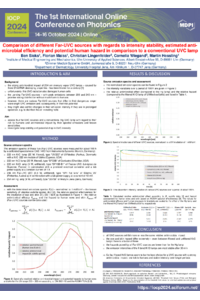
Comparison of different Far-UVC sources with regards to in-tensity stability, estimated antimicrobial efficiency and poten-tial human hazard in comparison to a conventional UVC lamp V2.pdf
How to recognize the formation of lipid rafts in membranes: FTIR spectroscopy data
Prototype of a Public Computer System with Fast Automatic Touchscreen Disinfection by Integrated UVC LEDs and Total Reflection