Event submissions
Published
This submission belongs to the session S1. Biophotonics and Biomedical Optics of the event The 1st International Online Conference on Photonics
Published date
14 Oct, 2024
Academic Editor
'%3e%3cpath%20d='M12.6657%2010.9104C12.4185%2010.325%2012.0599%209.79327%2011.6097%209.34482C11.1609%208.89508%2010.6293%208.5365%2010.0442%208.28888C10.0389%208.28626%2010.0337%208.28495%2010.0285%208.28233C10.8446%207.69279%2011.3752%206.73249%2011.3752%205.64904C11.3752%203.8542%209.92103%202.39999%208.1262%202.39999C6.33136%202.39999%204.87715%203.8542%204.87715%205.64904C4.87715%206.73249%205.40774%207.69279%206.22393%208.28364C6.21869%208.28626%206.21345%208.28757%206.20821%208.29019C5.62129%208.5378%205.09463%208.89284%204.64265%209.34613C4.1929%209.79493%203.83432%2010.3266%203.58671%2010.9117C3.34345%2011.4845%203.21226%2012.0987%203.20023%2012.7209C3.19988%2012.7349%203.20233%2012.7488%203.20744%2012.7619C3.21255%2012.7749%203.22022%2012.7867%203.22998%2012.7968C3.23975%2012.8068%203.25142%2012.8147%203.26431%2012.8202C3.2772%2012.8256%203.29105%2012.8284%203.30504%2012.8284H4.09109C4.14874%2012.8284%204.19459%2012.7825%204.1959%2012.7262C4.2221%2011.7148%204.62823%2010.7676%205.34617%2010.0497C6.08899%209.30683%207.0755%208.89808%208.1262%208.89808C9.17689%208.89808%2010.1634%209.30683%2010.9062%2010.0497C11.6242%2010.7676%2012.0303%2011.7148%2012.0565%2012.7262C12.0578%2012.7838%2012.1037%2012.8284%2012.1613%2012.8284H12.9474C12.9613%2012.8284%2012.9752%2012.8256%2012.9881%2012.8202C13.001%2012.8147%2013.0126%2012.8068%2013.0224%2012.7968C13.0322%2012.7867%2013.0398%2012.7749%2013.0449%2012.7619C13.0501%2012.7488%2013.0525%2012.7349%2013.0522%2012.7209C13.0391%2012.0947%2012.9094%2011.4855%2012.6657%2010.9104ZM8.1262%207.9024C7.52486%207.9024%206.9589%207.6679%206.53312%207.24211C6.10733%206.81633%205.87283%206.25037%205.87283%205.64904C5.87283%205.0477%206.10733%204.48174%206.53312%204.05596C6.9589%203.63018%207.52486%203.39567%208.1262%203.39567C8.72753%203.39567%209.29349%203.63018%209.71927%204.05596C10.1451%204.48174%2010.3796%205.0477%2010.3796%205.64904C10.3796%206.25037%2010.1451%206.81633%209.71927%207.24211C9.29349%207.6679%208.72753%207.9024%208.1262%207.9024Z'%20fill='%235D1EE1'/%3e%3c/g%3e%3c/svg%3e) Maurizio Ferrari
Maurizio FerrariCitation
Sebastian Johannes Deuschl, Ben Sicks, Helge Moritz, Martin Hessling, Prototype of a Public Computer System with Fast Automatic Touchscreen Disinfection by Integrated UVC LEDs and Total Reflection, in Proceedings of The 1st International Online Conference on Photonics, 14 October–16 October 2024, MDPI: Basel, Switzerland
Share
Email
Facebook
Twitter
LinkedIn
Prototype of a Public Computer System with Fast Automatic Touchscreen Disinfection by Integrated UVC LEDs and Total Reflection
'%3e%3cpath%20d='M12.6647%2010.9104C12.4176%2010.325%2012.0589%209.7933%2011.6088%209.34485C11.16%208.89511%2010.6283%208.53653%2010.0432%208.28891C10.038%208.28629%2010.0327%208.28498%2010.0275%208.28236C10.8437%207.69282%2011.3743%206.73252%2011.3743%205.64907C11.3743%203.85423%209.92005%202.40002%208.12522%202.40002C6.33038%202.40002%204.87618%203.85423%204.87618%205.64907C4.87618%206.73252%205.40677%207.69282%206.22296%208.28367C6.21772%208.28629%206.21248%208.2876%206.20724%208.29022C5.62031%208.53783%205.09365%208.89287%204.64167%209.34616C4.19192%209.79496%203.83334%2010.3266%203.58573%2010.9117C3.34247%2011.4846%203.21128%2012.0987%203.19925%2012.721C3.1989%2012.735%203.20135%2012.7489%203.20646%2012.7619C3.21157%2012.7749%203.21924%2012.7868%203.22901%2012.7968C3.23877%2012.8068%203.25045%2012.8148%203.26334%2012.8202C3.27623%2012.8256%203.29007%2012.8284%203.30406%2012.8284H4.09012C4.14776%2012.8284%204.19362%2012.7825%204.19493%2012.7262C4.22113%2011.7148%204.62726%2010.7676%205.34519%2010.0497C6.08802%209.30686%207.07452%208.89811%208.12522%208.89811C9.17592%208.89811%2010.1624%209.30686%2010.9052%2010.0497C11.6232%2010.7676%2012.0293%2011.7148%2012.0555%2012.7262C12.0568%2012.7839%2012.1027%2012.8284%2012.1603%2012.8284H12.9464C12.9604%2012.8284%2012.9742%2012.8256%2012.9871%2012.8202C13%2012.8148%2013.0117%2012.8068%2013.0214%2012.7968C13.0312%2012.7868%2013.0389%2012.7749%2013.044%2012.7619C13.0491%2012.7489%2013.0515%2012.735%2013.0512%2012.721C13.0381%2012.0947%2012.9084%2011.4856%2012.6647%2010.9104ZM8.12522%207.90243C7.52388%207.90243%206.95792%207.66793%206.53214%207.24215C6.10636%206.81636%205.87185%206.2504%205.87185%205.64907C5.87185%205.04773%206.10636%204.48177%206.53214%204.05599C6.95792%203.63021%207.52388%203.3957%208.12522%203.3957C8.72655%203.3957%209.29252%203.63021%209.7183%204.05599C10.1441%204.48177%2010.3786%205.04773%2010.3786%205.64907C10.3786%206.2504%2010.1441%206.81636%209.7183%207.24215C9.29252%207.66793%208.72655%207.90243%208.12522%207.90243Z'%20fill='%235D1EE1'/%3e%3c/g%3e%3c/svg%3e)
Sebastian Johannes Deuschl 1
Ben Sicks 1
Helge Moritz 2
Martin Hessling 1
1. Technische Hochschule Ulm (University of Applied Science), Albert-Einstein-Allee 55, 89081 Ulm (Germany)
2. Büchner Lichtsysteme GmbH, Uzstraße 2, 86465 Welden (Germany)
Abstract
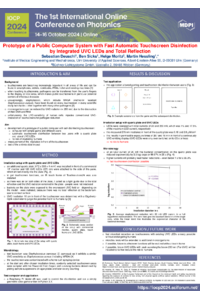
Public touchscreens, such as those used in ATMs or ticket payment systems, which are accessed by different people in a short period of time, could transmit pathogens and thus spread infections. Therefore, the aim of this study was to develop and test a prototype of a touchscreen system for the public sector that disinfects itself quickly and automatically between two users without harming any humans.
A quartz pane was installed in front of a commercial 19” monitor, into which 120 UVC LEDs emitted laterally. The quartz plate acted as a light guide and irradiated microorganisms on its surface, but—due to total reflection—not the user in front of the screen. A near-infrared touch frame was installed to recognize touch. The antibacterial effect was tested through intentional staphylococci contamination.
The prototype, composed of a Raspberry Pi microcomputer with a display, a touchscreen, and a touch frame was developed, as well as a simple game programmed that briefly switched on the UVC LEDs between two users. The antimicrobial effect was so strong that 1% of the maximum UVC LED current was sufficient for a 99.9% staphylococci reduction within 25 s. At 17.5% of the maximum current, no bacteria were observed after 5 s. The residual UVC irradiance at a distance of 100 mm in front of the screen was only 0.18 and 2.8 µW/cm2 for both currents, respectively. This would allow users to stay in front of the system for 287 or 18 minutes, even if the LEDs would emit UVC continuously, and not be turned off after a few seconds as in the presented device.
Therefore, fast, automatic touchscreen disinfection with UVC LEDs is already possible today and with higher currents, disinfection durations below 1 s seems to be feasible, while the light guide approach virtually prevents the direct irradiation of the human user.
Keywords
touchscreen
UVC LED
radiation disinfection
staphylococci
user protection
Raspberry Pi
game
Poster
Poster V4.pdf
Comparison of different Far-UVC sources with regards to intensity stability, estimated antimicrobial efficiency and potential human hazard in comparison to a conventional UVC lamp
Investigation of the optical contrast between nanofiber mats and mammalian cells dyed with fluorescent and other dyes