Event submissions
Published
This submission belongs to the session S8. New Applications Enabled by Photonics Technologies and Systems of the event The 1st International Online Conference on Photonics
Published date
14 Oct, 2024
Academic Editor
'%3e%3cpath%20d='M12.6657%2010.9104C12.4185%2010.325%2012.0599%209.79327%2011.6097%209.34482C11.1609%208.89508%2010.6293%208.5365%2010.0442%208.28888C10.0389%208.28626%2010.0337%208.28495%2010.0285%208.28233C10.8446%207.69279%2011.3752%206.73249%2011.3752%205.64904C11.3752%203.8542%209.92103%202.39999%208.1262%202.39999C6.33136%202.39999%204.87715%203.8542%204.87715%205.64904C4.87715%206.73249%205.40774%207.69279%206.22393%208.28364C6.21869%208.28626%206.21345%208.28757%206.20821%208.29019C5.62129%208.5378%205.09463%208.89284%204.64265%209.34613C4.1929%209.79493%203.83432%2010.3266%203.58671%2010.9117C3.34345%2011.4845%203.21226%2012.0987%203.20023%2012.7209C3.19988%2012.7349%203.20233%2012.7488%203.20744%2012.7619C3.21255%2012.7749%203.22022%2012.7867%203.22998%2012.7968C3.23975%2012.8068%203.25142%2012.8147%203.26431%2012.8202C3.2772%2012.8256%203.29105%2012.8284%203.30504%2012.8284H4.09109C4.14874%2012.8284%204.19459%2012.7825%204.1959%2012.7262C4.2221%2011.7148%204.62823%2010.7676%205.34617%2010.0497C6.08899%209.30683%207.0755%208.89808%208.1262%208.89808C9.17689%208.89808%2010.1634%209.30683%2010.9062%2010.0497C11.6242%2010.7676%2012.0303%2011.7148%2012.0565%2012.7262C12.0578%2012.7838%2012.1037%2012.8284%2012.1613%2012.8284H12.9474C12.9613%2012.8284%2012.9752%2012.8256%2012.9881%2012.8202C13.001%2012.8147%2013.0126%2012.8068%2013.0224%2012.7968C13.0322%2012.7867%2013.0398%2012.7749%2013.0449%2012.7619C13.0501%2012.7488%2013.0525%2012.7349%2013.0522%2012.7209C13.0391%2012.0947%2012.9094%2011.4855%2012.6657%2010.9104ZM8.1262%207.9024C7.52486%207.9024%206.9589%207.6679%206.53312%207.24211C6.10733%206.81633%205.87283%206.25037%205.87283%205.64904C5.87283%205.0477%206.10733%204.48174%206.53312%204.05596C6.9589%203.63018%207.52486%203.39567%208.1262%203.39567C8.72753%203.39567%209.29349%203.63018%209.71927%204.05596C10.1451%204.48174%2010.3796%205.0477%2010.3796%205.64904C10.3796%206.25037%2010.1451%206.81633%209.71927%207.24211C9.29349%207.6679%208.72753%207.9024%208.1262%207.9024Z'%20fill='%235D1EE1'/%3e%3c/g%3e%3c/svg%3e) Satyendra Kumar Mishra
Satyendra Kumar MishraCitation
Li ZongLin, Guancheng Huang, Zhengjun Liu, Single-pixel imaging techniques, in Proceedings of The 1st International Online Conference on Photonics, 14 October–16 October 2024, MDPI: Basel, Switzerland
Share
Email
Facebook
Twitter
LinkedIn
Single-pixel imaging techniques
'%3e%3cpath%20d='M12.6647%2010.9104C12.4176%2010.325%2012.0589%209.7933%2011.6088%209.34485C11.16%208.89511%2010.6283%208.53653%2010.0432%208.28891C10.038%208.28629%2010.0327%208.28498%2010.0275%208.28236C10.8437%207.69282%2011.3743%206.73252%2011.3743%205.64907C11.3743%203.85423%209.92005%202.40002%208.12522%202.40002C6.33038%202.40002%204.87618%203.85423%204.87618%205.64907C4.87618%206.73252%205.40677%207.69282%206.22296%208.28367C6.21772%208.28629%206.21248%208.2876%206.20724%208.29022C5.62031%208.53783%205.09365%208.89287%204.64167%209.34616C4.19192%209.79496%203.83334%2010.3266%203.58573%2010.9117C3.34247%2011.4846%203.21128%2012.0987%203.19925%2012.721C3.1989%2012.735%203.20135%2012.7489%203.20646%2012.7619C3.21157%2012.7749%203.21924%2012.7868%203.22901%2012.7968C3.23877%2012.8068%203.25045%2012.8148%203.26334%2012.8202C3.27623%2012.8256%203.29007%2012.8284%203.30406%2012.8284H4.09012C4.14776%2012.8284%204.19362%2012.7825%204.19493%2012.7262C4.22113%2011.7148%204.62726%2010.7676%205.34519%2010.0497C6.08802%209.30686%207.07452%208.89811%208.12522%208.89811C9.17592%208.89811%2010.1624%209.30686%2010.9052%2010.0497C11.6232%2010.7676%2012.0293%2011.7148%2012.0555%2012.7262C12.0568%2012.7839%2012.1027%2012.8284%2012.1603%2012.8284H12.9464C12.9604%2012.8284%2012.9742%2012.8256%2012.9871%2012.8202C13%2012.8148%2013.0117%2012.8068%2013.0214%2012.7968C13.0312%2012.7868%2013.0389%2012.7749%2013.044%2012.7619C13.0491%2012.7489%2013.0515%2012.735%2013.0512%2012.721C13.0381%2012.0947%2012.9084%2011.4856%2012.6647%2010.9104ZM8.12522%207.90243C7.52388%207.90243%206.95792%207.66793%206.53214%207.24215C6.10636%206.81636%205.87185%206.2504%205.87185%205.64907C5.87185%205.04773%206.10636%204.48177%206.53214%204.05599C6.95792%203.63021%207.52388%203.3957%208.12522%203.3957C8.72655%203.3957%209.29252%203.63021%209.7183%204.05599C10.1441%204.48177%2010.3786%205.04773%2010.3786%205.64907C10.3786%206.2504%2010.1441%206.81636%209.7183%207.24215C9.29252%207.66793%208.72655%207.90243%208.12522%207.90243Z'%20fill='%235D1EE1'/%3e%3c/g%3e%3c/svg%3e)
Li ZongLin 1
Guancheng Huang 1

Zhengjun Liu 1
1. School of Physics, Harbin Institute of Technology, Harbin 150001, China
Abstract
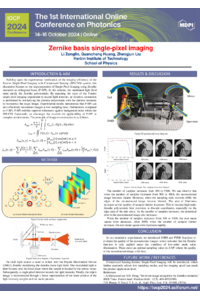
In the Fourier Single-Pixel Imaging (F-SPI) framework, Fourier basis patterns serve as orthogonal bases. An LED light source is reflected onto a Digital Micromirror Device (DMD) to modulate the light field, which is subsequently focused onto the sample's focal plane using an optical setup. A single-pixel detector captures the light intensity, and the object image is reconstructed via the four-step phase shift algorithm. An L-norm-based compressed reconstruction algorithm is introduced to achieve high-quality F-SPI at reduced spectrum sampling rates. Both simulation and experimental results indicate that the NESTA algorithm outperforms the D-AMP algorithm in terms of imaging efficiency, while ensuring superior imaging quality. The NESTA algorithm is adopted as the compressed sensing framework (CSF). These findings suggest that the proposed method can significantly enhance the sparse sensing module of F-SPI, facilitating rapid and high-quality image reconstruction. The Fourier regularization reconstruction mode and sub-pixel shift artifact removal algorithm are introduced to further reduce the imaging time consumption and suppress the imaging noise artifacts to a certain extent. Building upon the experimental validation of imaging efficiency in the Fourier Single-Pixel Imaging Compressed Sensing System (SPI-CSS), we discuss the Pixel Single-Pixel Imaging (P-SPI) scheme, which utilizes Zernike polynomials as orthogonal bases. In this approach, the modulated light field conforms to the Zernike polynomial patterns. The imaging process involves repeating the steps of Fourier Single-Pixel Imaging to record light intensity, followed by iteratively summing the product of Zernike polynomials and Zernike moments to reconstruct the target image. Experimental results demonstrate that P-SPI can effectively reconstruct images even at low sampling rates. Furthermore, compared to F-SPI, P-SPI exhibits a superior robustness to background noise within the SPI-CSS framework. This advantage extends the applicability of P-SPI to more complex environments, highlighting its potential for broader use in challenging imaging scenarios.
Keywords
Fourier Single-Pixel Imaging
compressed reconstruction algorithm
Fourier regularization reconstruction
Zernike polynomial
Poster
sciforum-095817-Poster.pdf
Photoacoustic Microscopy, Optical Coherence Tomography, and Fluorescence Imaging-Guided Stem Cell Retinal Therapy
Single-shot quantitative phase imaging using polarization-multiplexed LED illumination via space-domain Kramers–Kronig relations