Event submissions
Published
This submission belongs to the session S4. Lasers, Light Sources and Sensors of the event The 1st International Online Conference on Photonics
Published date
14 Oct, 2024
Academic Editor
'%3e%3cpath%20d='M12.6657%2010.9104C12.4185%2010.325%2012.0599%209.79327%2011.6097%209.34482C11.1609%208.89508%2010.6293%208.5365%2010.0442%208.28888C10.0389%208.28626%2010.0337%208.28495%2010.0285%208.28233C10.8446%207.69279%2011.3752%206.73249%2011.3752%205.64904C11.3752%203.8542%209.92103%202.39999%208.1262%202.39999C6.33136%202.39999%204.87715%203.8542%204.87715%205.64904C4.87715%206.73249%205.40774%207.69279%206.22393%208.28364C6.21869%208.28626%206.21345%208.28757%206.20821%208.29019C5.62129%208.5378%205.09463%208.89284%204.64265%209.34613C4.1929%209.79493%203.83432%2010.3266%203.58671%2010.9117C3.34345%2011.4845%203.21226%2012.0987%203.20023%2012.7209C3.19988%2012.7349%203.20233%2012.7488%203.20744%2012.7619C3.21255%2012.7749%203.22022%2012.7867%203.22998%2012.7968C3.23975%2012.8068%203.25142%2012.8147%203.26431%2012.8202C3.2772%2012.8256%203.29105%2012.8284%203.30504%2012.8284H4.09109C4.14874%2012.8284%204.19459%2012.7825%204.1959%2012.7262C4.2221%2011.7148%204.62823%2010.7676%205.34617%2010.0497C6.08899%209.30683%207.0755%208.89808%208.1262%208.89808C9.17689%208.89808%2010.1634%209.30683%2010.9062%2010.0497C11.6242%2010.7676%2012.0303%2011.7148%2012.0565%2012.7262C12.0578%2012.7838%2012.1037%2012.8284%2012.1613%2012.8284H12.9474C12.9613%2012.8284%2012.9752%2012.8256%2012.9881%2012.8202C13.001%2012.8147%2013.0126%2012.8068%2013.0224%2012.7968C13.0322%2012.7867%2013.0398%2012.7749%2013.0449%2012.7619C13.0501%2012.7488%2013.0525%2012.7349%2013.0522%2012.7209C13.0391%2012.0947%2012.9094%2011.4855%2012.6657%2010.9104ZM8.1262%207.9024C7.52486%207.9024%206.9589%207.6679%206.53312%207.24211C6.10733%206.81633%205.87283%206.25037%205.87283%205.64904C5.87283%205.0477%206.10733%204.48174%206.53312%204.05596C6.9589%203.63018%207.52486%203.39567%208.1262%203.39567C8.72753%203.39567%209.29349%203.63018%209.71927%204.05596C10.1451%204.48174%2010.3796%205.0477%2010.3796%205.64904C10.3796%206.25037%2010.1451%206.81633%209.71927%207.24211C9.29349%207.6679%208.72753%207.9024%208.1262%207.9024Z'%20fill='%235D1EE1'/%3e%3c/g%3e%3c/svg%3e) Flavio Esposito
Flavio EspositoCitation
Amit Halder, Md. Riyad Tanshen, Ultra-Sensitive Photonic-Crystal-Fibre-Based Refractive Index Sensor for Efficient Alcohol Detection at Near-Infrared Region, in Proceedings of The 1st International Online Conference on Photonics, 14 October–16 October 2024, MDPI: Basel, Switzerland
Share
Email
Facebook
Twitter
LinkedIn
Ultra-Sensitive Photonic-Crystal-Fibre-Based Refractive Index Sensor for Efficient Alcohol Detection at Near-Infrared Region

Amit Halder 1,2
'%3e%3cpath%20d='M12.6647%2010.9104C12.4176%2010.325%2012.0589%209.7933%2011.6088%209.34485C11.16%208.89511%2010.6283%208.53653%2010.0432%208.28891C10.038%208.28629%2010.0327%208.28498%2010.0275%208.28236C10.8437%207.69282%2011.3743%206.73252%2011.3743%205.64907C11.3743%203.85423%209.92005%202.40002%208.12522%202.40002C6.33038%202.40002%204.87618%203.85423%204.87618%205.64907C4.87618%206.73252%205.40677%207.69282%206.22296%208.28367C6.21772%208.28629%206.21248%208.2876%206.20724%208.29022C5.62031%208.53783%205.09365%208.89287%204.64167%209.34616C4.19192%209.79496%203.83334%2010.3266%203.58573%2010.9117C3.34247%2011.4846%203.21128%2012.0987%203.19925%2012.721C3.1989%2012.735%203.20135%2012.7489%203.20646%2012.7619C3.21157%2012.7749%203.21924%2012.7868%203.22901%2012.7968C3.23877%2012.8068%203.25045%2012.8148%203.26334%2012.8202C3.27623%2012.8256%203.29007%2012.8284%203.30406%2012.8284H4.09012C4.14776%2012.8284%204.19362%2012.7825%204.19493%2012.7262C4.22113%2011.7148%204.62726%2010.7676%205.34519%2010.0497C6.08802%209.30686%207.07452%208.89811%208.12522%208.89811C9.17592%208.89811%2010.1624%209.30686%2010.9052%2010.0497C11.6232%2010.7676%2012.0293%2011.7148%2012.0555%2012.7262C12.0568%2012.7839%2012.1027%2012.8284%2012.1603%2012.8284H12.9464C12.9604%2012.8284%2012.9742%2012.8256%2012.9871%2012.8202C13%2012.8148%2013.0117%2012.8068%2013.0214%2012.7968C13.0312%2012.7868%2013.0389%2012.7749%2013.044%2012.7619C13.0491%2012.7489%2013.0515%2012.735%2013.0512%2012.721C13.0381%2012.0947%2012.9084%2011.4856%2012.6647%2010.9104ZM8.12522%207.90243C7.52388%207.90243%206.95792%207.66793%206.53214%207.24215C6.10636%206.81636%205.87185%206.2504%205.87185%205.64907C5.87185%205.04773%206.10636%204.48177%206.53214%204.05599C6.95792%203.63021%207.52388%203.3957%208.12522%203.3957C8.72655%203.3957%209.29252%203.63021%209.7183%204.05599C10.1441%204.48177%2010.3786%205.04773%2010.3786%205.64907C10.3786%206.2504%2010.1441%206.81636%209.7183%207.24215C9.29252%207.66793%208.72655%207.90243%208.12522%207.90243Z'%20fill='%235D1EE1'/%3e%3c/g%3e%3c/svg%3e)
Md. Riyad Tanshen 2
1. Rajshahi University of Engineering and Technology, Rajshahi-6204
2. World University of Bangladesh, Dhaka-1230
Abstract
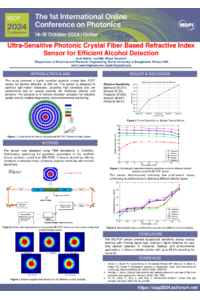
This paper describes the development and evaluation of an ultra-sensitive modified circular photonic crystal fibre (MC-PCF) sensor for efficient alcohol detection. Operating at 850 nm, the sensor has exceptional relative sensitivity and low confinement losses, making it suitable for a wide range of practical applications. The MC-PCF sensor was developed using Comsol Multiphysics and a finite element method to improve light--matter interaction by increasing sensitivity and precision. Performance metrics such as relative sensitivity, confinement loss, and nonlinear coefficients were assessed for various alcohols (methanol, ethanol, propanol, butanol, and pentanol). The sensor has impressive relative sensitivity values: 95.51% for methanol, 97.2% for ethanol, 97.85% for propanol, 98.69% for butanol, and 99.4% for pentanol. The confinement losses are 2.345×10⁻⁹, 1.022×10⁻⁹, 8.656×10⁻¹⁰, 1.821×10⁻⁹, and 3.097×10⁻⁹ dB/m, respectively. Methanol, ethanol, propanol, butanol, and pentanol have nonlinear coefficients of 78.95, 75, 73.69, 73.03, and 72.54 W⁻¹km⁻¹, respectively. The numerical apertures for the MC-PCF sensor at an 850 nm operating wavelength are 0.2599 for methanol, 0.2566 for ethanol, and 0.2567 for propanol, butanol, and pentanol. The optimized design of the MC-PCF sensor significantly improves light--matter interaction, resulting in high precision and rapid response when detecting changes in alcohol concentration. This makes the proposed sensor a strong and dependable solution for industrial quality control, medical diagnostics, and environmental monitoring. In summary, the MC-PCF sensor's outstanding sensitivity and low confinement loss at the near-infrared region demonstrate its potential for effective alcohol detection across various fields.
Keywords
Photonic Crystal Fiber
Refractive Index Sensor
Alcohol Detection
Near Infrared
Light-Matter Interaction
Poster
102949.pdf
SINGLE-CRYSTAL HYBRID PEROVSKITES AS NEXT-GENERATION OPTOELECTRONIC MATERIALS FOR PHOTODETECTION
LUMINESCENCE MANOMETRY BASED ON Ni2+ IONS EMISSION IN DOPED SPINEL