Event submissions
Published
This submission belongs to the session S4. Lasers, Light Sources and Sensors of the event The 1st International Online Conference on Photonics
Published date
14 Oct, 2024
Academic Editor
'%3e%3cpath%20d='M12.6657%2010.9104C12.4185%2010.325%2012.0599%209.79327%2011.6097%209.34482C11.1609%208.89508%2010.6293%208.5365%2010.0442%208.28888C10.0389%208.28626%2010.0337%208.28495%2010.0285%208.28233C10.8446%207.69279%2011.3752%206.73249%2011.3752%205.64904C11.3752%203.8542%209.92103%202.39999%208.1262%202.39999C6.33136%202.39999%204.87715%203.8542%204.87715%205.64904C4.87715%206.73249%205.40774%207.69279%206.22393%208.28364C6.21869%208.28626%206.21345%208.28757%206.20821%208.29019C5.62129%208.5378%205.09463%208.89284%204.64265%209.34613C4.1929%209.79493%203.83432%2010.3266%203.58671%2010.9117C3.34345%2011.4845%203.21226%2012.0987%203.20023%2012.7209C3.19988%2012.7349%203.20233%2012.7488%203.20744%2012.7619C3.21255%2012.7749%203.22022%2012.7867%203.22998%2012.7968C3.23975%2012.8068%203.25142%2012.8147%203.26431%2012.8202C3.2772%2012.8256%203.29105%2012.8284%203.30504%2012.8284H4.09109C4.14874%2012.8284%204.19459%2012.7825%204.1959%2012.7262C4.2221%2011.7148%204.62823%2010.7676%205.34617%2010.0497C6.08899%209.30683%207.0755%208.89808%208.1262%208.89808C9.17689%208.89808%2010.1634%209.30683%2010.9062%2010.0497C11.6242%2010.7676%2012.0303%2011.7148%2012.0565%2012.7262C12.0578%2012.7838%2012.1037%2012.8284%2012.1613%2012.8284H12.9474C12.9613%2012.8284%2012.9752%2012.8256%2012.9881%2012.8202C13.001%2012.8147%2013.0126%2012.8068%2013.0224%2012.7968C13.0322%2012.7867%2013.0398%2012.7749%2013.0449%2012.7619C13.0501%2012.7488%2013.0525%2012.7349%2013.0522%2012.7209C13.0391%2012.0947%2012.9094%2011.4855%2012.6657%2010.9104ZM8.1262%207.9024C7.52486%207.9024%206.9589%207.6679%206.53312%207.24211C6.10733%206.81633%205.87283%206.25037%205.87283%205.64904C5.87283%205.0477%206.10733%204.48174%206.53312%204.05596C6.9589%203.63018%207.52486%203.39567%208.1262%203.39567C8.72753%203.39567%209.29349%203.63018%209.71927%204.05596C10.1451%204.48174%2010.3796%205.0477%2010.3796%205.64904C10.3796%206.25037%2010.1451%206.81633%209.71927%207.24211C9.29349%207.6679%208.72753%207.9024%208.1262%207.9024Z'%20fill='%235D1EE1'/%3e%3c/g%3e%3c/svg%3e) Giuseppe Quero
Giuseppe QueroCitation
Gabriela CROITORU, Florin JIPA, Madalin GRECULEASA, Alin BROASCA, Flavius Marian VOICU, Lucian Marian GHEORGHE, Nicolaie PAVEL, Laser emissions from buried depressed-cladding waveguides inscribed in Nd³⁺:CLNGG laser crystals by picosecond-laser beam writing, in Proceedings of The 1st International Online Conference on Photonics, 14 October–16 October 2024, MDPI: Basel, Switzerland
Share
Email
Facebook
Twitter
LinkedIn
Laser emissions from buried depressed-cladding waveguides inscribed in Nd3+:CLNGG laser crystals by picosecond-laser beam writing
'%3e%3cpath%20d='M12.6647%2010.9104C12.4176%2010.325%2012.0589%209.7933%2011.6088%209.34485C11.16%208.89511%2010.6283%208.53653%2010.0432%208.28891C10.038%208.28629%2010.0327%208.28498%2010.0275%208.28236C10.8437%207.69282%2011.3743%206.73252%2011.3743%205.64907C11.3743%203.85423%209.92005%202.40002%208.12522%202.40002C6.33038%202.40002%204.87618%203.85423%204.87618%205.64907C4.87618%206.73252%205.40677%207.69282%206.22296%208.28367C6.21772%208.28629%206.21248%208.2876%206.20724%208.29022C5.62031%208.53783%205.09365%208.89287%204.64167%209.34616C4.19192%209.79496%203.83334%2010.3266%203.58573%2010.9117C3.34247%2011.4846%203.21128%2012.0987%203.19925%2012.721C3.1989%2012.735%203.20135%2012.7489%203.20646%2012.7619C3.21157%2012.7749%203.21924%2012.7868%203.22901%2012.7968C3.23877%2012.8068%203.25045%2012.8148%203.26334%2012.8202C3.27623%2012.8256%203.29007%2012.8284%203.30406%2012.8284H4.09012C4.14776%2012.8284%204.19362%2012.7825%204.19493%2012.7262C4.22113%2011.7148%204.62726%2010.7676%205.34519%2010.0497C6.08802%209.30686%207.07452%208.89811%208.12522%208.89811C9.17592%208.89811%2010.1624%209.30686%2010.9052%2010.0497C11.6232%2010.7676%2012.0293%2011.7148%2012.0555%2012.7262C12.0568%2012.7839%2012.1027%2012.8284%2012.1603%2012.8284H12.9464C12.9604%2012.8284%2012.9742%2012.8256%2012.9871%2012.8202C13%2012.8148%2013.0117%2012.8068%2013.0214%2012.7968C13.0312%2012.7868%2013.0389%2012.7749%2013.044%2012.7619C13.0491%2012.7489%2013.0515%2012.735%2013.0512%2012.721C13.0381%2012.0947%2012.9084%2011.4856%2012.6647%2010.9104ZM8.12522%207.90243C7.52388%207.90243%206.95792%207.66793%206.53214%207.24215C6.10636%206.81636%205.87185%206.2504%205.87185%205.64907C5.87185%205.04773%206.10636%204.48177%206.53214%204.05599C6.95792%203.63021%207.52388%203.3957%208.12522%203.3957C8.72655%203.3957%209.29252%203.63021%209.7183%204.05599C10.1441%204.48177%2010.3786%205.04773%2010.3786%205.64907C10.3786%206.2504%2010.1441%206.81636%209.7183%207.24215C9.29252%207.66793%208.72655%207.90243%208.12522%207.90243Z'%20fill='%235D1EE1'/%3e%3c/g%3e%3c/svg%3e)
Gabriela CROITORU 1

Florin JIPA 2
Madalin GRECULEASA 1
Alin BROASCA 1

Flavius Marian VOICU 1

Lucian Marian GHEORGHE 1
Nicolaie PAVEL 1
1. National Institute for Laser, Plasma and Radiation Physics, Laboratory of Solid-State Quantum Electronics,
Magurele 077125, Ilfov, Romania
2. National Institute for Laser, Plasma and Radiation Physics, Center for Advanced Laser Technology,
Photonic Investigations Laboratory - PhIL, Magurele 077125, Ilfov, Romania
Abstract
Picosecond (ps-) laser systems can be successfully employed in ultrafast micromachining due to some specific characteristics such as extended system stability, reduced costs, increased laser pulse energies, and higher repetition rates. However, there are only a few reports in the literature regarding the fabrication of waveguides in glasses and crystalline materials with laser systems delivering pulses of few ps-pulse duration [1]. In general, such waveguides are realized with femtosecond (fs-) laser sources and by using a line-by-line translation inscription technique along a defined shape [2].
In this work, we are reporting on the fabrication of buried depressed-cladding waveguides in a 0.7-at.% Nd:CLNGG disordered crystal by ps-laser beam writing. The laser emission performances were characterized under the pump at 807 nm with a fiber-coupled diode laser. For a quasi-continuous-wave pumping regime, a waveguide with 100 mm diameter (circular cross-section) delivered laser pulses at 1.06 mm with energy Ep= 0.35 mJ for a pump pulse energy of Epump= 13.3 mJ (corresponding to an overall optical-to-optical efficiency ho= 0.03), with a slope efficiency of hs = 0.04. Such waveguides are good candidates for the realization of integrated laser sources consisting of cladding waveguides pumped by diode lasers and for the generation of ultra-short laser pulses at 1 mm.
Funding: This work was financed by the postdoctoral project PD 63/2022, code PN-III-P1-1.1-PD-2021-0522 and partially supported by the program NUCLEU-LAPLAS VII 30N/2023, Ministry of Research, Innovation and Digitization, Romania. The support of the National Interest Infrastructure facility IOSIN - CETAL at INFLPR is acknowledged.
- Corbari, C.; Champion, A.; Gecevičius, M.; Beresna, M.; Bellouard, Y; Kazansky, P.G. Femtosecond versus picosecond laser machining of nano-gratings and micro-channels in silica glass. Opt. Express 2013, 21, 3946-3958.
- Okhrimchuk, A.; Mezentsev, V.; Shestakov, A.; Bennion, I. Low loss depressed cladding waveguide inscribed in YAG:Nd single crystal by femtosecond laser pulses. Opt. Express 2012, 20, 3832-3843.
Keywords
waveguide lasers
picosecond-laser beam writing
Nd3+:CLNGG disordered crystals
optical pumping
laser emission
Poster
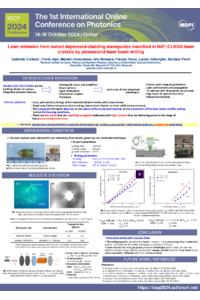
Gabriela CROITORU_IOCP 2024_S6_16.10.'24 poster.pdf
The effect of geometric anisotropy on the heating of gold nanoparticles under a femtosecond pulse
Y-branch splitters inscribed in Nd3+:YAG ceramics by picosecond-laser beam writing