Event submissions
Published
This submission belongs to the session S4. Lasers, Light Sources and Sensors of the event The 1st International Online Conference on Photonics
Published date
14 Oct, 2024
Academic Editor
'%3e%3cpath%20d='M12.6657%2010.9104C12.4185%2010.325%2012.0599%209.79327%2011.6097%209.34482C11.1609%208.89508%2010.6293%208.5365%2010.0442%208.28888C10.0389%208.28626%2010.0337%208.28495%2010.0285%208.28233C10.8446%207.69279%2011.3752%206.73249%2011.3752%205.64904C11.3752%203.8542%209.92103%202.39999%208.1262%202.39999C6.33136%202.39999%204.87715%203.8542%204.87715%205.64904C4.87715%206.73249%205.40774%207.69279%206.22393%208.28364C6.21869%208.28626%206.21345%208.28757%206.20821%208.29019C5.62129%208.5378%205.09463%208.89284%204.64265%209.34613C4.1929%209.79493%203.83432%2010.3266%203.58671%2010.9117C3.34345%2011.4845%203.21226%2012.0987%203.20023%2012.7209C3.19988%2012.7349%203.20233%2012.7488%203.20744%2012.7619C3.21255%2012.7749%203.22022%2012.7867%203.22998%2012.7968C3.23975%2012.8068%203.25142%2012.8147%203.26431%2012.8202C3.2772%2012.8256%203.29105%2012.8284%203.30504%2012.8284H4.09109C4.14874%2012.8284%204.19459%2012.7825%204.1959%2012.7262C4.2221%2011.7148%204.62823%2010.7676%205.34617%2010.0497C6.08899%209.30683%207.0755%208.89808%208.1262%208.89808C9.17689%208.89808%2010.1634%209.30683%2010.9062%2010.0497C11.6242%2010.7676%2012.0303%2011.7148%2012.0565%2012.7262C12.0578%2012.7838%2012.1037%2012.8284%2012.1613%2012.8284H12.9474C12.9613%2012.8284%2012.9752%2012.8256%2012.9881%2012.8202C13.001%2012.8147%2013.0126%2012.8068%2013.0224%2012.7968C13.0322%2012.7867%2013.0398%2012.7749%2013.0449%2012.7619C13.0501%2012.7488%2013.0525%2012.7349%2013.0522%2012.7209C13.0391%2012.0947%2012.9094%2011.4855%2012.6657%2010.9104ZM8.1262%207.9024C7.52486%207.9024%206.9589%207.6679%206.53312%207.24211C6.10733%206.81633%205.87283%206.25037%205.87283%205.64904C5.87283%205.0477%206.10733%204.48174%206.53312%204.05596C6.9589%203.63018%207.52486%203.39567%208.1262%203.39567C8.72753%203.39567%209.29349%203.63018%209.71927%204.05596C10.1451%204.48174%2010.3796%205.0477%2010.3796%205.64904C10.3796%206.25037%2010.1451%206.81633%209.71927%207.24211C9.29349%207.6679%208.72753%207.9024%208.1262%207.9024Z'%20fill='%235D1EE1'/%3e%3c/g%3e%3c/svg%3e) Flavio Esposito
Flavio EspositoCitation
Muhammad Ali Butt, Advancing Sensing Capabilities: Hybrid Integration of Orthogonal Mode Couplers with Plasmonic Waveguides, in Proceedings of The 1st International Online Conference on Photonics, 14 October–16 October 2024, MDPI: Basel, Switzerland
Share
Email
Facebook
Twitter
LinkedIn
Advancing Sensing Capabilities: Hybrid Integration of Orthogonal Mode Couplers with Plasmonic Waveguides

Muhammad Ali Butt 1
1. Institute of Microelectronics and Optoelectronics, Warsaw University of Technology, Koszykowa 75, 00-662, Warsaw, Poland
Abstract
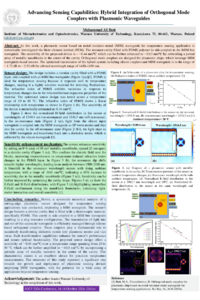
Plasmonic sensors offer ultra-sensitive detection capabilities at the nanoscale, enabling the detection of slight variations in refractive index, molecular binding events, and environmental conditions. Their compact size and compatibility with integrated circuits make them promising candidates for various applications, ranging from biomedical diagnostics to environmental monitoring and beyond. In this study, a comprehensive numerical investigation is conducted using the finite element method (FEM) to analyze a plasmonic sensor employing a metal–insulator–metal (MIM) waveguide for temperature sensing applications. The sensor configuration includes a resonant cavity that is coupled to the MIM bus waveguide and filled with a PDMS polymer. Initially, the device's sensitivity is approximately −0.44 nm/°C. While recognizing the existence of various sensitive plasmonic sensor designs, a gap in understanding the light coupling mechanisms to nanoscale waveguides is identified. To address this, a novel approach is employed: orthogonal mode couplers specifically tailored for plasmonic chips utilizing MIM waveguide-based sensors . Through optimization, the hybrid system, comprising silicon couplers and an MIM waveguide, exhibits optimized transmission ranging from −1.73 dB to −2.93 dB across a broad wavelength spectrum of 1450–1650 nm. The strategic integration of these couplers not only distinguishes the proposed plasmonic sensor but also positions it as a highly promising solution for an extensive range of sensing applications.
Keywords
Metal-insulator-metal waveguide
dielectric waveguide mode couplers
temperature sensor
plasmonic sensor.
Poster
Poster.pdf
Y-branch splitters inscribed in Nd3+:YAG ceramics by picosecond-laser beam writing
Optical and upconversion properties of new phosphates activated by Pr3+