Event submissions
Published
This submission belongs to the session S4. Urban Water, Treatment Technologies, Systems Efficiency and Smart Water Grids of the event The 8th International Electronic Conference on Water Sciences
Published date
14 Oct, 2024
Academic Editor
'%3e%3cpath%20d='M12.6657%2010.9104C12.4185%2010.325%2012.0599%209.79327%2011.6097%209.34482C11.1609%208.89508%2010.6293%208.5365%2010.0442%208.28888C10.0389%208.28626%2010.0337%208.28495%2010.0285%208.28233C10.8446%207.69279%2011.3752%206.73249%2011.3752%205.64904C11.3752%203.8542%209.92103%202.39999%208.1262%202.39999C6.33136%202.39999%204.87715%203.8542%204.87715%205.64904C4.87715%206.73249%205.40774%207.69279%206.22393%208.28364C6.21869%208.28626%206.21345%208.28757%206.20821%208.29019C5.62129%208.5378%205.09463%208.89284%204.64265%209.34613C4.1929%209.79493%203.83432%2010.3266%203.58671%2010.9117C3.34345%2011.4845%203.21226%2012.0987%203.20023%2012.7209C3.19988%2012.7349%203.20233%2012.7488%203.20744%2012.7619C3.21255%2012.7749%203.22022%2012.7867%203.22998%2012.7968C3.23975%2012.8068%203.25142%2012.8147%203.26431%2012.8202C3.2772%2012.8256%203.29105%2012.8284%203.30504%2012.8284H4.09109C4.14874%2012.8284%204.19459%2012.7825%204.1959%2012.7262C4.2221%2011.7148%204.62823%2010.7676%205.34617%2010.0497C6.08899%209.30683%207.0755%208.89808%208.1262%208.89808C9.17689%208.89808%2010.1634%209.30683%2010.9062%2010.0497C11.6242%2010.7676%2012.0303%2011.7148%2012.0565%2012.7262C12.0578%2012.7838%2012.1037%2012.8284%2012.1613%2012.8284H12.9474C12.9613%2012.8284%2012.9752%2012.8256%2012.9881%2012.8202C13.001%2012.8147%2013.0126%2012.8068%2013.0224%2012.7968C13.0322%2012.7867%2013.0398%2012.7749%2013.0449%2012.7619C13.0501%2012.7488%2013.0525%2012.7349%2013.0522%2012.7209C13.0391%2012.0947%2012.9094%2011.4855%2012.6657%2010.9104ZM8.1262%207.9024C7.52486%207.9024%206.9589%207.6679%206.53312%207.24211C6.10733%206.81633%205.87283%206.25037%205.87283%205.64904C5.87283%205.0477%206.10733%204.48174%206.53312%204.05596C6.9589%203.63018%207.52486%203.39567%208.1262%203.39567C8.72753%203.39567%209.29349%203.63018%209.71927%204.05596C10.1451%204.48174%2010.3796%205.0477%2010.3796%205.64904C10.3796%206.25037%2010.1451%206.81633%209.71927%207.24211C9.29349%207.6679%208.72753%207.9024%208.1262%207.9024Z'%20fill='%235D1EE1'/%3e%3c/g%3e%3c/svg%3e) Carmen Teodosiu
Carmen TeodosiuCitation
Sofia Pereira, Cristina Calheiros, Floating Wetland Islands as a water treatment technology, in Proceedings of The 8th International Electronic Conference on Water Sciences, 14 October–16 October 2024, MDPI: Basel, Switzerland
Share
Email
Facebook
Twitter
LinkedIn
Floating Wetland Islands as a water treatment technology

Sofia Pereira 1

Cristina Calheiros 2
1. Universidade Católica Portuguesa
2. Interdisciplinary Centre of Marine and Environmental Research (CIIMAR), University of Porto, Portugal
Abstract
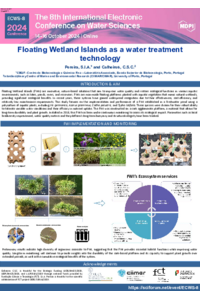
Floating wetland islands (FWIs) are innovative nature-based solutions designed to enhance water quality in various aquatic environments, including lakes, ponds, and reservoirs, while restoring their ecological functions. In recent years, FWIs have gained popularity due to their effectiveness, low cost, and low maintenance needs. These systems provide a range of valuable ecosystem services, such as boosting biodiversity, enhancing aesthetic appeal, and improving water quality through phytoremediation. The plants on FWIs absorb excess nutrients like nitrogen and phosphorus, mitigating nutrient pollution, reducing eutrophication, and preventing water body degradation. Additionally, the microorganisms associated with plant roots and floating mats decompose organic matter, while the plants facilitate oxygen transfer into the water. Moreover, FWIs provide essential habitats for wildlife such as birds and insects, thereby enriching local biodiversity.
This study aimed to showcase the implementation of an FWI composed of a polyculture of Iris germanica, Acorus gramineus, Caltha palustris, and Typha latifolia, established on a cork agglomerate platform in a freshwater pond. The FWI was installed in 2018, with ongoing monitoring to evaluate improvements in local biodiversity and to assess the long-term effectiveness of the buoyancy in supporting plant growth.
Acknowledgments: Calheiros C.S.C. is thankful for the Strategic Funding UIDB/04423/2020, UIDP/04423/2020, and LA/P/0101/2020 through national funds provided by Fundação Ciência e Tecnologia (FCT). S.I.A. Pereira is thankful to the scientific collaboration of FCT project UIDB/ 50016/2020.
Keywords
water management
nature-based solution
phytoremediation
ecosystem services
ecological engineering
Poster
Pereira and Calheiros_Poster.pdf
Can microbes act as a potential treatment to PFAS in water?
Assessing Coastal Vulnerability to Oil Spills Using GNOME and GIS Analysis