Event submissions
Published
This submission belongs to the session S4. Urban Water, Treatment Technologies, Systems Efficiency and Smart Water Grids of the event The 8th International Electronic Conference on Water Sciences
Published date
14 Oct, 2024
Academic Editor
'%3e%3cpath%20d='M12.6657%2010.9104C12.4185%2010.325%2012.0599%209.79327%2011.6097%209.34482C11.1609%208.89508%2010.6293%208.5365%2010.0442%208.28888C10.0389%208.28626%2010.0337%208.28495%2010.0285%208.28233C10.8446%207.69279%2011.3752%206.73249%2011.3752%205.64904C11.3752%203.8542%209.92103%202.39999%208.1262%202.39999C6.33136%202.39999%204.87715%203.8542%204.87715%205.64904C4.87715%206.73249%205.40774%207.69279%206.22393%208.28364C6.21869%208.28626%206.21345%208.28757%206.20821%208.29019C5.62129%208.5378%205.09463%208.89284%204.64265%209.34613C4.1929%209.79493%203.83432%2010.3266%203.58671%2010.9117C3.34345%2011.4845%203.21226%2012.0987%203.20023%2012.7209C3.19988%2012.7349%203.20233%2012.7488%203.20744%2012.7619C3.21255%2012.7749%203.22022%2012.7867%203.22998%2012.7968C3.23975%2012.8068%203.25142%2012.8147%203.26431%2012.8202C3.2772%2012.8256%203.29105%2012.8284%203.30504%2012.8284H4.09109C4.14874%2012.8284%204.19459%2012.7825%204.1959%2012.7262C4.2221%2011.7148%204.62823%2010.7676%205.34617%2010.0497C6.08899%209.30683%207.0755%208.89808%208.1262%208.89808C9.17689%208.89808%2010.1634%209.30683%2010.9062%2010.0497C11.6242%2010.7676%2012.0303%2011.7148%2012.0565%2012.7262C12.0578%2012.7838%2012.1037%2012.8284%2012.1613%2012.8284H12.9474C12.9613%2012.8284%2012.9752%2012.8256%2012.9881%2012.8202C13.001%2012.8147%2013.0126%2012.8068%2013.0224%2012.7968C13.0322%2012.7867%2013.0398%2012.7749%2013.0449%2012.7619C13.0501%2012.7488%2013.0525%2012.7349%2013.0522%2012.7209C13.0391%2012.0947%2012.9094%2011.4855%2012.6657%2010.9104ZM8.1262%207.9024C7.52486%207.9024%206.9589%207.6679%206.53312%207.24211C6.10733%206.81633%205.87283%206.25037%205.87283%205.64904C5.87283%205.0477%206.10733%204.48174%206.53312%204.05596C6.9589%203.63018%207.52486%203.39567%208.1262%203.39567C8.72753%203.39567%209.29349%203.63018%209.71927%204.05596C10.1451%204.48174%2010.3796%205.0477%2010.3796%205.64904C10.3796%206.25037%2010.1451%206.81633%209.71927%207.24211C9.29349%207.6679%208.72753%207.9024%208.1262%207.9024Z'%20fill='%235D1EE1'/%3e%3c/g%3e%3c/svg%3e) Carmen Teodosiu
Carmen TeodosiuCitation
Maria Inês Roque, Matheus M. Pereira, Fethi Ghribi, João Gomes, Luísa Durães, Rui C. Martins, The potential of photocatalysis aided by layered double hydroxides for the removal of 4-chloro-L-phenylalanine from water, in Proceedings of The 8th International Electronic Conference on Water Sciences, 14 October–16 October 2024, MDPI: Basel, Switzerland
Share
Email
Facebook
Twitter
LinkedIn
The potential of photocatalysis aided by layered double hydroxides for the removal of 4-chloro-L-phenylalanine from water
'%3e%3cpath%20d='M12.6647%2010.9104C12.4176%2010.325%2012.0589%209.7933%2011.6088%209.34485C11.16%208.89511%2010.6283%208.53653%2010.0432%208.28891C10.038%208.28629%2010.0327%208.28498%2010.0275%208.28236C10.8437%207.69282%2011.3743%206.73252%2011.3743%205.64907C11.3743%203.85423%209.92005%202.40002%208.12522%202.40002C6.33038%202.40002%204.87618%203.85423%204.87618%205.64907C4.87618%206.73252%205.40677%207.69282%206.22296%208.28367C6.21772%208.28629%206.21248%208.2876%206.20724%208.29022C5.62031%208.53783%205.09365%208.89287%204.64167%209.34616C4.19192%209.79496%203.83334%2010.3266%203.58573%2010.9117C3.34247%2011.4846%203.21128%2012.0987%203.19925%2012.721C3.1989%2012.735%203.20135%2012.7489%203.20646%2012.7619C3.21157%2012.7749%203.21924%2012.7868%203.22901%2012.7968C3.23877%2012.8068%203.25045%2012.8148%203.26334%2012.8202C3.27623%2012.8256%203.29007%2012.8284%203.30406%2012.8284H4.09012C4.14776%2012.8284%204.19362%2012.7825%204.19493%2012.7262C4.22113%2011.7148%204.62726%2010.7676%205.34519%2010.0497C6.08802%209.30686%207.07452%208.89811%208.12522%208.89811C9.17592%208.89811%2010.1624%209.30686%2010.9052%2010.0497C11.6232%2010.7676%2012.0293%2011.7148%2012.0555%2012.7262C12.0568%2012.7839%2012.1027%2012.8284%2012.1603%2012.8284H12.9464C12.9604%2012.8284%2012.9742%2012.8256%2012.9871%2012.8202C13%2012.8148%2013.0117%2012.8068%2013.0214%2012.7968C13.0312%2012.7868%2013.0389%2012.7749%2013.044%2012.7619C13.0491%2012.7489%2013.0515%2012.735%2013.0512%2012.721C13.0381%2012.0947%2012.9084%2011.4856%2012.6647%2010.9104ZM8.12522%207.90243C7.52388%207.90243%206.95792%207.66793%206.53214%207.24215C6.10636%206.81636%205.87185%206.2504%205.87185%205.64907C5.87185%205.04773%206.10636%204.48177%206.53214%204.05599C6.95792%203.63021%207.52388%203.3957%208.12522%203.3957C8.72655%203.3957%209.29252%203.63021%209.7183%204.05599C10.1441%204.48177%2010.3786%205.04773%2010.3786%205.64907C10.3786%206.2504%2010.1441%206.81636%209.7183%207.24215C9.29252%207.66793%208.72655%207.90243%208.12522%207.90243Z'%20fill='%235D1EE1'/%3e%3c/g%3e%3c/svg%3e)
Maria Inês Roque 1
Matheus M. Pereira 1
Fethi Ghribi 2,3

João Gomes 1

Luísa Durães 1

Rui C. Martins 1
1. University of Coimbra, CERES, Department of Chemical Engineering, University of Coimbra, Rua Sílvio Lima, 3030-790 Coimbra, Portugal
2. Centre de Recherche Scientifique et Technique en Analyses Physico-chimiques (CRAPC). Zone Industrielle, BP 384 Bou-Ismail, Tipaza, Algeria
3. Unité de Recherche en Analyses Physico-Chimiques des Milieux Fluides et Sols –(URAPC-MFS/ CRAPC), 11, Chemin Doudou Mokhtar, Ben Aknoun – Alger, Algeria
Abstract
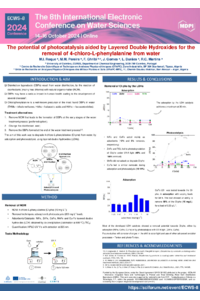
Disinfection By-Products (DBPs) are generated through the interaction of the free chlorine added during the drinking water (DW) disinfection process with natural organic matter (NOM) that may be part of the raw water. The most common DBPs found in DW include trihalomethanes, haloacetic acids, haloacetonitriles and haloketones. The presence of DBPs in DW can lead to several consequences for human health due to their high toxicity; thus, their reduction is crucial to achieve better water quality worldwide. For this purpose, NOM can be removed at the early stages of the treatment process, or the DBPs can be removed at the end of the process.
In this work, photocatalysis was investigated as a potential removal alternative for 4-chloro-L-phenylalanine (Cl-phe), a known precursor of some of the most incident DBPs in DW. For this purpose, several metal layered double hydroxides (LDHs) were synthesized by the co-precipitation method, combining iron with zinc (ZnFe), copper (CuFe), cobalt (CoFe), nickel (NiFe) and manganese (MnFe), and their photocatalytic potential was assessed. Additionally, their performance was compared to commercial titanium dioxide (TiO₂). A 10 mg/L solution of Cl-phe (the highest possible concentration of NOM in DW) was used for the photocatalysis tests, with a load of 200 mg/L, a pH of 7 and UV-A light. TiO₂ was able to completely remove Cl-phe with 2 h of UV-A light exposure. As for the LDH catalysts, CoFe and MnFe did not show an effect on the removal of Cl-phe, whereas CuFe and NiFe showed a greater affinity during the adsorption phase rather than under UV-A light. In contrast, ZnFe was able to remove the Cl-phe by photocatalysis, leading to a removal of 45% with 2 h of UV-A light exposure.
Funding: EU—H2OforAll Horizon project (GA 101081963); FCT—CERES unit, with Refs. UIDB/00102/2020 and UIDP/00102/2020.
Keywords
Disinfection by-products
Natural Organic Matter
Photocatalysis
Metal Layered Double Hydroxides
4-chloro-L-phenylalanine
Poster
MIRoque_Poster_ECWS.pdf
Removal of Pb (II) by Plant-Based MnFe2O4/g-C3N4 Nanoparticles for Water Treatment: Experimental and Machine Learning Study
Visualising Exceptional Rainfall in Portugal: The Severity Heat Map Approach (1981/1982–2022/2023)