Event submissions
Published
This submission belongs to the session S6. Water Resources Management, Floods and Risk Mitigation of the event The 8th International Electronic Conference on Water Sciences
Published date
14 Oct, 2024
Academic Editor
'%3e%3cpath%20d='M12.6657%2010.9104C12.4185%2010.325%2012.0599%209.79327%2011.6097%209.34482C11.1609%208.89508%2010.6293%208.5365%2010.0442%208.28888C10.0389%208.28626%2010.0337%208.28495%2010.0285%208.28233C10.8446%207.69279%2011.3752%206.73249%2011.3752%205.64904C11.3752%203.8542%209.92103%202.39999%208.1262%202.39999C6.33136%202.39999%204.87715%203.8542%204.87715%205.64904C4.87715%206.73249%205.40774%207.69279%206.22393%208.28364C6.21869%208.28626%206.21345%208.28757%206.20821%208.29019C5.62129%208.5378%205.09463%208.89284%204.64265%209.34613C4.1929%209.79493%203.83432%2010.3266%203.58671%2010.9117C3.34345%2011.4845%203.21226%2012.0987%203.20023%2012.7209C3.19988%2012.7349%203.20233%2012.7488%203.20744%2012.7619C3.21255%2012.7749%203.22022%2012.7867%203.22998%2012.7968C3.23975%2012.8068%203.25142%2012.8147%203.26431%2012.8202C3.2772%2012.8256%203.29105%2012.8284%203.30504%2012.8284H4.09109C4.14874%2012.8284%204.19459%2012.7825%204.1959%2012.7262C4.2221%2011.7148%204.62823%2010.7676%205.34617%2010.0497C6.08899%209.30683%207.0755%208.89808%208.1262%208.89808C9.17689%208.89808%2010.1634%209.30683%2010.9062%2010.0497C11.6242%2010.7676%2012.0303%2011.7148%2012.0565%2012.7262C12.0578%2012.7838%2012.1037%2012.8284%2012.1613%2012.8284H12.9474C12.9613%2012.8284%2012.9752%2012.8256%2012.9881%2012.8202C13.001%2012.8147%2013.0126%2012.8068%2013.0224%2012.7968C13.0322%2012.7867%2013.0398%2012.7749%2013.0449%2012.7619C13.0501%2012.7488%2013.0525%2012.7349%2013.0522%2012.7209C13.0391%2012.0947%2012.9094%2011.4855%2012.6657%2010.9104ZM8.1262%207.9024C7.52486%207.9024%206.9589%207.6679%206.53312%207.24211C6.10733%206.81633%205.87283%206.25037%205.87283%205.64904C5.87283%205.0477%206.10733%204.48174%206.53312%204.05596C6.9589%203.63018%207.52486%203.39567%208.1262%203.39567C8.72753%203.39567%209.29349%203.63018%209.71927%204.05596C10.1451%204.48174%2010.3796%205.0477%2010.3796%205.64904C10.3796%206.25037%2010.1451%206.81633%209.71927%207.24211C9.29349%207.6679%208.72753%207.9024%208.1262%207.9024Z'%20fill='%235D1EE1'/%3e%3c/g%3e%3c/svg%3e) ATHANASIOS LOUKAS
ATHANASIOS LOUKASCitation
Shanza Arshad, Mubashra Mahmood, Tanveer Ahmed, Talal Naseer, The Integration of Rainwater Harvesting with Urban Water Systems for Simultaneous Reduction in Stormwater Runoff and Groundwater Extraction: A Case Study in Lahore, Pakistan, in Proceedings of The 8th International Electronic Conference on Water Sciences, 14 October–16 October 2024, MDPI: Basel, Switzerland
Share
Email
Facebook
Twitter
LinkedIn
The Integration of Rainwater Harvesting with Urban Water Systems for Simultaneous Reduction in Stormwater Runoff and Groundwater Extraction: A Case Study in Lahore, Pakistan
'%3e%3cpath%20d='M12.6647%2010.9104C12.4176%2010.325%2012.0589%209.7933%2011.6088%209.34485C11.16%208.89511%2010.6283%208.53653%2010.0432%208.28891C10.038%208.28629%2010.0327%208.28498%2010.0275%208.28236C10.8437%207.69282%2011.3743%206.73252%2011.3743%205.64907C11.3743%203.85423%209.92005%202.40002%208.12522%202.40002C6.33038%202.40002%204.87618%203.85423%204.87618%205.64907C4.87618%206.73252%205.40677%207.69282%206.22296%208.28367C6.21772%208.28629%206.21248%208.2876%206.20724%208.29022C5.62031%208.53783%205.09365%208.89287%204.64167%209.34616C4.19192%209.79496%203.83334%2010.3266%203.58573%2010.9117C3.34247%2011.4846%203.21128%2012.0987%203.19925%2012.721C3.1989%2012.735%203.20135%2012.7489%203.20646%2012.7619C3.21157%2012.7749%203.21924%2012.7868%203.22901%2012.7968C3.23877%2012.8068%203.25045%2012.8148%203.26334%2012.8202C3.27623%2012.8256%203.29007%2012.8284%203.30406%2012.8284H4.09012C4.14776%2012.8284%204.19362%2012.7825%204.19493%2012.7262C4.22113%2011.7148%204.62726%2010.7676%205.34519%2010.0497C6.08802%209.30686%207.07452%208.89811%208.12522%208.89811C9.17592%208.89811%2010.1624%209.30686%2010.9052%2010.0497C11.6232%2010.7676%2012.0293%2011.7148%2012.0555%2012.7262C12.0568%2012.7839%2012.1027%2012.8284%2012.1603%2012.8284H12.9464C12.9604%2012.8284%2012.9742%2012.8256%2012.9871%2012.8202C13%2012.8148%2013.0117%2012.8068%2013.0214%2012.7968C13.0312%2012.7868%2013.0389%2012.7749%2013.044%2012.7619C13.0491%2012.7489%2013.0515%2012.735%2013.0512%2012.721C13.0381%2012.0947%2012.9084%2011.4856%2012.6647%2010.9104ZM8.12522%207.90243C7.52388%207.90243%206.95792%207.66793%206.53214%207.24215C6.10636%206.81636%205.87185%206.2504%205.87185%205.64907C5.87185%205.04773%206.10636%204.48177%206.53214%204.05599C6.95792%203.63021%207.52388%203.3957%208.12522%203.3957C8.72655%203.3957%209.29252%203.63021%209.7183%204.05599C10.1441%204.48177%2010.3786%205.04773%2010.3786%205.64907C10.3786%206.2504%2010.1441%206.81636%209.7183%207.24215C9.29252%207.66793%208.72655%207.90243%208.12522%207.90243Z'%20fill='%235D1EE1'/%3e%3c/g%3e%3c/svg%3e)
Shanza Arshad 1
Mubashra Mahmood 2
Tanveer Ahmed 2

Talal Naseer 3
1. Forman Christian College, University, Lahore, 54600, Pakistan
2. University of Engineering and Technology, Lahore, 39161, Pakistan
3. Food and Agriculture Organization of the United Nations, Pakistan
Abstract
This study focuses on designing and evaluating a household-level rainwater harvesting system (RWHS) aimed at enhancing groundwater conservation, reducing costs, and mitigating urban flooding. Utilizing WaterGEMS for hydraulic analysis, the research highlights the effectiveness of an RWHS in advancing sustainable urban water management. Initially, this study involved designing the water supply system without a rainwater harvesting component. Subsequently, the rainwater potential and storage tank volumes were computed for 3, 5, and 10-marla houses using four methods, with the SamSam model being identified as the optimal approach. Further, the calculated storage volume was divided into the rain barrel volume and the underground tank volume. Three scenarios were developed based on different percentages of water demand being met through harvested rainwater, with case I (covering gardening, house cleaning, and laundry, meeting 18% of the demand) deemed the most viable. Simulations using the Storm Water Management Model (SWMM) revealed an average of 8.6% reduction in water demand, a 17.38% decrease in electricity consumption, and significant reductions in peak urban flooding for return periods of 2, 5, and 10 years, accompanied by 20-24% less flooding at the society level and 17% energy savings. The implementation costs for RWHS were determined as PKR 550,253 (USD 1974) for 3-marla, PKR 670,890 (USD 2407) for 5-marla, and PKR 1,112,283 (USD 3992) for 10-marla houses, underscoring the substantial potential of RWHS in bolstering urban water supply sustainability through efficient rainwater management and utilization.
Keywords
Rainwater Harvesting
Urban Flood Mitigation
Sustainable Water Supply
WaterGEMS
Storm Water Management Model
Poster
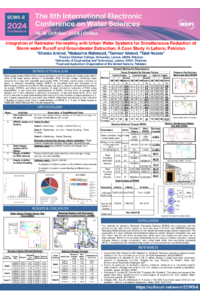
Poster Integration of Rainwater Harvesting with Urban Water Systems for Simultaneou Reduction of Storm water Runoff and GroundwaterExtraction A Case Study in Lahore, Pakistan.pdf
Pressure Reduction Forecasting in Urban Water Distribution Systems Using EPANET and Machine Learning Models
Evaluating the Efficiency of Machine Learning Models in Flood Risk Prediction: A Case Study of the Ottawa River Watershed, Ontario, Canada