Event submissions
Published
This submission belongs to the session S6. Water Resources Management, Floods and Risk Mitigation of the event The 8th International Electronic Conference on Water Sciences
Published date
14 Oct, 2024
Academic Editor
'%3e%3cpath%20d='M12.6657%2010.9104C12.4185%2010.325%2012.0599%209.79327%2011.6097%209.34482C11.1609%208.89508%2010.6293%208.5365%2010.0442%208.28888C10.0389%208.28626%2010.0337%208.28495%2010.0285%208.28233C10.8446%207.69279%2011.3752%206.73249%2011.3752%205.64904C11.3752%203.8542%209.92103%202.39999%208.1262%202.39999C6.33136%202.39999%204.87715%203.8542%204.87715%205.64904C4.87715%206.73249%205.40774%207.69279%206.22393%208.28364C6.21869%208.28626%206.21345%208.28757%206.20821%208.29019C5.62129%208.5378%205.09463%208.89284%204.64265%209.34613C4.1929%209.79493%203.83432%2010.3266%203.58671%2010.9117C3.34345%2011.4845%203.21226%2012.0987%203.20023%2012.7209C3.19988%2012.7349%203.20233%2012.7488%203.20744%2012.7619C3.21255%2012.7749%203.22022%2012.7867%203.22998%2012.7968C3.23975%2012.8068%203.25142%2012.8147%203.26431%2012.8202C3.2772%2012.8256%203.29105%2012.8284%203.30504%2012.8284H4.09109C4.14874%2012.8284%204.19459%2012.7825%204.1959%2012.7262C4.2221%2011.7148%204.62823%2010.7676%205.34617%2010.0497C6.08899%209.30683%207.0755%208.89808%208.1262%208.89808C9.17689%208.89808%2010.1634%209.30683%2010.9062%2010.0497C11.6242%2010.7676%2012.0303%2011.7148%2012.0565%2012.7262C12.0578%2012.7838%2012.1037%2012.8284%2012.1613%2012.8284H12.9474C12.9613%2012.8284%2012.9752%2012.8256%2012.9881%2012.8202C13.001%2012.8147%2013.0126%2012.8068%2013.0224%2012.7968C13.0322%2012.7867%2013.0398%2012.7749%2013.0449%2012.7619C13.0501%2012.7488%2013.0525%2012.7349%2013.0522%2012.7209C13.0391%2012.0947%2012.9094%2011.4855%2012.6657%2010.9104ZM8.1262%207.9024C7.52486%207.9024%206.9589%207.6679%206.53312%207.24211C6.10733%206.81633%205.87283%206.25037%205.87283%205.64904C5.87283%205.0477%206.10733%204.48174%206.53312%204.05596C6.9589%203.63018%207.52486%203.39567%208.1262%203.39567C8.72753%203.39567%209.29349%203.63018%209.71927%204.05596C10.1451%204.48174%2010.3796%205.0477%2010.3796%205.64904C10.3796%206.25037%2010.1451%206.81633%209.71927%207.24211C9.29349%207.6679%208.72753%207.9024%208.1262%207.9024Z'%20fill='%235D1EE1'/%3e%3c/g%3e%3c/svg%3e) ATHANASIOS LOUKAS
ATHANASIOS LOUKASCitation
Gema Ortega González, Juan Manuel Barragán Valdivia, Fernando Ortega González, Francisco José Guerrero Ruiz, MOUNTAIN AND FOOTHILL WETLANDS SURROUNDING GUADALQUIVIR VALLEY (JAÉN, ANDALUSIA, SPAIN): RECENT HISTORICAL EVOLUTION AND MAIN ANTHROPICAL AGRESSIONS, in Proceedings of The 8th International Electronic Conference on Water Sciences, 14 October–16 October 2024, MDPI: Basel, Switzerland
Share
Email
Facebook
Twitter
LinkedIn
MOUNTAIN AND FOOTHILL WETLANDS SURROUNDING GUADALQUIVIR VALLEY (JAÉN, ANDALUSIA, SPAIN): RECENT HISTORICAL EVOLUTION AND MAIN ANTHROPICAL AGRESSIONS
'%3e%3cpath%20d='M12.6647%2010.9104C12.4176%2010.325%2012.0589%209.7933%2011.6088%209.34485C11.16%208.89511%2010.6283%208.53653%2010.0432%208.28891C10.038%208.28629%2010.0327%208.28498%2010.0275%208.28236C10.8437%207.69282%2011.3743%206.73252%2011.3743%205.64907C11.3743%203.85423%209.92005%202.40002%208.12522%202.40002C6.33038%202.40002%204.87618%203.85423%204.87618%205.64907C4.87618%206.73252%205.40677%207.69282%206.22296%208.28367C6.21772%208.28629%206.21248%208.2876%206.20724%208.29022C5.62031%208.53783%205.09365%208.89287%204.64167%209.34616C4.19192%209.79496%203.83334%2010.3266%203.58573%2010.9117C3.34247%2011.4846%203.21128%2012.0987%203.19925%2012.721C3.1989%2012.735%203.20135%2012.7489%203.20646%2012.7619C3.21157%2012.7749%203.21924%2012.7868%203.22901%2012.7968C3.23877%2012.8068%203.25045%2012.8148%203.26334%2012.8202C3.27623%2012.8256%203.29007%2012.8284%203.30406%2012.8284H4.09012C4.14776%2012.8284%204.19362%2012.7825%204.19493%2012.7262C4.22113%2011.7148%204.62726%2010.7676%205.34519%2010.0497C6.08802%209.30686%207.07452%208.89811%208.12522%208.89811C9.17592%208.89811%2010.1624%209.30686%2010.9052%2010.0497C11.6232%2010.7676%2012.0293%2011.7148%2012.0555%2012.7262C12.0568%2012.7839%2012.1027%2012.8284%2012.1603%2012.8284H12.9464C12.9604%2012.8284%2012.9742%2012.8256%2012.9871%2012.8202C13%2012.8148%2013.0117%2012.8068%2013.0214%2012.7968C13.0312%2012.7868%2013.0389%2012.7749%2013.044%2012.7619C13.0491%2012.7489%2013.0515%2012.735%2013.0512%2012.721C13.0381%2012.0947%2012.9084%2011.4856%2012.6647%2010.9104ZM8.12522%207.90243C7.52388%207.90243%206.95792%207.66793%206.53214%207.24215C6.10636%206.81636%205.87185%206.2504%205.87185%205.64907C5.87185%205.04773%206.10636%204.48177%206.53214%204.05599C6.95792%203.63021%207.52388%203.3957%208.12522%203.3957C8.72655%203.3957%209.29252%203.63021%209.7183%204.05599C10.1441%204.48177%2010.3786%205.04773%2010.3786%205.64907C10.3786%206.2504%2010.1441%206.81636%209.7183%207.24215C9.29252%207.66793%208.72655%207.90243%208.12522%207.90243Z'%20fill='%235D1EE1'/%3e%3c/g%3e%3c/svg%3e)
Gema Ortega González 1
Juan Manuel Barragán Valdivia 1
Fernando Ortega González 1

Francisco José Guerrero Ruiz 2
1. University of Jaén. Department of Animal Biology, Vegetal Biology and Ecology.Campus de Las Lagunillas, s/n. 23071 Jaén (Spain)
2. University of Jaén. Department of Animal Biology, Vegetal Biology and Ecology.Campus de Las Lagunillas, s/n. 23071 Jaén (Spain).
University of Jaén. Center for Advanced Studies in Earth, Energy and Environmental Sciences. Campus de Las Lagunillas, s/n.
Abstract
Wetlands are considered one of the most valued ecosystems in the world, due to their transitional role between the terrestrial and aquatic environments, which favors biodiversity. Ponds also provide some ecosystem services that are very useful for the population, such as flood regulation, or their involvement in essential processes, such as nutrient cycles. That is why the analysis of the historical evolution of these ecosystems and the effects they have suffered is a key aspect to understanding the current state of the conservation of wetlands in a given territory. The study area is located in the mountains and foothills of the province of Jaén, Andalusia (Spain); this is a set of mountain ranges that border the Guadalquivir valley. In total, this study covers 48 ponds, whose recent evolution is studied over a period of 68 years, starting from the study of American flights in 1956 to the PNOA images of today. The objective of this study is to establish a baseline on the main aggressions that, from an anthropic point of view, can affect the ecological alteration of wetlands and their environment in this period of time. Human action and changes in land use have led to a progressive decrease in the surface area of some of these wetlands, which has led to the invasion of the wetland basin area, in most cases due to the intensification of olive grove cultivation, especially in the last quarter of the twentieth century and in the present twenty-first century.
Keywords
Wetlands
Mountains
foothills
evolution
agriculture
anthropogenic impacts
Poster
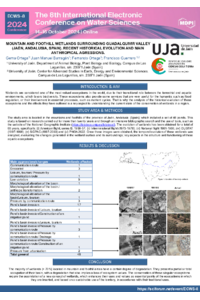
Poster_def.pdf
Estimation of base flow contribution using hydrograph separation techniques and analysis of temporal variation in upper Mahanadi basin
Towards Net-Zero Carbon in the Water Sector: The case of Maderia Island's water supply system