Event submissions
Published
This submission belongs to the session S4. Urban Water, Treatment Technologies, Systems Efficiency and Smart Water Grids of the event The 8th International Electronic Conference on Water Sciences
Published date
14 Oct, 2024
Academic Editor
'%3e%3cpath%20d='M12.6657%2010.9104C12.4185%2010.325%2012.0599%209.79327%2011.6097%209.34482C11.1609%208.89508%2010.6293%208.5365%2010.0442%208.28888C10.0389%208.28626%2010.0337%208.28495%2010.0285%208.28233C10.8446%207.69279%2011.3752%206.73249%2011.3752%205.64904C11.3752%203.8542%209.92103%202.39999%208.1262%202.39999C6.33136%202.39999%204.87715%203.8542%204.87715%205.64904C4.87715%206.73249%205.40774%207.69279%206.22393%208.28364C6.21869%208.28626%206.21345%208.28757%206.20821%208.29019C5.62129%208.5378%205.09463%208.89284%204.64265%209.34613C4.1929%209.79493%203.83432%2010.3266%203.58671%2010.9117C3.34345%2011.4845%203.21226%2012.0987%203.20023%2012.7209C3.19988%2012.7349%203.20233%2012.7488%203.20744%2012.7619C3.21255%2012.7749%203.22022%2012.7867%203.22998%2012.7968C3.23975%2012.8068%203.25142%2012.8147%203.26431%2012.8202C3.2772%2012.8256%203.29105%2012.8284%203.30504%2012.8284H4.09109C4.14874%2012.8284%204.19459%2012.7825%204.1959%2012.7262C4.2221%2011.7148%204.62823%2010.7676%205.34617%2010.0497C6.08899%209.30683%207.0755%208.89808%208.1262%208.89808C9.17689%208.89808%2010.1634%209.30683%2010.9062%2010.0497C11.6242%2010.7676%2012.0303%2011.7148%2012.0565%2012.7262C12.0578%2012.7838%2012.1037%2012.8284%2012.1613%2012.8284H12.9474C12.9613%2012.8284%2012.9752%2012.8256%2012.9881%2012.8202C13.001%2012.8147%2013.0126%2012.8068%2013.0224%2012.7968C13.0322%2012.7867%2013.0398%2012.7749%2013.0449%2012.7619C13.0501%2012.7488%2013.0525%2012.7349%2013.0522%2012.7209C13.0391%2012.0947%2012.9094%2011.4855%2012.6657%2010.9104ZM8.1262%207.9024C7.52486%207.9024%206.9589%207.6679%206.53312%207.24211C6.10733%206.81633%205.87283%206.25037%205.87283%205.64904C5.87283%205.0477%206.10733%204.48174%206.53312%204.05596C6.9589%203.63018%207.52486%203.39567%208.1262%203.39567C8.72753%203.39567%209.29349%203.63018%209.71927%204.05596C10.1451%204.48174%2010.3796%205.0477%2010.3796%205.64904C10.3796%206.25037%2010.1451%206.81633%209.71927%207.24211C9.29349%207.6679%208.72753%207.9024%208.1262%207.9024Z'%20fill='%235D1EE1'/%3e%3c/g%3e%3c/svg%3e) Carmen Teodosiu
Carmen TeodosiuCitation
Amman Khokhar, Fraz Nayyar, Revitalizing Pond Waste: A Novel Approach with Floating Wetlands and Electrolysis for Sustainable Agriculture, Including Wastewater Polishing, in Proceedings of The 8th International Electronic Conference on Water Sciences, 14 October–16 October 2024, MDPI: Basel, Switzerland
Share
Email
Facebook
Twitter
LinkedIn
Revitalizing Pond Waste: A Novel Approach with Floating Wetlands and Electrolysis for Sustainable Agriculture, Including Wastewater Polishing
'%3e%3cpath%20d='M12.6647%2010.9104C12.4176%2010.325%2012.0589%209.7933%2011.6088%209.34485C11.16%208.89511%2010.6283%208.53653%2010.0432%208.28891C10.038%208.28629%2010.0327%208.28498%2010.0275%208.28236C10.8437%207.69282%2011.3743%206.73252%2011.3743%205.64907C11.3743%203.85423%209.92005%202.40002%208.12522%202.40002C6.33038%202.40002%204.87618%203.85423%204.87618%205.64907C4.87618%206.73252%205.40677%207.69282%206.22296%208.28367C6.21772%208.28629%206.21248%208.2876%206.20724%208.29022C5.62031%208.53783%205.09365%208.89287%204.64167%209.34616C4.19192%209.79496%203.83334%2010.3266%203.58573%2010.9117C3.34247%2011.4846%203.21128%2012.0987%203.19925%2012.721C3.1989%2012.735%203.20135%2012.7489%203.20646%2012.7619C3.21157%2012.7749%203.21924%2012.7868%203.22901%2012.7968C3.23877%2012.8068%203.25045%2012.8148%203.26334%2012.8202C3.27623%2012.8256%203.29007%2012.8284%203.30406%2012.8284H4.09012C4.14776%2012.8284%204.19362%2012.7825%204.19493%2012.7262C4.22113%2011.7148%204.62726%2010.7676%205.34519%2010.0497C6.08802%209.30686%207.07452%208.89811%208.12522%208.89811C9.17592%208.89811%2010.1624%209.30686%2010.9052%2010.0497C11.6232%2010.7676%2012.0293%2011.7148%2012.0555%2012.7262C12.0568%2012.7839%2012.1027%2012.8284%2012.1603%2012.8284H12.9464C12.9604%2012.8284%2012.9742%2012.8256%2012.9871%2012.8202C13%2012.8148%2013.0117%2012.8068%2013.0214%2012.7968C13.0312%2012.7868%2013.0389%2012.7749%2013.044%2012.7619C13.0491%2012.7489%2013.0515%2012.735%2013.0512%2012.721C13.0381%2012.0947%2012.9084%2011.4856%2012.6647%2010.9104ZM8.12522%207.90243C7.52388%207.90243%206.95792%207.66793%206.53214%207.24215C6.10636%206.81636%205.87185%206.2504%205.87185%205.64907C5.87185%205.04773%206.10636%204.48177%206.53214%204.05599C6.95792%203.63021%207.52388%203.3957%208.12522%203.3957C8.72655%203.3957%209.29252%203.63021%209.7183%204.05599C10.1441%204.48177%2010.3786%205.04773%2010.3786%205.64907C10.3786%206.2504%2010.1441%206.81636%209.7183%207.24215C9.29252%207.66793%208.72655%207.90243%208.12522%207.90243Z'%20fill='%235D1EE1'/%3e%3c/g%3e%3c/svg%3e)
Amman Khokhar 1
Fraz Nayyar 2
1. University of Agriculture Faisalabad, Faisalabad, Punjab, 38000, Pakistan
2. Department of Farm Machinery and Power, University of Agriculture Faisalabad , 38000, Pakistan
Abstract
Sustainable agriculture requires effective managment of environmental challenges, and one such challenge is pond waste. In Pakistan, vast networks of freshwater ponds (approximately 60,470 hectares) are used for fish farming. While this practice produces valuable food, the resulting nutrient-rich wastewater is often discarded, creating a potential environmental burden. However, this very waste holds immense potential for agriculture.
A groundbreaking solution has emerged from NIBGE (a research institution). Their innovative method tackles pond waste using a unique combination of floating wetlands and electrolysis. Floating wetlands act as miniature ecosystems within the ponds. These plant-based systems filter and purify the water by absorbing pollutants and fostering the growth of beneficial microorganisms. Electrolysis takes things a step further by using electricity to break down remaining contaminants and potentially even harvest valuable minerals.
This two-pronged approach offers a dual benefit. First, the process transforms pond waste into a usable, nitrogen-rich sludge. Nitrogen is a vital element for plant growth, making this sludge a valuable organic fertilizer. By replacing synthetic fertilizers, this method reduces reliance on potentially harmful chemicals and promotes sustainable agricultural practices. Second, the method simultaneously cleans and polishes the wastewater, removing impurities and achieving crystal clarity. This treated water becomes a valuable resource, suitable for reuse in irrigation or replenishing aquaculture systems. This not only promotes water conservation but also minimizes the environmental impact of agriculture by reducing reliance on freshwater sources.
By addressing both aspects of pond waste management, NIBGE's innovative method positions itself as a promising solution for sustainable agriculture in Pakistan. This approach promotes organic practices, reduces dependence on chemical fertilizers, conserves water, and minimizes environmental impact. This paves the way for a more sustainable future for Pakistani agriculture.
Keywords
Electrolysis
nitrogen-rich fertilizer
synthetic fertilizers
wastewater treatment
wastewater polishing
irrigation
aquaculture
Poster
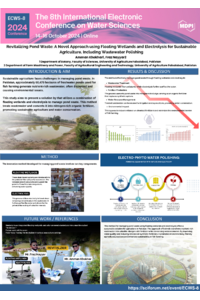
Sustainable agriculture faces challenges in managing pond waste. In Pakistan, approximately 60,470 hectares of freshwater ponds used for fish farming generate nutrient-rich wastewater, often disca (1).pdf
Mitigating the Global Potable Water Crisis: A Systematic Review of Emerging Urban Stormwater Conversion Technologies
ASSESSMENT OF RESILIENCE IN IRRIGATION NETWORKS USING OPTIMIZATION ALGORITHMS