Event submissions
Published
This submission belongs to the session S4. Urban Water, Treatment Technologies, Systems Efficiency and Smart Water Grids of the event The 8th International Electronic Conference on Water Sciences
Published date
14 Oct, 2024
Academic Editor
'%3e%3cpath%20d='M12.6657%2010.9104C12.4185%2010.325%2012.0599%209.79327%2011.6097%209.34482C11.1609%208.89508%2010.6293%208.5365%2010.0442%208.28888C10.0389%208.28626%2010.0337%208.28495%2010.0285%208.28233C10.8446%207.69279%2011.3752%206.73249%2011.3752%205.64904C11.3752%203.8542%209.92103%202.39999%208.1262%202.39999C6.33136%202.39999%204.87715%203.8542%204.87715%205.64904C4.87715%206.73249%205.40774%207.69279%206.22393%208.28364C6.21869%208.28626%206.21345%208.28757%206.20821%208.29019C5.62129%208.5378%205.09463%208.89284%204.64265%209.34613C4.1929%209.79493%203.83432%2010.3266%203.58671%2010.9117C3.34345%2011.4845%203.21226%2012.0987%203.20023%2012.7209C3.19988%2012.7349%203.20233%2012.7488%203.20744%2012.7619C3.21255%2012.7749%203.22022%2012.7867%203.22998%2012.7968C3.23975%2012.8068%203.25142%2012.8147%203.26431%2012.8202C3.2772%2012.8256%203.29105%2012.8284%203.30504%2012.8284H4.09109C4.14874%2012.8284%204.19459%2012.7825%204.1959%2012.7262C4.2221%2011.7148%204.62823%2010.7676%205.34617%2010.0497C6.08899%209.30683%207.0755%208.89808%208.1262%208.89808C9.17689%208.89808%2010.1634%209.30683%2010.9062%2010.0497C11.6242%2010.7676%2012.0303%2011.7148%2012.0565%2012.7262C12.0578%2012.7838%2012.1037%2012.8284%2012.1613%2012.8284H12.9474C12.9613%2012.8284%2012.9752%2012.8256%2012.9881%2012.8202C13.001%2012.8147%2013.0126%2012.8068%2013.0224%2012.7968C13.0322%2012.7867%2013.0398%2012.7749%2013.0449%2012.7619C13.0501%2012.7488%2013.0525%2012.7349%2013.0522%2012.7209C13.0391%2012.0947%2012.9094%2011.4855%2012.6657%2010.9104ZM8.1262%207.9024C7.52486%207.9024%206.9589%207.6679%206.53312%207.24211C6.10733%206.81633%205.87283%206.25037%205.87283%205.64904C5.87283%205.0477%206.10733%204.48174%206.53312%204.05596C6.9589%203.63018%207.52486%203.39567%208.1262%203.39567C8.72753%203.39567%209.29349%203.63018%209.71927%204.05596C10.1451%204.48174%2010.3796%205.0477%2010.3796%205.64904C10.3796%206.25037%2010.1451%206.81633%209.71927%207.24211C9.29349%207.6679%208.72753%207.9024%208.1262%207.9024Z'%20fill='%235D1EE1'/%3e%3c/g%3e%3c/svg%3e) Carmen Teodosiu
Carmen TeodosiuCitation
Shahriar Iqbal Raj, Mujtaba Ahsan, Amity Kundu, Enhancing Water Security in Commercial Buildings through Rainwater Harvesting and Innovative Strategies: A Case Study in Dhaka, Bangladesh., in Proceedings of The 8th International Electronic Conference on Water Sciences, 14 October–16 October 2024, MDPI: Basel, Switzerland
Share
Email
Facebook
Twitter
LinkedIn
Enhancing Water Security in Commercial Buildings through Rainwater Harvesting and Innovative Strategies: A Case Study in Dhaka, Bangladesh.
'%3e%3cpath%20d='M12.6647%2010.9104C12.4176%2010.325%2012.0589%209.7933%2011.6088%209.34485C11.16%208.89511%2010.6283%208.53653%2010.0432%208.28891C10.038%208.28629%2010.0327%208.28498%2010.0275%208.28236C10.8437%207.69282%2011.3743%206.73252%2011.3743%205.64907C11.3743%203.85423%209.92005%202.40002%208.12522%202.40002C6.33038%202.40002%204.87618%203.85423%204.87618%205.64907C4.87618%206.73252%205.40677%207.69282%206.22296%208.28367C6.21772%208.28629%206.21248%208.2876%206.20724%208.29022C5.62031%208.53783%205.09365%208.89287%204.64167%209.34616C4.19192%209.79496%203.83334%2010.3266%203.58573%2010.9117C3.34247%2011.4846%203.21128%2012.0987%203.19925%2012.721C3.1989%2012.735%203.20135%2012.7489%203.20646%2012.7619C3.21157%2012.7749%203.21924%2012.7868%203.22901%2012.7968C3.23877%2012.8068%203.25045%2012.8148%203.26334%2012.8202C3.27623%2012.8256%203.29007%2012.8284%203.30406%2012.8284H4.09012C4.14776%2012.8284%204.19362%2012.7825%204.19493%2012.7262C4.22113%2011.7148%204.62726%2010.7676%205.34519%2010.0497C6.08802%209.30686%207.07452%208.89811%208.12522%208.89811C9.17592%208.89811%2010.1624%209.30686%2010.9052%2010.0497C11.6232%2010.7676%2012.0293%2011.7148%2012.0555%2012.7262C12.0568%2012.7839%2012.1027%2012.8284%2012.1603%2012.8284H12.9464C12.9604%2012.8284%2012.9742%2012.8256%2012.9871%2012.8202C13%2012.8148%2013.0117%2012.8068%2013.0214%2012.7968C13.0312%2012.7868%2013.0389%2012.7749%2013.044%2012.7619C13.0491%2012.7489%2013.0515%2012.735%2013.0512%2012.721C13.0381%2012.0947%2012.9084%2011.4856%2012.6647%2010.9104ZM8.12522%207.90243C7.52388%207.90243%206.95792%207.66793%206.53214%207.24215C6.10636%206.81636%205.87185%206.2504%205.87185%205.64907C5.87185%205.04773%206.10636%204.48177%206.53214%204.05599C6.95792%203.63021%207.52388%203.3957%208.12522%203.3957C8.72655%203.3957%209.29252%203.63021%209.7183%204.05599C10.1441%204.48177%2010.3786%205.04773%2010.3786%205.64907C10.3786%206.2504%2010.1441%206.81636%209.7183%207.24215C9.29252%207.66793%208.72655%207.90243%208.12522%207.90243Z'%20fill='%235D1EE1'/%3e%3c/g%3e%3c/svg%3e)
Shahriar Iqbal Raj 1

Mujtaba Ahsan 2
Amity Kundu 3
1. Department of Architecture, North South University
2. Department of Architecure, North South University
3. Department of ARchitecure, North-South University
Abstract
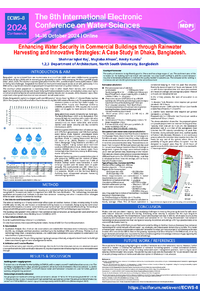
Introduction: Bangladesh faces severe climate change impacts exacerbated by its vulnerability to disasters. The Climate Vulnerability Index-2023 ranks Bangladesh as the seventh most disaster-risk-prone country globally. Poor and developing countries like Bangladesh bear disproportionate impacts from climate change, with significant vulnerabilities identified, including sea-level rise, erratic rainfall, and water security issues.
Methods: This study focuses on a commercial high-rise building on Gulshan Avenue, Dhaka, which is recognized for achieving 50% water efficiency compared to similar-sized buildings. The building employs rainwater harvesting, wastewater recycling, and advanced treatment technologies and integrates innovative water grid systems. It is LEED Platinum-certified by the U.S. Green Building Council, marking it as a pioneer in sustainable construction in Dhaka. Data were collected through on-site observations, interviews with the building architects, and a review of LEED certification documentation.
Results: The commercial building at Gulshan Avenue demonstrates substantial water efficiency gains through innovative strategies. Rainwater harvesting, wastewater recycling, and low-flow fixtures supported by innovative water grid systems significantly reduce reliance on groundwater and mitigate water quality issues from contaminated surface sources. The building's LEED certification underscores its leadership in sustainable practices, achieving the highest environmental standards in Bangladesh's commercial building sector.
Conclusion: The case study highlights the importance of rainwater harvesting, wastewater recycling, and intelligent water grid systems in enhancing water efficiency in Dhaka's commercial buildings. The success of the Gulshan Avenue building underscores the feasibility and benefits of adopting comprehensive water management strategies amidst growing water scarcity and pollution challenges. Further promotion and implementation of such integrated systems are crucial for mitigating water-related risks and advancing urban sustainability.
Keywords
Rainwater harvesting
commercial building
LEED
sustainability
water efficiency
Dhaka
water grid
Poster
Poster_Shahriar_Iqbal_Raj.pdf
Impeller 3D Printing and Optimization Techniques in Turbomachinery: Review
Potential of green roofs to support urban rainwater management: hydraulic experimental assessment