Event submissions
Published
This submission belongs to the session S4. Urban Water, Treatment Technologies, Systems Efficiency and Smart Water Grids of the event The 8th International Electronic Conference on Water Sciences
Published date
14 Oct, 2024
Academic Editor
'%3e%3cpath%20d='M12.6657%2010.9104C12.4185%2010.325%2012.0599%209.79327%2011.6097%209.34482C11.1609%208.89508%2010.6293%208.5365%2010.0442%208.28888C10.0389%208.28626%2010.0337%208.28495%2010.0285%208.28233C10.8446%207.69279%2011.3752%206.73249%2011.3752%205.64904C11.3752%203.8542%209.92103%202.39999%208.1262%202.39999C6.33136%202.39999%204.87715%203.8542%204.87715%205.64904C4.87715%206.73249%205.40774%207.69279%206.22393%208.28364C6.21869%208.28626%206.21345%208.28757%206.20821%208.29019C5.62129%208.5378%205.09463%208.89284%204.64265%209.34613C4.1929%209.79493%203.83432%2010.3266%203.58671%2010.9117C3.34345%2011.4845%203.21226%2012.0987%203.20023%2012.7209C3.19988%2012.7349%203.20233%2012.7488%203.20744%2012.7619C3.21255%2012.7749%203.22022%2012.7867%203.22998%2012.7968C3.23975%2012.8068%203.25142%2012.8147%203.26431%2012.8202C3.2772%2012.8256%203.29105%2012.8284%203.30504%2012.8284H4.09109C4.14874%2012.8284%204.19459%2012.7825%204.1959%2012.7262C4.2221%2011.7148%204.62823%2010.7676%205.34617%2010.0497C6.08899%209.30683%207.0755%208.89808%208.1262%208.89808C9.17689%208.89808%2010.1634%209.30683%2010.9062%2010.0497C11.6242%2010.7676%2012.0303%2011.7148%2012.0565%2012.7262C12.0578%2012.7838%2012.1037%2012.8284%2012.1613%2012.8284H12.9474C12.9613%2012.8284%2012.9752%2012.8256%2012.9881%2012.8202C13.001%2012.8147%2013.0126%2012.8068%2013.0224%2012.7968C13.0322%2012.7867%2013.0398%2012.7749%2013.0449%2012.7619C13.0501%2012.7488%2013.0525%2012.7349%2013.0522%2012.7209C13.0391%2012.0947%2012.9094%2011.4855%2012.6657%2010.9104ZM8.1262%207.9024C7.52486%207.9024%206.9589%207.6679%206.53312%207.24211C6.10733%206.81633%205.87283%206.25037%205.87283%205.64904C5.87283%205.0477%206.10733%204.48174%206.53312%204.05596C6.9589%203.63018%207.52486%203.39567%208.1262%203.39567C8.72753%203.39567%209.29349%203.63018%209.71927%204.05596C10.1451%204.48174%2010.3796%205.0477%2010.3796%205.64904C10.3796%206.25037%2010.1451%206.81633%209.71927%207.24211C9.29349%207.6679%208.72753%207.9024%208.1262%207.9024Z'%20fill='%235D1EE1'/%3e%3c/g%3e%3c/svg%3e) Carmen Teodosiu
Carmen TeodosiuCitation
Athanasios Vasileios Serafeim, Anastasios Perdios, Nikolaos Th. Fourniotis, George Kokosalakis, Andreas Langousis, Assessing the Environmental and Economic Footprint of Leakages in Water Distribution Networks, in Proceedings of The 8th International Electronic Conference on Water Sciences, 14 October–16 October 2024, MDPI: Basel, Switzerland
Share
Email
Facebook
Twitter
LinkedIn
Assessing the Environmental and Economic Footprint of Leakages in Water Distribution Networks
'%3e%3cpath%20d='M12.6647%2010.9104C12.4176%2010.325%2012.0589%209.7933%2011.6088%209.34485C11.16%208.89511%2010.6283%208.53653%2010.0432%208.28891C10.038%208.28629%2010.0327%208.28498%2010.0275%208.28236C10.8437%207.69282%2011.3743%206.73252%2011.3743%205.64907C11.3743%203.85423%209.92005%202.40002%208.12522%202.40002C6.33038%202.40002%204.87618%203.85423%204.87618%205.64907C4.87618%206.73252%205.40677%207.69282%206.22296%208.28367C6.21772%208.28629%206.21248%208.2876%206.20724%208.29022C5.62031%208.53783%205.09365%208.89287%204.64167%209.34616C4.19192%209.79496%203.83334%2010.3266%203.58573%2010.9117C3.34247%2011.4846%203.21128%2012.0987%203.19925%2012.721C3.1989%2012.735%203.20135%2012.7489%203.20646%2012.7619C3.21157%2012.7749%203.21924%2012.7868%203.22901%2012.7968C3.23877%2012.8068%203.25045%2012.8148%203.26334%2012.8202C3.27623%2012.8256%203.29007%2012.8284%203.30406%2012.8284H4.09012C4.14776%2012.8284%204.19362%2012.7825%204.19493%2012.7262C4.22113%2011.7148%204.62726%2010.7676%205.34519%2010.0497C6.08802%209.30686%207.07452%208.89811%208.12522%208.89811C9.17592%208.89811%2010.1624%209.30686%2010.9052%2010.0497C11.6232%2010.7676%2012.0293%2011.7148%2012.0555%2012.7262C12.0568%2012.7839%2012.1027%2012.8284%2012.1603%2012.8284H12.9464C12.9604%2012.8284%2012.9742%2012.8256%2012.9871%2012.8202C13%2012.8148%2013.0117%2012.8068%2013.0214%2012.7968C13.0312%2012.7868%2013.0389%2012.7749%2013.044%2012.7619C13.0491%2012.7489%2013.0515%2012.735%2013.0512%2012.721C13.0381%2012.0947%2012.9084%2011.4856%2012.6647%2010.9104ZM8.12522%207.90243C7.52388%207.90243%206.95792%207.66793%206.53214%207.24215C6.10636%206.81636%205.87185%206.2504%205.87185%205.64907C5.87185%205.04773%206.10636%204.48177%206.53214%204.05599C6.95792%203.63021%207.52388%203.3957%208.12522%203.3957C8.72655%203.3957%209.29252%203.63021%209.7183%204.05599C10.1441%204.48177%2010.3786%205.04773%2010.3786%205.64907C10.3786%206.2504%2010.1441%206.81636%209.7183%207.24215C9.29252%207.66793%208.72655%207.90243%208.12522%207.90243Z'%20fill='%235D1EE1'/%3e%3c/g%3e%3c/svg%3e)
Athanasios Vasileios Serafeim 1,2
Anastasios Perdios 1,2
Nikolaos Th. Fourniotis 3
George Kokosalakis 1,4
Andreas Langousis 1
1. Department of Civil Engineering, University of Patras, 26504 Patras, Greece
2. Dipartimento di Ingegneria Civile, Ambientale ed Architettura Università degli Studi di Cagliari, 09124 Cagliari, Italy
3. Department of Civil Engineering, University of the Peloponnese, 26334 Patras, Greece
4. Department of Maritime Transport and Logistics, School of Business and Economics, Deree, American College of Greece, 15342 Athens, Greece
Abstract
Introduction:
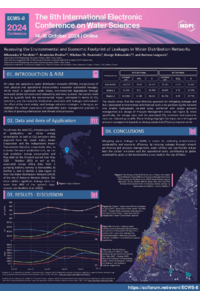
All urban and agricultural water distribution networks (WDNs), irrespectively of their physical and operational characteristics encounter substantial leakages, which result in significant water losses, environmental degradation through increased carbon emissions and noteworthy economic burdens. The current work aims to quantify both the environmental impact, estimated in terms of CO₂ emissions, and the economic implications associated with leakages and evaluate the effect of the most widely used leakage reduction strategies.
Methods:
The effectiveness of the studied approaches is tasted via a real-world application on the WDN of the city of Patras, in western Greece, which exhibits significant leakage rates (more than 40% of the system's input volume). To estimate the total CO₂ emissions and the water production cost, we utilize energy consumption as well as energy billing data associated with pumping and water treatment. Additionally, we use flow time series from pumping stations and individual district metered areas (DMAs) and/or pressure management areas (PMAs) to estimate the water balance of the network. This comprehensive approach allows us to assess both the environmental and economic impacts of leakages.
Results:
The results reveal that the most effective approach for mitigating leakages and their associated environmental and financial costs is by partitioning the network into smaller hydraulically isolated areas, combined with proper pressure management (i.e. design of PMAs). More specifically, the leakage rates and the associated CO₂ emissions and economic costs are reduced up to 40%. These findings highlight the importance of targeted pressure management towards achieving substantial efficiency improvements.
Conclusions:
Mitigating water leakages in WDNs is crucial for achieving environmental sustainability and economic efficiency. By reducing leakages through network partitioning and pressure management, water utilities can significantly reduce both the carbon emissions and the operational costs, contributing to global sustainability goals, as demonstrated by a case study in the city of Patras.
Keywords
Leakages
Water Distribution Networks
Leakage Management
Environmental Footprint
CO2 Emissions
Water networks Efficiency
Poster
ECWS_8_Serafeim_et_al.pdf
Potential of green roofs to support urban rainwater management: hydraulic experimental assessment
Advanced Flood Classification Using Rapid Machine Learning Techniques: Insights from Saint-Charles Station, Quebec