Event submissions
Published
This submission belongs to the session S4. Urban Water, Treatment Technologies, Systems Efficiency and Smart Water Grids of the event The 8th International Electronic Conference on Water Sciences
Published date
14 Oct, 2024
Academic Editor
'%3e%3cpath%20d='M12.6657%2010.9104C12.4185%2010.325%2012.0599%209.79327%2011.6097%209.34482C11.1609%208.89508%2010.6293%208.5365%2010.0442%208.28888C10.0389%208.28626%2010.0337%208.28495%2010.0285%208.28233C10.8446%207.69279%2011.3752%206.73249%2011.3752%205.64904C11.3752%203.8542%209.92103%202.39999%208.1262%202.39999C6.33136%202.39999%204.87715%203.8542%204.87715%205.64904C4.87715%206.73249%205.40774%207.69279%206.22393%208.28364C6.21869%208.28626%206.21345%208.28757%206.20821%208.29019C5.62129%208.5378%205.09463%208.89284%204.64265%209.34613C4.1929%209.79493%203.83432%2010.3266%203.58671%2010.9117C3.34345%2011.4845%203.21226%2012.0987%203.20023%2012.7209C3.19988%2012.7349%203.20233%2012.7488%203.20744%2012.7619C3.21255%2012.7749%203.22022%2012.7867%203.22998%2012.7968C3.23975%2012.8068%203.25142%2012.8147%203.26431%2012.8202C3.2772%2012.8256%203.29105%2012.8284%203.30504%2012.8284H4.09109C4.14874%2012.8284%204.19459%2012.7825%204.1959%2012.7262C4.2221%2011.7148%204.62823%2010.7676%205.34617%2010.0497C6.08899%209.30683%207.0755%208.89808%208.1262%208.89808C9.17689%208.89808%2010.1634%209.30683%2010.9062%2010.0497C11.6242%2010.7676%2012.0303%2011.7148%2012.0565%2012.7262C12.0578%2012.7838%2012.1037%2012.8284%2012.1613%2012.8284H12.9474C12.9613%2012.8284%2012.9752%2012.8256%2012.9881%2012.8202C13.001%2012.8147%2013.0126%2012.8068%2013.0224%2012.7968C13.0322%2012.7867%2013.0398%2012.7749%2013.0449%2012.7619C13.0501%2012.7488%2013.0525%2012.7349%2013.0522%2012.7209C13.0391%2012.0947%2012.9094%2011.4855%2012.6657%2010.9104ZM8.1262%207.9024C7.52486%207.9024%206.9589%207.6679%206.53312%207.24211C6.10733%206.81633%205.87283%206.25037%205.87283%205.64904C5.87283%205.0477%206.10733%204.48174%206.53312%204.05596C6.9589%203.63018%207.52486%203.39567%208.1262%203.39567C8.72753%203.39567%209.29349%203.63018%209.71927%204.05596C10.1451%204.48174%2010.3796%205.0477%2010.3796%205.64904C10.3796%206.25037%2010.1451%206.81633%209.71927%207.24211C9.29349%207.6679%208.72753%207.9024%208.1262%207.9024Z'%20fill='%235D1EE1'/%3e%3c/g%3e%3c/svg%3e) Carmen Teodosiu
Carmen TeodosiuCitation
Sara Ghaznavinia, Seiyed Mossa Hosseini, Statistical Analysis of 24-Hour Rainfall Patterns in Tehran Metropolitan Area, in Proceedings of The 8th International Electronic Conference on Water Sciences, 14 October–16 October 2024, MDPI: Basel, Switzerland
Share
Email
Facebook
Twitter
LinkedIn
Statistical Analysis of 24-Hour Rainfall Patterns in Tehran Metropolitan Area

Sara Ghaznavinia 1

Seiyed Mossa Hosseini 2
1. Faculty of geography , University of Tehran
2. Associate Professor, Physical Geography Department, University of Tehran
Abstract
The determination of rainfall patterns in urban areas influences the availability of water resources, weather systems, and urban planning. In this study, the 24-hour rainfall pattern in 15 rain gauges over the Tehran province was determined and statistically analyzed. In total, 137 storm events with a duration of 20 to 28 hrs each, recorded in a time step of 1 min over a 30 year period, were used. To extract the 24-hour rainfall patterns, Pilgrim and Cordery’s methods were adopted. The Chi-square test was used to assess the accuracy and meaningfulness of the obtained patterns. Then, one-way analysis of variance (ANOVA) was adopted to test the difference between the patterns in the stations and also between the four standard patters in the Soil Conservation Service (SCS) of USA. The results of this study reveal that the higher percentages of the 24-hour rainfall depth occurred in the middle quartiles of rainfall time. ANOVA tests reveal that a significant difference (with a 95% confidence level) was detected between the 15 patterns obtained in the stations in Tehran, and also the between the patterns from Tehran’s and the SCS. The topograpical and local geographical atmospheric conditions (e.g., heat islands) influence the rainfall pattern in Tehran. Continued research in this field is essential for developing effective strategies to mitigate the impacts of changes in rainfall patterns to ensure the resilience of urban communities and ecosystems.
Keywords
24-hr Rainfall Pattern
Time Distribution
Tehran Province
Urbanization
Poster
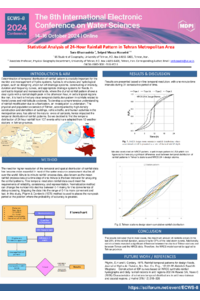
poster sciforum-097369 .pdf
Photo-degradation of reactive blue dye (171) by TiO2/Fe2O3 photocatalysis under visible light irradiation
Flood Risk Map For Büyükçekmece District Based On Socioeconomic Factors