Event submissions
Published
This submission belongs to the session S6. Water Resources Management, Floods and Risk Mitigation of the event The 8th International Electronic Conference on Water Sciences
Published date
14 Oct, 2024
Academic Editor
'%3e%3cpath%20d='M12.6657%2010.9104C12.4185%2010.325%2012.0599%209.79327%2011.6097%209.34482C11.1609%208.89508%2010.6293%208.5365%2010.0442%208.28888C10.0389%208.28626%2010.0337%208.28495%2010.0285%208.28233C10.8446%207.69279%2011.3752%206.73249%2011.3752%205.64904C11.3752%203.8542%209.92103%202.39999%208.1262%202.39999C6.33136%202.39999%204.87715%203.8542%204.87715%205.64904C4.87715%206.73249%205.40774%207.69279%206.22393%208.28364C6.21869%208.28626%206.21345%208.28757%206.20821%208.29019C5.62129%208.5378%205.09463%208.89284%204.64265%209.34613C4.1929%209.79493%203.83432%2010.3266%203.58671%2010.9117C3.34345%2011.4845%203.21226%2012.0987%203.20023%2012.7209C3.19988%2012.7349%203.20233%2012.7488%203.20744%2012.7619C3.21255%2012.7749%203.22022%2012.7867%203.22998%2012.7968C3.23975%2012.8068%203.25142%2012.8147%203.26431%2012.8202C3.2772%2012.8256%203.29105%2012.8284%203.30504%2012.8284H4.09109C4.14874%2012.8284%204.19459%2012.7825%204.1959%2012.7262C4.2221%2011.7148%204.62823%2010.7676%205.34617%2010.0497C6.08899%209.30683%207.0755%208.89808%208.1262%208.89808C9.17689%208.89808%2010.1634%209.30683%2010.9062%2010.0497C11.6242%2010.7676%2012.0303%2011.7148%2012.0565%2012.7262C12.0578%2012.7838%2012.1037%2012.8284%2012.1613%2012.8284H12.9474C12.9613%2012.8284%2012.9752%2012.8256%2012.9881%2012.8202C13.001%2012.8147%2013.0126%2012.8068%2013.0224%2012.7968C13.0322%2012.7867%2013.0398%2012.7749%2013.0449%2012.7619C13.0501%2012.7488%2013.0525%2012.7349%2013.0522%2012.7209C13.0391%2012.0947%2012.9094%2011.4855%2012.6657%2010.9104ZM8.1262%207.9024C7.52486%207.9024%206.9589%207.6679%206.53312%207.24211C6.10733%206.81633%205.87283%206.25037%205.87283%205.64904C5.87283%205.0477%206.10733%204.48174%206.53312%204.05596C6.9589%203.63018%207.52486%203.39567%208.1262%203.39567C8.72753%203.39567%209.29349%203.63018%209.71927%204.05596C10.1451%204.48174%2010.3796%205.0477%2010.3796%205.64904C10.3796%206.25037%2010.1451%206.81633%209.71927%207.24211C9.29349%207.6679%208.72753%207.9024%208.1262%207.9024Z'%20fill='%235D1EE1'/%3e%3c/g%3e%3c/svg%3e) ATHANASIOS LOUKAS
ATHANASIOS LOUKASCitation
Agegnehu Kitanbo Yoshe, Integrated study of GRACE-based groundwater storage variability across Ethiopia for sustainable economic development, in Proceedings of The 8th International Electronic Conference on Water Sciences, 14 October–16 October 2024, MDPI: Basel, Switzerland
Share
Email
Facebook
Twitter
LinkedIn
Integrated study of GRACE-based groundwater storage variability across Ethiopia for sustainable economic development

Agegnehu Kitanbo Yoshe 1
1. Department of Water Resources and Irrigation Engineering, Arba Minch University, 21 Post Office Box, Arba Minch, Ethiopia
Abstract
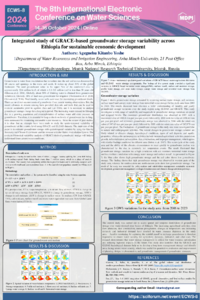
Surface and groundwater variations are difficult to assess due to complexity and the lack of spatiotemporal observation. The increasing population of Ethiopia is coupled with growth in infrastructure, agriculture, and industries, which are the largest water consumers, leading to the depletion of water resources, including groundwater. From the review of past studies, it is clear that no attempts have been made to study the spatiotemporal variability of groundwater at the country level using GRACE and GLDAS datasets. Nowadays, different parts of Ethiopia face a severe water crisis due to the overexploitation of surface water resources, which adds extra pressure on groundwater. In this study, groundwater storage was estimated using the three products of gravity recovery and climate experimentation from the global land data assimilation system in Ethiopia. The estimated monthly groundwater storage ranged from 1948.69 to 28111.07 mm and yearly groundwater storage ranged from 263879.1 to 311505.5 mm for the study period. The monthly, seasonal, and annual variations in groundwater storage were evaluated. This research found that groundwater storage exhibits interannual fluctuation following the seasonal pattern of the study area. The variation in groundwater storage may be occurring as a result of complex activities with natural and anthropogenic impacts. We found that GRACE and GLDAS datasets can be combined effectively to evaluate the long-term GWS in large-scale basins with limited hydrological data.
Keywords
Groundwater storage
anthropogenic and natural factors
climatic variable
spatiotemporal variation
and hydrological water balance components
Poster
GWS-Conf, Agegnehu Kitanbo.pdf
Hydrological Response to Climate Change in Baro Basin, Ethiopia, Using Representative Concentration Pathway Scenarios
Importance of cryospheric reserves in sustaining streamflow of Himalayan mountainous catchments