Event submissions
Published
This submission belongs to the session S6. Plant Diversity of the event The 3rd International Electronic Conference on Diversity
Published date
14 Oct, 2024
Academic Editor
'%3e%3cpath%20d='M12.6657%2010.9104C12.4185%2010.325%2012.0599%209.79327%2011.6097%209.34482C11.1609%208.89508%2010.6293%208.5365%2010.0442%208.28888C10.0389%208.28626%2010.0337%208.28495%2010.0285%208.28233C10.8446%207.69279%2011.3752%206.73249%2011.3752%205.64904C11.3752%203.8542%209.92103%202.39999%208.1262%202.39999C6.33136%202.39999%204.87715%203.8542%204.87715%205.64904C4.87715%206.73249%205.40774%207.69279%206.22393%208.28364C6.21869%208.28626%206.21345%208.28757%206.20821%208.29019C5.62129%208.5378%205.09463%208.89284%204.64265%209.34613C4.1929%209.79493%203.83432%2010.3266%203.58671%2010.9117C3.34345%2011.4845%203.21226%2012.0987%203.20023%2012.7209C3.19988%2012.7349%203.20233%2012.7488%203.20744%2012.7619C3.21255%2012.7749%203.22022%2012.7867%203.22998%2012.7968C3.23975%2012.8068%203.25142%2012.8147%203.26431%2012.8202C3.2772%2012.8256%203.29105%2012.8284%203.30504%2012.8284H4.09109C4.14874%2012.8284%204.19459%2012.7825%204.1959%2012.7262C4.2221%2011.7148%204.62823%2010.7676%205.34617%2010.0497C6.08899%209.30683%207.0755%208.89808%208.1262%208.89808C9.17689%208.89808%2010.1634%209.30683%2010.9062%2010.0497C11.6242%2010.7676%2012.0303%2011.7148%2012.0565%2012.7262C12.0578%2012.7838%2012.1037%2012.8284%2012.1613%2012.8284H12.9474C12.9613%2012.8284%2012.9752%2012.8256%2012.9881%2012.8202C13.001%2012.8147%2013.0126%2012.8068%2013.0224%2012.7968C13.0322%2012.7867%2013.0398%2012.7749%2013.0449%2012.7619C13.0501%2012.7488%2013.0525%2012.7349%2013.0522%2012.7209C13.0391%2012.0947%2012.9094%2011.4855%2012.6657%2010.9104ZM8.1262%207.9024C7.52486%207.9024%206.9589%207.6679%206.53312%207.24211C6.10733%206.81633%205.87283%206.25037%205.87283%205.64904C5.87283%205.0477%206.10733%204.48174%206.53312%204.05596C6.9589%203.63018%207.52486%203.39567%208.1262%203.39567C8.72753%203.39567%209.29349%203.63018%209.71927%204.05596C10.1451%204.48174%2010.3796%205.0477%2010.3796%205.64904C10.3796%206.25037%2010.1451%206.81633%209.71927%207.24211C9.29349%207.6679%208.72753%207.9024%208.1262%207.9024Z'%20fill='%235D1EE1'/%3e%3c/g%3e%3c/svg%3e) Mario A. Pagnotta
Mario A. PagnottaCitation
Anamika Pandey, Mohd. Kamran Khan, Mehmet Hamurcu, Ali Topal, Sait Gezgin, Transcriptomic changes in boron-tolerant Triticum zhukovskyi genotype under high boron conditions, in Proceedings of The 3rd International Electronic Conference on Diversity, 15 October–17 October 2024, MDPI: Basel, Switzerland
Share
Email
Facebook
Twitter
LinkedIn
Transcriptomic changes in boron-tolerant Triticum zhukovskyi genotype under high boron conditions

Anamika Pandey 1

Mohd. Kamran Khan 1
'%3e%3cpath%20d='M12.6647%2010.9104C12.4176%2010.325%2012.0589%209.7933%2011.6088%209.34485C11.16%208.89511%2010.6283%208.53653%2010.0432%208.28891C10.038%208.28629%2010.0327%208.28498%2010.0275%208.28236C10.8437%207.69282%2011.3743%206.73252%2011.3743%205.64907C11.3743%203.85423%209.92005%202.40002%208.12522%202.40002C6.33038%202.40002%204.87618%203.85423%204.87618%205.64907C4.87618%206.73252%205.40677%207.69282%206.22296%208.28367C6.21772%208.28629%206.21248%208.2876%206.20724%208.29022C5.62031%208.53783%205.09365%208.89287%204.64167%209.34616C4.19192%209.79496%203.83334%2010.3266%203.58573%2010.9117C3.34247%2011.4846%203.21128%2012.0987%203.19925%2012.721C3.1989%2012.735%203.20135%2012.7489%203.20646%2012.7619C3.21157%2012.7749%203.21924%2012.7868%203.22901%2012.7968C3.23877%2012.8068%203.25045%2012.8148%203.26334%2012.8202C3.27623%2012.8256%203.29007%2012.8284%203.30406%2012.8284H4.09012C4.14776%2012.8284%204.19362%2012.7825%204.19493%2012.7262C4.22113%2011.7148%204.62726%2010.7676%205.34519%2010.0497C6.08802%209.30686%207.07452%208.89811%208.12522%208.89811C9.17592%208.89811%2010.1624%209.30686%2010.9052%2010.0497C11.6232%2010.7676%2012.0293%2011.7148%2012.0555%2012.7262C12.0568%2012.7839%2012.1027%2012.8284%2012.1603%2012.8284H12.9464C12.9604%2012.8284%2012.9742%2012.8256%2012.9871%2012.8202C13%2012.8148%2013.0117%2012.8068%2013.0214%2012.7968C13.0312%2012.7868%2013.0389%2012.7749%2013.044%2012.7619C13.0491%2012.7489%2013.0515%2012.735%2013.0512%2012.721C13.0381%2012.0947%2012.9084%2011.4856%2012.6647%2010.9104ZM8.12522%207.90243C7.52388%207.90243%206.95792%207.66793%206.53214%207.24215C6.10636%206.81636%205.87185%206.2504%205.87185%205.64907C5.87185%205.04773%206.10636%204.48177%206.53214%204.05599C6.95792%203.63021%207.52388%203.3957%208.12522%203.3957C8.72655%203.3957%209.29252%203.63021%209.7183%204.05599C10.1441%204.48177%2010.3786%205.04773%2010.3786%205.64907C10.3786%206.2504%2010.1441%206.81636%209.7183%207.24215C9.29252%207.66793%208.72655%207.90243%208.12522%207.90243Z'%20fill='%235D1EE1'/%3e%3c/g%3e%3c/svg%3e)
Mehmet Hamurcu 1
Ali Topal 2
Sait Gezgin 1
1. Department of Soil Science and Plant Nutrition, Faculty of Agriculture, Selcuk University, Konya 42130, Turkiye
2. Department of Field Crops, Faculty of Agriculture, Selcuk University, Konya 42130, Turkiye
Abstract
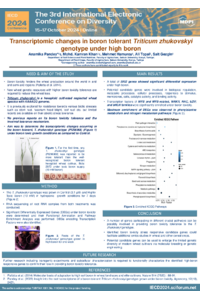
Triticum zhukovskyi is a hexaploid cultivated wheat form that was first reported by Upadhya and Swaminathan in 1963. The species with an AAAAGG genome developed from the crossing of domesticated T. timopheevii (AAGG) with cultivated einkorn T. monococcum (AA), established a separate lineage (AAGG). Despite its restricted distribution, the Timopheevi lineage has previously been explored for resistance towards various biotic stresses such as stem rust, fusarium head blight, leaf rust, etc. However, there are limited reports on the abiotic stress tolerance of T. zhukovskyi. Boron toxicity hinders wheat production around the world via yellowing and necrosis of leaves, limiting the plant's growth and development. In order to reduce this loss, it is necessary to identify diverse genetic wheat resources with greater tolerance towards high boron and understand the underlying mechanism that is responsible for making them boron-toxicity-tolerant. Here, we report a boron-toxicity-tolerant T. zhukovskyi genotype and discuss how the physiological and biochemical response towards high boron is associated with molecular changes in plants under boron toxicity. Differentially expressed genes in boron-treated plants were found to be directly related to different biochemical pathways. However, it is important to confirm the functions of these genes, so that these can be further utilized in breeding programs to diversify the boron toxicity tolerance trait in modern wheat cultivars. The future prospects of efficiently utilizing this genotype and the obtained information will also be thoroughly discussed.
Acknowledgements: The authors acknowledge the TUBITAK 1001 (No. 119O455) project for the funding provided to conduct this research work.
Keywords
abiotic stress
boron toxicity
genetic resources
pathways
RNA sequencing
expression profiling
Triticum species
wheat wild relatives
Poster
Poster_096857_AP.pdf
Genetic characterization of primitive and wild wheat species using SSR markers
Exploring the Biodiversity and Ecological Features of Fragile Alnus glutinosa Riverine woodlands: A Study on Vegetation Composition and Vulnerability in Fragmented Ecosystems