Event submissions
Published
This submission belongs to the session S6. Plant Diversity of the event The 3rd International Electronic Conference on Diversity
Published date
14 Oct, 2024
Academic Editor
'%3e%3cpath%20d='M12.6657%2010.9104C12.4185%2010.325%2012.0599%209.79327%2011.6097%209.34482C11.1609%208.89508%2010.6293%208.5365%2010.0442%208.28888C10.0389%208.28626%2010.0337%208.28495%2010.0285%208.28233C10.8446%207.69279%2011.3752%206.73249%2011.3752%205.64904C11.3752%203.8542%209.92103%202.39999%208.1262%202.39999C6.33136%202.39999%204.87715%203.8542%204.87715%205.64904C4.87715%206.73249%205.40774%207.69279%206.22393%208.28364C6.21869%208.28626%206.21345%208.28757%206.20821%208.29019C5.62129%208.5378%205.09463%208.89284%204.64265%209.34613C4.1929%209.79493%203.83432%2010.3266%203.58671%2010.9117C3.34345%2011.4845%203.21226%2012.0987%203.20023%2012.7209C3.19988%2012.7349%203.20233%2012.7488%203.20744%2012.7619C3.21255%2012.7749%203.22022%2012.7867%203.22998%2012.7968C3.23975%2012.8068%203.25142%2012.8147%203.26431%2012.8202C3.2772%2012.8256%203.29105%2012.8284%203.30504%2012.8284H4.09109C4.14874%2012.8284%204.19459%2012.7825%204.1959%2012.7262C4.2221%2011.7148%204.62823%2010.7676%205.34617%2010.0497C6.08899%209.30683%207.0755%208.89808%208.1262%208.89808C9.17689%208.89808%2010.1634%209.30683%2010.9062%2010.0497C11.6242%2010.7676%2012.0303%2011.7148%2012.0565%2012.7262C12.0578%2012.7838%2012.1037%2012.8284%2012.1613%2012.8284H12.9474C12.9613%2012.8284%2012.9752%2012.8256%2012.9881%2012.8202C13.001%2012.8147%2013.0126%2012.8068%2013.0224%2012.7968C13.0322%2012.7867%2013.0398%2012.7749%2013.0449%2012.7619C13.0501%2012.7488%2013.0525%2012.7349%2013.0522%2012.7209C13.0391%2012.0947%2012.9094%2011.4855%2012.6657%2010.9104ZM8.1262%207.9024C7.52486%207.9024%206.9589%207.6679%206.53312%207.24211C6.10733%206.81633%205.87283%206.25037%205.87283%205.64904C5.87283%205.0477%206.10733%204.48174%206.53312%204.05596C6.9589%203.63018%207.52486%203.39567%208.1262%203.39567C8.72753%203.39567%209.29349%203.63018%209.71927%204.05596C10.1451%204.48174%2010.3796%205.0477%2010.3796%205.64904C10.3796%206.25037%2010.1451%206.81633%209.71927%207.24211C9.29349%207.6679%208.72753%207.9024%208.1262%207.9024Z'%20fill='%235D1EE1'/%3e%3c/g%3e%3c/svg%3e) Mario A. Pagnotta
Mario A. PagnottaCitation
Faten Y. Ellmouni, Hesham H. ElFayoumi, Maryam W. Mohammed, Yasmeen M. Fekry, Reham Khaled, Ahmed Karem, Yousef Alamir, Mohamed Ahmed, Salma k. Shaltout, The floristic composition of some botanical gardens in the Fayoum Depression, Egypt., in Proceedings of The 3rd International Electronic Conference on Diversity, 15 October–17 October 2024, MDPI: Basel, Switzerland
Share
Email
Facebook
Twitter
LinkedIn
The floristic composition of some botanical gardens in the Fayoum Depression, Egypt.
'%3e%3cpath%20d='M12.6647%2010.9104C12.4176%2010.325%2012.0589%209.7933%2011.6088%209.34485C11.16%208.89511%2010.6283%208.53653%2010.0432%208.28891C10.038%208.28629%2010.0327%208.28498%2010.0275%208.28236C10.8437%207.69282%2011.3743%206.73252%2011.3743%205.64907C11.3743%203.85423%209.92005%202.40002%208.12522%202.40002C6.33038%202.40002%204.87618%203.85423%204.87618%205.64907C4.87618%206.73252%205.40677%207.69282%206.22296%208.28367C6.21772%208.28629%206.21248%208.2876%206.20724%208.29022C5.62031%208.53783%205.09365%208.89287%204.64167%209.34616C4.19192%209.79496%203.83334%2010.3266%203.58573%2010.9117C3.34247%2011.4846%203.21128%2012.0987%203.19925%2012.721C3.1989%2012.735%203.20135%2012.7489%203.20646%2012.7619C3.21157%2012.7749%203.21924%2012.7868%203.22901%2012.7968C3.23877%2012.8068%203.25045%2012.8148%203.26334%2012.8202C3.27623%2012.8256%203.29007%2012.8284%203.30406%2012.8284H4.09012C4.14776%2012.8284%204.19362%2012.7825%204.19493%2012.7262C4.22113%2011.7148%204.62726%2010.7676%205.34519%2010.0497C6.08802%209.30686%207.07452%208.89811%208.12522%208.89811C9.17592%208.89811%2010.1624%209.30686%2010.9052%2010.0497C11.6232%2010.7676%2012.0293%2011.7148%2012.0555%2012.7262C12.0568%2012.7839%2012.1027%2012.8284%2012.1603%2012.8284H12.9464C12.9604%2012.8284%2012.9742%2012.8256%2012.9871%2012.8202C13%2012.8148%2013.0117%2012.8068%2013.0214%2012.7968C13.0312%2012.7868%2013.0389%2012.7749%2013.044%2012.7619C13.0491%2012.7489%2013.0515%2012.735%2013.0512%2012.721C13.0381%2012.0947%2012.9084%2011.4856%2012.6647%2010.9104ZM8.12522%207.90243C7.52388%207.90243%206.95792%207.66793%206.53214%207.24215C6.10636%206.81636%205.87185%206.2504%205.87185%205.64907C5.87185%205.04773%206.10636%204.48177%206.53214%204.05599C6.95792%203.63021%207.52388%203.3957%208.12522%203.3957C8.72655%203.3957%209.29252%203.63021%209.7183%204.05599C10.1441%204.48177%2010.3786%205.04773%2010.3786%205.64907C10.3786%206.2504%2010.1441%206.81636%209.7183%207.24215C9.29252%207.66793%208.72655%207.90243%208.12522%207.90243Z'%20fill='%235D1EE1'/%3e%3c/g%3e%3c/svg%3e)
Faten Y. Ellmouni 1
Hesham H. ElFayoumi 1
Maryam W. Mohammed 1
Yasmeen M. Fekry 1
Reham Khaled 1
Ahmed Karem 1
Yousef Alamir 1
Mohamed Ahmed 1
Salma k. Shaltout 2
1. Botany Department, Faculty of Science, Fayoum University, Fayoum 63514, Egypt
2. Department of Botany, Faculty of Science, Tanta University, Tanta 31527, Egypt
Abstract
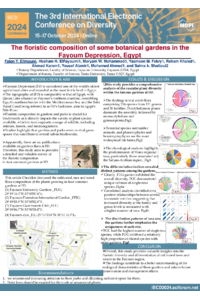
The Fayoum Depression (FD) is considered one of the world's oldest agricultural cities and the most fertile agrarian terrain in Egypt. The topography of FD is comparable to that of Egypt, with Qarun Lake situated on Fayoum's northern coastline, resembling Egypt's northern border with the Mediterranean Sea, and the Bahr Yusuf Canal, referred to as FD's backbone, being akin to Egypt's Nile River. This article discusses the cultivated, tree, and weed flora composition of the plants growing in four common gardens in the FD (Fayoum University Gardens—FUGs, Fayoum Plantation International Garden—FPIG, Fayoum Governorate Club—FGC, and Fayoum Zoo—FZ). Two hundred sixteen species and one hundred fifty-one genera representing 58 plant families have been identified. Asteraceae, Moraceae, and Fabaceae are the richest families of the region's floristic composition. Unexpectedly, perennial species (81%) were dominant over annual species (19%). This is a prominent feature in the FD, where perennial species may be more tolerant of climatic changeability than annual species. Six life form categories were found; Phanerophytes (46.5%) were the most common life form, followed by Hemicryptophytes (38%). Furthermore, there were four primary phytogeographical plant groups: worldwide, bi-regional, pluri-regional, and mono-regional. The largest participation rates were seen in the bi-regional and mono-regional categories, with 21% and 53%, respectively. Twenty-seven species (13%) were found to be native to the Saharo-Arabian region. The current results of the flora survey include information on the life form, chorology, and lifespan of the area's wild and cultivated plants, as well as information on their collection, identification, and documentation.
Keywords
Fayoum Depression
gardens
floristic composition
life form
life spin
chorology
Poster
Faten_Ellmouni_ 101618_poster.pdf
Unveiling Diversity: Morphological and Biochemical Insights into Datura metel L. Accessions
Reprogramming of Proteins and modulation of Antioxidant Enzymes in Alfalfa (Medicago sativa) Seedlings.