Event submissions
Published
This submission belongs to the session S6. Plant Diversity of the event The 3rd International Electronic Conference on Diversity
Published date
14 Oct, 2024
Academic Editor
'%3e%3cpath%20d='M12.6657%2010.9104C12.4185%2010.325%2012.0599%209.79327%2011.6097%209.34482C11.1609%208.89508%2010.6293%208.5365%2010.0442%208.28888C10.0389%208.28626%2010.0337%208.28495%2010.0285%208.28233C10.8446%207.69279%2011.3752%206.73249%2011.3752%205.64904C11.3752%203.8542%209.92103%202.39999%208.1262%202.39999C6.33136%202.39999%204.87715%203.8542%204.87715%205.64904C4.87715%206.73249%205.40774%207.69279%206.22393%208.28364C6.21869%208.28626%206.21345%208.28757%206.20821%208.29019C5.62129%208.5378%205.09463%208.89284%204.64265%209.34613C4.1929%209.79493%203.83432%2010.3266%203.58671%2010.9117C3.34345%2011.4845%203.21226%2012.0987%203.20023%2012.7209C3.19988%2012.7349%203.20233%2012.7488%203.20744%2012.7619C3.21255%2012.7749%203.22022%2012.7867%203.22998%2012.7968C3.23975%2012.8068%203.25142%2012.8147%203.26431%2012.8202C3.2772%2012.8256%203.29105%2012.8284%203.30504%2012.8284H4.09109C4.14874%2012.8284%204.19459%2012.7825%204.1959%2012.7262C4.2221%2011.7148%204.62823%2010.7676%205.34617%2010.0497C6.08899%209.30683%207.0755%208.89808%208.1262%208.89808C9.17689%208.89808%2010.1634%209.30683%2010.9062%2010.0497C11.6242%2010.7676%2012.0303%2011.7148%2012.0565%2012.7262C12.0578%2012.7838%2012.1037%2012.8284%2012.1613%2012.8284H12.9474C12.9613%2012.8284%2012.9752%2012.8256%2012.9881%2012.8202C13.001%2012.8147%2013.0126%2012.8068%2013.0224%2012.7968C13.0322%2012.7867%2013.0398%2012.7749%2013.0449%2012.7619C13.0501%2012.7488%2013.0525%2012.7349%2013.0522%2012.7209C13.0391%2012.0947%2012.9094%2011.4855%2012.6657%2010.9104ZM8.1262%207.9024C7.52486%207.9024%206.9589%207.6679%206.53312%207.24211C6.10733%206.81633%205.87283%206.25037%205.87283%205.64904C5.87283%205.0477%206.10733%204.48174%206.53312%204.05596C6.9589%203.63018%207.52486%203.39567%208.1262%203.39567C8.72753%203.39567%209.29349%203.63018%209.71927%204.05596C10.1451%204.48174%2010.3796%205.0477%2010.3796%205.64904C10.3796%206.25037%2010.1451%206.81633%209.71927%207.24211C9.29349%207.6679%208.72753%207.9024%208.1262%207.9024Z'%20fill='%235D1EE1'/%3e%3c/g%3e%3c/svg%3e) Mario A. Pagnotta
Mario A. PagnottaCitation
Denitsa Kancheva, Milena Nikolova, Ina Aneva, Comparative study of rosmarinic acid content in methanolic extracts of Bulgarian Thymus species, section Hyphodromi, in Proceedings of The 3rd International Electronic Conference on Diversity, 15 October–17 October 2024, MDPI: Basel, Switzerland
Share
Email
Facebook
Twitter
LinkedIn
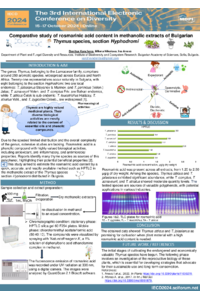
Comparative study of rosmarinic acid content in methanolic extracts of Bulgarian Thymus species, section Hyphodromi
'%3e%3cpath%20d='M12.6647%2010.9104C12.4176%2010.325%2012.0589%209.7933%2011.6088%209.34485C11.16%208.89511%2010.6283%208.53653%2010.0432%208.28891C10.038%208.28629%2010.0327%208.28498%2010.0275%208.28236C10.8437%207.69282%2011.3743%206.73252%2011.3743%205.64907C11.3743%203.85423%209.92005%202.40002%208.12522%202.40002C6.33038%202.40002%204.87618%203.85423%204.87618%205.64907C4.87618%206.73252%205.40677%207.69282%206.22296%208.28367C6.21772%208.28629%206.21248%208.2876%206.20724%208.29022C5.62031%208.53783%205.09365%208.89287%204.64167%209.34616C4.19192%209.79496%203.83334%2010.3266%203.58573%2010.9117C3.34247%2011.4846%203.21128%2012.0987%203.19925%2012.721C3.1989%2012.735%203.20135%2012.7489%203.20646%2012.7619C3.21157%2012.7749%203.21924%2012.7868%203.22901%2012.7968C3.23877%2012.8068%203.25045%2012.8148%203.26334%2012.8202C3.27623%2012.8256%203.29007%2012.8284%203.30406%2012.8284H4.09012C4.14776%2012.8284%204.19362%2012.7825%204.19493%2012.7262C4.22113%2011.7148%204.62726%2010.7676%205.34519%2010.0497C6.08802%209.30686%207.07452%208.89811%208.12522%208.89811C9.17592%208.89811%2010.1624%209.30686%2010.9052%2010.0497C11.6232%2010.7676%2012.0293%2011.7148%2012.0555%2012.7262C12.0568%2012.7839%2012.1027%2012.8284%2012.1603%2012.8284H12.9464C12.9604%2012.8284%2012.9742%2012.8256%2012.9871%2012.8202C13%2012.8148%2013.0117%2012.8068%2013.0214%2012.7968C13.0312%2012.7868%2013.0389%2012.7749%2013.044%2012.7619C13.0491%2012.7489%2013.0515%2012.735%2013.0512%2012.721C13.0381%2012.0947%2012.9084%2011.4856%2012.6647%2010.9104ZM8.12522%207.90243C7.52388%207.90243%206.95792%207.66793%206.53214%207.24215C6.10636%206.81636%205.87185%206.2504%205.87185%205.64907C5.87185%205.04773%206.10636%204.48177%206.53214%204.05599C6.95792%203.63021%207.52388%203.3957%208.12522%203.3957C8.72655%203.3957%209.29252%203.63021%209.7183%204.05599C10.1441%204.48177%2010.3786%205.04773%2010.3786%205.64907C10.3786%206.2504%2010.1441%206.81636%209.7183%207.24215C9.29252%207.66793%208.72655%207.90243%208.12522%207.90243Z'%20fill='%235D1EE1'/%3e%3c/g%3e%3c/svg%3e)
Denitsa Kancheva 1
Milena Nikolova 1

Ina Aneva 1
1. Department of Plant and Fungal Diversity and Resources, Institute of Biodiversity and Ecosystem Research, Bulgarian Academy of Sciences, Sofia, Bulgaria.
Abstract
Genus Thymus consists of around 250 species known for their therapeutic properties: antioxidant, anti-inflammatory, expectorant, and carminative. Twenty-one species occur naturally in Bulgaria, with eight belonging to the section Hyphodromi: Bulgarian endemics: T. jalasianus Stoyanov & Marinov. and T. perinicus (Velen.) Jalas; Balkan endemics: T. aznavourii Velen. T. compus Friv.; T. atticus Čelak (sub-endemic), as well as T. leucotrichus Halácsy T. striatus Vahl. and T. zygioides Griseb., all widespread. Due to the species’ limited distribution and the overall complexity of the genus, extensive studies are lacking. Rosmarinic acid is a phenolic compound with highly valued biological activities, including antioxidant, anti-inflammatory, and antimicrobial properties. Many thyme species are reported to be sources of this polyphenol, showcasing their potential beneficial properties. This study aimed to estimate the rosmarinic acid content by a quick, accurate, and readily available method such as HPTLC in the methanolic extract of the Thymus species section Hyphodromi distributed in Bulgaria. Plant materials were collected from the natural localities of the studied taxa. The quantification of rosmarinic content was achieved using HPTLC silica gel 60 F254 plates. The mobile phase was chloroform/ethyl acetate/formic acid (50:40:10). The compounds were visualized by spraying with ‘Naturstoffreagenz A’ reagent. The fluorescence emission of rosmarinic acid was recorded under UV radiation at 336 nm, using a digital camera. The images were analyzed by QuantiScan 2.1 Biosoft software. The results shows that the content varied between 1.20 and 2.50 μg/g dry weight. Thymus atticus and T. jalasianus extracts were found to be the richest sources of rosmarinic acid, while those of T. comptus, T. aznavouiri, and T. striatus showed moderate levels. The obtained data showed Thymus atticus and T. jalasianus as promising for cultivation when plant material with a high rosmarinic acid content is needed.
Keywords
Thymus
medicinal plants
rosmarinic acid
natural antioxidant
Poster
PosterRA 097136.pdf
Fern Diversity and Soil Characteristics in the Moist Temperate Deciduous Forest of the Indian Central Himalayas.
Aegilops species as a source of boron toxicity tolerance