Event submissions
Published
This submission belongs to the session S6. Plant Diversity of the event The 3rd International Electronic Conference on Diversity
Published date
14 Oct, 2024
Academic Editor
'%3e%3cpath%20d='M12.6657%2010.9104C12.4185%2010.325%2012.0599%209.79327%2011.6097%209.34482C11.1609%208.89508%2010.6293%208.5365%2010.0442%208.28888C10.0389%208.28626%2010.0337%208.28495%2010.0285%208.28233C10.8446%207.69279%2011.3752%206.73249%2011.3752%205.64904C11.3752%203.8542%209.92103%202.39999%208.1262%202.39999C6.33136%202.39999%204.87715%203.8542%204.87715%205.64904C4.87715%206.73249%205.40774%207.69279%206.22393%208.28364C6.21869%208.28626%206.21345%208.28757%206.20821%208.29019C5.62129%208.5378%205.09463%208.89284%204.64265%209.34613C4.1929%209.79493%203.83432%2010.3266%203.58671%2010.9117C3.34345%2011.4845%203.21226%2012.0987%203.20023%2012.7209C3.19988%2012.7349%203.20233%2012.7488%203.20744%2012.7619C3.21255%2012.7749%203.22022%2012.7867%203.22998%2012.7968C3.23975%2012.8068%203.25142%2012.8147%203.26431%2012.8202C3.2772%2012.8256%203.29105%2012.8284%203.30504%2012.8284H4.09109C4.14874%2012.8284%204.19459%2012.7825%204.1959%2012.7262C4.2221%2011.7148%204.62823%2010.7676%205.34617%2010.0497C6.08899%209.30683%207.0755%208.89808%208.1262%208.89808C9.17689%208.89808%2010.1634%209.30683%2010.9062%2010.0497C11.6242%2010.7676%2012.0303%2011.7148%2012.0565%2012.7262C12.0578%2012.7838%2012.1037%2012.8284%2012.1613%2012.8284H12.9474C12.9613%2012.8284%2012.9752%2012.8256%2012.9881%2012.8202C13.001%2012.8147%2013.0126%2012.8068%2013.0224%2012.7968C13.0322%2012.7867%2013.0398%2012.7749%2013.0449%2012.7619C13.0501%2012.7488%2013.0525%2012.7349%2013.0522%2012.7209C13.0391%2012.0947%2012.9094%2011.4855%2012.6657%2010.9104ZM8.1262%207.9024C7.52486%207.9024%206.9589%207.6679%206.53312%207.24211C6.10733%206.81633%205.87283%206.25037%205.87283%205.64904C5.87283%205.0477%206.10733%204.48174%206.53312%204.05596C6.9589%203.63018%207.52486%203.39567%208.1262%203.39567C8.72753%203.39567%209.29349%203.63018%209.71927%204.05596C10.1451%204.48174%2010.3796%205.0477%2010.3796%205.64904C10.3796%206.25037%2010.1451%206.81633%209.71927%207.24211C9.29349%207.6679%208.72753%207.9024%208.1262%207.9024Z'%20fill='%235D1EE1'/%3e%3c/g%3e%3c/svg%3e) Russell Wang
Russell WangCitation
Ioannis Zografakis, Emmanouil Avramakis, Theodoros Vrachnakis, Dimitrios Kollaros, Ioannis Chasourakis, Antonios Loulakis, Antonia Bagkeri, Nikolaos Volakakis, Pagona Kampanou, Dionysis Kontoyiannis, Dimitrios Markakis, Argiro Strataridaki, Emmanouil Kambourakis, Plant diversity and agroecosystem service provision in olive orchards in Crete, Greece: The effect of agricultural management systems and agroecological zones, in Proceedings of The 3rd International Electronic Conference on Diversity, 15 October–17 October 2024, MDPI: Basel, Switzerland
Share
Email
Facebook
Twitter
LinkedIn
Plant diversity and agroecosystem service provision in olive orchards in Crete, Greece: The effect of agricultural management systems and agroecological zones
'%3e%3cpath%20d='M12.6647%2010.9104C12.4176%2010.325%2012.0589%209.7933%2011.6088%209.34485C11.16%208.89511%2010.6283%208.53653%2010.0432%208.28891C10.038%208.28629%2010.0327%208.28498%2010.0275%208.28236C10.8437%207.69282%2011.3743%206.73252%2011.3743%205.64907C11.3743%203.85423%209.92005%202.40002%208.12522%202.40002C6.33038%202.40002%204.87618%203.85423%204.87618%205.64907C4.87618%206.73252%205.40677%207.69282%206.22296%208.28367C6.21772%208.28629%206.21248%208.2876%206.20724%208.29022C5.62031%208.53783%205.09365%208.89287%204.64167%209.34616C4.19192%209.79496%203.83334%2010.3266%203.58573%2010.9117C3.34247%2011.4846%203.21128%2012.0987%203.19925%2012.721C3.1989%2012.735%203.20135%2012.7489%203.20646%2012.7619C3.21157%2012.7749%203.21924%2012.7868%203.22901%2012.7968C3.23877%2012.8068%203.25045%2012.8148%203.26334%2012.8202C3.27623%2012.8256%203.29007%2012.8284%203.30406%2012.8284H4.09012C4.14776%2012.8284%204.19362%2012.7825%204.19493%2012.7262C4.22113%2011.7148%204.62726%2010.7676%205.34519%2010.0497C6.08802%209.30686%207.07452%208.89811%208.12522%208.89811C9.17592%208.89811%2010.1624%209.30686%2010.9052%2010.0497C11.6232%2010.7676%2012.0293%2011.7148%2012.0555%2012.7262C12.0568%2012.7839%2012.1027%2012.8284%2012.1603%2012.8284H12.9464C12.9604%2012.8284%2012.9742%2012.8256%2012.9871%2012.8202C13%2012.8148%2013.0117%2012.8068%2013.0214%2012.7968C13.0312%2012.7868%2013.0389%2012.7749%2013.044%2012.7619C13.0491%2012.7489%2013.0515%2012.735%2013.0512%2012.721C13.0381%2012.0947%2012.9084%2011.4856%2012.6647%2010.9104ZM8.12522%207.90243C7.52388%207.90243%206.95792%207.66793%206.53214%207.24215C6.10636%206.81636%205.87185%206.2504%205.87185%205.64907C5.87185%205.04773%206.10636%204.48177%206.53214%204.05599C6.95792%203.63021%207.52388%203.3957%208.12522%203.3957C8.72655%203.3957%209.29252%203.63021%209.7183%204.05599C10.1441%204.48177%2010.3786%205.04773%2010.3786%205.64907C10.3786%206.2504%2010.1441%206.81636%209.7183%207.24215C9.29252%207.66793%208.72655%207.90243%208.12522%207.90243Z'%20fill='%235D1EE1'/%3e%3c/g%3e%3c/svg%3e)
Ioannis Zografakis 1
Emmanouil Avramakis 2
Theodoros Vrachnakis 1
Dimitrios Kollaros 1
Ioannis Chasourakis 1
Antonios Loulakis 1
Antonia Bagkeri 1
Nikolaos Volakakis 1
Pagona Kampanou 1
Dionysis Kontoyiannis 1
Dimitrios Markakis 1
Argiro Strataridaki 1
Emmanouil Kambourakis 1
1. Olive, Vine and Agroecological Production Systems Lab, Department of Agriculture, Hellenic Mediterranean University, Estavromenos, 71004 Heraklion, Greece
2. Natural History Museum of Crete, University of Crete, Knossou Avenue, 71409 Heraklion, Greece.
Abstract
The agricultural expansion and intensification of farming practices have deteriorated natural and agricultural ecosystems worldwide. Olive orchards cover the 1/4 of the agricultural land in Crete and about the 20% of the Cretan landscape, contributing largely to the island’s topography, economy and cultural heritage. The management of spontaneous vegetation with sustainable/agroecological practices can be an important measure to mitigate the adverse effects of intensive farming in olive orchards, providing several agroecosystem services. Vegetative soil cover and plant diversity are directly related to biodiversity conservation, soil fertility, water quality and quantity, pest management, landscape conservation, outdoor recreation, climate regulation and resilience to climate change. Plant diversity and the effect of management systems and agroecological zones were studied in six paired conventional and organic olive orchards in Crete. The orchards are located at two agroecological zones (hilly and plain). In each orchard, the floristic diversity was determined in 3/ha monitoring stations (64 m2 area) for a 1-year period. The effects of management system and agroecological zone on floristic diversity were determined with biodiversity indices and univariate comparative analyses. In total, 270 species of plants were identified, including 50 edible species and 40 legumes, indicating the importance of spontaneous vegetation for the provision of agroecosystem services. The agroecological zone shapes the floristic diversity of olive orchards, especially in the wet period, with a higher diversity expected to be present in the hilly zone. Plant diversity did not present significant differences between organic and conventional orchards. The variety of farming practices and the intensity applied among the orchards are responsible for the above result. Further analysis of the effect of each farming practice on floristic diversity is needed to determine which practices are the most suitable for the improvement of olive orchards' environmental performance.
Keywords
Agroecology
Plant diversity
Olive orchards
Green infrastructure
Organic farming
Poster
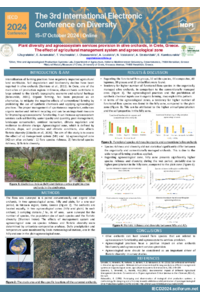
Zografakis Ioannis IECD Conference poster presentation.pdf
Taxonomic Revision of genus Annona native to Africa using selected barcode loci (matK, trnL and rbcL)
Genome size variation in Peruvian Andean maize landraces