Event submissions
Published
This submission belongs to the session S3. Marine Diversity of the event The 3rd International Electronic Conference on Diversity
Published date
14 Oct, 2024
Academic Editor
'%3e%3cpath%20d='M12.6657%2010.9104C12.4185%2010.325%2012.0599%209.79327%2011.6097%209.34482C11.1609%208.89508%2010.6293%208.5365%2010.0442%208.28888C10.0389%208.28626%2010.0337%208.28495%2010.0285%208.28233C10.8446%207.69279%2011.3752%206.73249%2011.3752%205.64904C11.3752%203.8542%209.92103%202.39999%208.1262%202.39999C6.33136%202.39999%204.87715%203.8542%204.87715%205.64904C4.87715%206.73249%205.40774%207.69279%206.22393%208.28364C6.21869%208.28626%206.21345%208.28757%206.20821%208.29019C5.62129%208.5378%205.09463%208.89284%204.64265%209.34613C4.1929%209.79493%203.83432%2010.3266%203.58671%2010.9117C3.34345%2011.4845%203.21226%2012.0987%203.20023%2012.7209C3.19988%2012.7349%203.20233%2012.7488%203.20744%2012.7619C3.21255%2012.7749%203.22022%2012.7867%203.22998%2012.7968C3.23975%2012.8068%203.25142%2012.8147%203.26431%2012.8202C3.2772%2012.8256%203.29105%2012.8284%203.30504%2012.8284H4.09109C4.14874%2012.8284%204.19459%2012.7825%204.1959%2012.7262C4.2221%2011.7148%204.62823%2010.7676%205.34617%2010.0497C6.08899%209.30683%207.0755%208.89808%208.1262%208.89808C9.17689%208.89808%2010.1634%209.30683%2010.9062%2010.0497C11.6242%2010.7676%2012.0303%2011.7148%2012.0565%2012.7262C12.0578%2012.7838%2012.1037%2012.8284%2012.1613%2012.8284H12.9474C12.9613%2012.8284%2012.9752%2012.8256%2012.9881%2012.8202C13.001%2012.8147%2013.0126%2012.8068%2013.0224%2012.7968C13.0322%2012.7867%2013.0398%2012.7749%2013.0449%2012.7619C13.0501%2012.7488%2013.0525%2012.7349%2013.0522%2012.7209C13.0391%2012.0947%2012.9094%2011.4855%2012.6657%2010.9104ZM8.1262%207.9024C7.52486%207.9024%206.9589%207.6679%206.53312%207.24211C6.10733%206.81633%205.87283%206.25037%205.87283%205.64904C5.87283%205.0477%206.10733%204.48174%206.53312%204.05596C6.9589%203.63018%207.52486%203.39567%208.1262%203.39567C8.72753%203.39567%209.29349%203.63018%209.71927%204.05596C10.1451%204.48174%2010.3796%205.0477%2010.3796%205.64904C10.3796%206.25037%2010.1451%206.81633%209.71927%207.24211C9.29349%207.6679%208.72753%207.9024%208.1262%207.9024Z'%20fill='%235D1EE1'/%3e%3c/g%3e%3c/svg%3e) Paulo Vale
Paulo ValeCitation
Marina Guller, Lucía Alejandra Bonavita, Diego G. Zelaya, Cephalopoda (Mollusca) from the Southwestern Austral Atlantic: an ongoing integrative study, in Proceedings of The 3rd International Electronic Conference on Diversity, 15 October–17 October 2024, MDPI: Basel, Switzerland
Share
Email
Facebook
Twitter
LinkedIn
Cephalopoda (Mollusca) from the Southwestern Austral Atlantic: an ongoing integrative study
'%3e%3cpath%20d='M12.6647%2010.9104C12.4176%2010.325%2012.0589%209.7933%2011.6088%209.34485C11.16%208.89511%2010.6283%208.53653%2010.0432%208.28891C10.038%208.28629%2010.0327%208.28498%2010.0275%208.28236C10.8437%207.69282%2011.3743%206.73252%2011.3743%205.64907C11.3743%203.85423%209.92005%202.40002%208.12522%202.40002C6.33038%202.40002%204.87618%203.85423%204.87618%205.64907C4.87618%206.73252%205.40677%207.69282%206.22296%208.28367C6.21772%208.28629%206.21248%208.2876%206.20724%208.29022C5.62031%208.53783%205.09365%208.89287%204.64167%209.34616C4.19192%209.79496%203.83334%2010.3266%203.58573%2010.9117C3.34247%2011.4846%203.21128%2012.0987%203.19925%2012.721C3.1989%2012.735%203.20135%2012.7489%203.20646%2012.7619C3.21157%2012.7749%203.21924%2012.7868%203.22901%2012.7968C3.23877%2012.8068%203.25045%2012.8148%203.26334%2012.8202C3.27623%2012.8256%203.29007%2012.8284%203.30406%2012.8284H4.09012C4.14776%2012.8284%204.19362%2012.7825%204.19493%2012.7262C4.22113%2011.7148%204.62726%2010.7676%205.34519%2010.0497C6.08802%209.30686%207.07452%208.89811%208.12522%208.89811C9.17592%208.89811%2010.1624%209.30686%2010.9052%2010.0497C11.6232%2010.7676%2012.0293%2011.7148%2012.0555%2012.7262C12.0568%2012.7839%2012.1027%2012.8284%2012.1603%2012.8284H12.9464C12.9604%2012.8284%2012.9742%2012.8256%2012.9871%2012.8202C13%2012.8148%2013.0117%2012.8068%2013.0214%2012.7968C13.0312%2012.7868%2013.0389%2012.7749%2013.044%2012.7619C13.0491%2012.7489%2013.0515%2012.735%2013.0512%2012.721C13.0381%2012.0947%2012.9084%2011.4856%2012.6647%2010.9104ZM8.12522%207.90243C7.52388%207.90243%206.95792%207.66793%206.53214%207.24215C6.10636%206.81636%205.87185%206.2504%205.87185%205.64907C5.87185%205.04773%206.10636%204.48177%206.53214%204.05599C6.95792%203.63021%207.52388%203.3957%208.12522%203.3957C8.72655%203.3957%209.29252%203.63021%209.7183%204.05599C10.1441%204.48177%2010.3786%205.04773%2010.3786%205.64907C10.3786%206.2504%2010.1441%206.81636%209.7183%207.24215C9.29252%207.66793%208.72655%207.90243%208.12522%207.90243Z'%20fill='%235D1EE1'/%3e%3c/g%3e%3c/svg%3e)
Marina Guller 1,2
Lucía Alejandra Bonavita 1
Diego G. Zelaya 1,2
1. Departamento de Biodiversidad y Biología Experimental, Facultad de Ciencias Exactas y Naturales, Universidad de Buenos Aires, Argentina
2. Consejo Nacional de Investigaciones Científicas y Técnicas (CONICET), Argentina
Abstract
The Southwestern Austral Atlantic Ocean encompasses the southernmost tip of South America (the nearby shelf of Tierra del Fuego archipelago), the Burdwood Bank, the Malvinas / Falkland Islands, and their adjacent slope areas. Although it represents an area of great biological importance, knowledge on the marine biodiversity of this area is still limited. This is particularly noticeable in the case of cephalopod fauna species, many of which are only known from few (and occasional) records, and several nominal species have been mentioned without proper supporting information (photographs, vouchers, or similar). The aim of this research is to perform the first integrative study of the orders Octopoda and Sepiida of the Class Cephalopoda (Mollusca) occurring in the Southwestern Austral Atlantic, by combining morphological, morphometric, anatomical, and molecular characters. For that, newly obtained samples, collected between 2015 and 2018 by the Argentine research vessels GC-189 Prefecto García and BO Puerto Deseado, were studied. The specimens studied come from 37 sampling stations located between 53-55°S and 58-68°W in depths ranging from 40 to 785 m. Recently sampled cephalopods were photographed to document the coloration pattern of living specimens. Then, specimens were fixed for morphological, morphometric, and anatomical studies, which were performed in the laboratory; a small piece of tissue was preserved in ethanol for molecular studies (COI). For comparative purposes, the available type material of all nominal species described from this area was studied. As part of this study, eight cephalopod species were recognized, comprising two species of sepiolids and six species of octopods. Octopods belonged to the genera Enteroctopus, Muusoctopus, Graneledone, and Thaumeledone, and, among the studied material, a new (undescribed) species was recognized.
Keywords
Octopoda
Sepiolidae
AMP Namuncurá-Banco Burdwood
Argentina
Poster
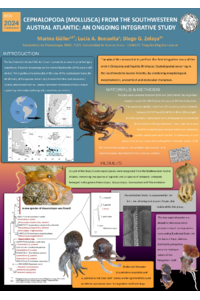
Guller et al, 2024 - Cephalopod Poster.pdf
Fish Assemblages Reveal the Environmental Heterogeneity of Shallow Coastal Areas in Monte Hermoso, Argentina
Evolutionary functional adaptations in the gills of the crab Achelous hastatus (Linnaeus, 1767) from Ganzirri coast, Messina (Italy)