Event submissions
Published
This submission belongs to the session S3. Marine Diversity of the event The 3rd International Electronic Conference on Diversity
Published date
14 Oct, 2024
Academic Editor
'%3e%3cpath%20d='M12.6657%2010.9104C12.4185%2010.325%2012.0599%209.79327%2011.6097%209.34482C11.1609%208.89508%2010.6293%208.5365%2010.0442%208.28888C10.0389%208.28626%2010.0337%208.28495%2010.0285%208.28233C10.8446%207.69279%2011.3752%206.73249%2011.3752%205.64904C11.3752%203.8542%209.92103%202.39999%208.1262%202.39999C6.33136%202.39999%204.87715%203.8542%204.87715%205.64904C4.87715%206.73249%205.40774%207.69279%206.22393%208.28364C6.21869%208.28626%206.21345%208.28757%206.20821%208.29019C5.62129%208.5378%205.09463%208.89284%204.64265%209.34613C4.1929%209.79493%203.83432%2010.3266%203.58671%2010.9117C3.34345%2011.4845%203.21226%2012.0987%203.20023%2012.7209C3.19988%2012.7349%203.20233%2012.7488%203.20744%2012.7619C3.21255%2012.7749%203.22022%2012.7867%203.22998%2012.7968C3.23975%2012.8068%203.25142%2012.8147%203.26431%2012.8202C3.2772%2012.8256%203.29105%2012.8284%203.30504%2012.8284H4.09109C4.14874%2012.8284%204.19459%2012.7825%204.1959%2012.7262C4.2221%2011.7148%204.62823%2010.7676%205.34617%2010.0497C6.08899%209.30683%207.0755%208.89808%208.1262%208.89808C9.17689%208.89808%2010.1634%209.30683%2010.9062%2010.0497C11.6242%2010.7676%2012.0303%2011.7148%2012.0565%2012.7262C12.0578%2012.7838%2012.1037%2012.8284%2012.1613%2012.8284H12.9474C12.9613%2012.8284%2012.9752%2012.8256%2012.9881%2012.8202C13.001%2012.8147%2013.0126%2012.8068%2013.0224%2012.7968C13.0322%2012.7867%2013.0398%2012.7749%2013.0449%2012.7619C13.0501%2012.7488%2013.0525%2012.7349%2013.0522%2012.7209C13.0391%2012.0947%2012.9094%2011.4855%2012.6657%2010.9104ZM8.1262%207.9024C7.52486%207.9024%206.9589%207.6679%206.53312%207.24211C6.10733%206.81633%205.87283%206.25037%205.87283%205.64904C5.87283%205.0477%206.10733%204.48174%206.53312%204.05596C6.9589%203.63018%207.52486%203.39567%208.1262%203.39567C8.72753%203.39567%209.29349%203.63018%209.71927%204.05596C10.1451%204.48174%2010.3796%205.0477%2010.3796%205.64904C10.3796%206.25037%2010.1451%206.81633%209.71927%207.24211C9.29349%207.6679%208.72753%207.9024%208.1262%207.9024Z'%20fill='%235D1EE1'/%3e%3c/g%3e%3c/svg%3e) Gioele Capillo
Gioele CapilloCitation
Daniela Klisarova, Dimitar Gerdzhikov, Petya Dragomirova, Dynamics of Lingulodinium polyedra development in the Bulgarian part of Black Sea (1992-2022), in Proceedings of The 3rd International Electronic Conference on Diversity, 15 October–17 October 2024, MDPI: Basel, Switzerland
Share
Email
Facebook
Twitter
LinkedIn
Dynamics of Lingulodinium polyedra development in the Bulgarian part of Black Sea (1992-2022)
'%3e%3cpath%20d='M12.6647%2010.9104C12.4176%2010.325%2012.0589%209.7933%2011.6088%209.34485C11.16%208.89511%2010.6283%208.53653%2010.0432%208.28891C10.038%208.28629%2010.0327%208.28498%2010.0275%208.28236C10.8437%207.69282%2011.3743%206.73252%2011.3743%205.64907C11.3743%203.85423%209.92005%202.40002%208.12522%202.40002C6.33038%202.40002%204.87618%203.85423%204.87618%205.64907C4.87618%206.73252%205.40677%207.69282%206.22296%208.28367C6.21772%208.28629%206.21248%208.2876%206.20724%208.29022C5.62031%208.53783%205.09365%208.89287%204.64167%209.34616C4.19192%209.79496%203.83334%2010.3266%203.58573%2010.9117C3.34247%2011.4846%203.21128%2012.0987%203.19925%2012.721C3.1989%2012.735%203.20135%2012.7489%203.20646%2012.7619C3.21157%2012.7749%203.21924%2012.7868%203.22901%2012.7968C3.23877%2012.8068%203.25045%2012.8148%203.26334%2012.8202C3.27623%2012.8256%203.29007%2012.8284%203.30406%2012.8284H4.09012C4.14776%2012.8284%204.19362%2012.7825%204.19493%2012.7262C4.22113%2011.7148%204.62726%2010.7676%205.34519%2010.0497C6.08802%209.30686%207.07452%208.89811%208.12522%208.89811C9.17592%208.89811%2010.1624%209.30686%2010.9052%2010.0497C11.6232%2010.7676%2012.0293%2011.7148%2012.0555%2012.7262C12.0568%2012.7839%2012.1027%2012.8284%2012.1603%2012.8284H12.9464C12.9604%2012.8284%2012.9742%2012.8256%2012.9871%2012.8202C13%2012.8148%2013.0117%2012.8068%2013.0214%2012.7968C13.0312%2012.7868%2013.0389%2012.7749%2013.044%2012.7619C13.0491%2012.7489%2013.0515%2012.735%2013.0512%2012.721C13.0381%2012.0947%2012.9084%2011.4856%2012.6647%2010.9104ZM8.12522%207.90243C7.52388%207.90243%206.95792%207.66793%206.53214%207.24215C6.10636%206.81636%205.87185%206.2504%205.87185%205.64907C5.87185%205.04773%206.10636%204.48177%206.53214%204.05599C6.95792%203.63021%207.52388%203.3957%208.12522%203.3957C8.72655%203.3957%209.29252%203.63021%209.7183%204.05599C10.1441%204.48177%2010.3786%205.04773%2010.3786%205.64907C10.3786%206.2504%2010.1441%206.81636%209.7183%207.24215C9.29252%207.66793%208.72655%207.90243%208.12522%207.90243Z'%20fill='%235D1EE1'/%3e%3c/g%3e%3c/svg%3e)
Daniela Klisarova 1,2
Dimitar Gerdzhikov 2
Petya Dragomirova 1
1. Department of Anatomy, Histology, Cytology and Biology, Faculty of Medicine, Medical University,
5800 Pleven, Bulgaria
2. Institute of Fish resources, Agriculture Academy, Varna, Bulgaria, 9000, PoBox72, Primorski 4
Abstract
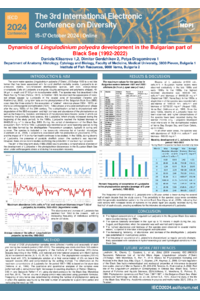
Long-term data on the phytoplankton of the Bulgarian Black Sea (BBS) coast describe three states for the ecosystem: a “pristine” reference phase (1954-1970 years); an intensive anthropogenic eutrophication (1970-1991 years) phase; and a post-eutrophication phase after the early 1990s of the 20th century. The eutrophication period is characterised with ecosystem degradation and intense phytoplankton blooms, some of which are formed by the potentially toxic species Lingulodinium polyedra. This warm-water species is a red tide former that has been associated with fish and shellfish mortality events. In the 1980s, L. polyedra reached a highest biomass of 84.4 g.m-3 in Varna Bay, BBS. The aim of this long-term study (1992-2022) was to provide a comprehensive overview of the development of L. polyedra in the phytoplankton biocoenosis in the Black Sea when under anthropogenic stress and during the ecosystem recovery. An analysis of the distribution of the dinoflagellate L. polyedra is based on a total of 5,126 phytoplankton samples collected for the period 1992-2022 under projects led by the Institute of Fish Resources, Varna. Samples was analyzed by standard methods validated for the Black Sea, and phytoplankton abundance and biomass were determined. The species are most abundant in summer in coastal marine areas exposed to anthropogenic influence. During the analysed period, decreases in the abundance and biomass of L. polyedra in Bulgarian Black Sea waters were observed. We established that the frequency of the occurrence of L. polyedra was higher in the first half of each decade of the period and was related to changes in hydrometeorological conditions in the Black Sea.
Keywords
Black Sea
phytoplankton
dinoflagellates
Lingulodinium polyedra
abundance
biomass
Poster
Klisarova-Gerdzhikov-Dragomirova-poster-MDPI-END.pdf
Evolutionary functional adaptations in the gills of the crab Achelous hastatus (Linnaeus, 1767) from Ganzirri coast, Messina (Italy)
Community structure and predation marks on Astarte longirostra d’Orbigny (Bivalvia) from the Southwest Atlantic off Tierra del Fuego