Event submissions
Published
This submission belongs to the session S3. Marine Diversity of the event The 3rd International Electronic Conference on Diversity
Published date
14 Oct, 2024
Academic Editor
'%3e%3cpath%20d='M12.6657%2010.9104C12.4185%2010.325%2012.0599%209.79327%2011.6097%209.34482C11.1609%208.89508%2010.6293%208.5365%2010.0442%208.28888C10.0389%208.28626%2010.0337%208.28495%2010.0285%208.28233C10.8446%207.69279%2011.3752%206.73249%2011.3752%205.64904C11.3752%203.8542%209.92103%202.39999%208.1262%202.39999C6.33136%202.39999%204.87715%203.8542%204.87715%205.64904C4.87715%206.73249%205.40774%207.69279%206.22393%208.28364C6.21869%208.28626%206.21345%208.28757%206.20821%208.29019C5.62129%208.5378%205.09463%208.89284%204.64265%209.34613C4.1929%209.79493%203.83432%2010.3266%203.58671%2010.9117C3.34345%2011.4845%203.21226%2012.0987%203.20023%2012.7209C3.19988%2012.7349%203.20233%2012.7488%203.20744%2012.7619C3.21255%2012.7749%203.22022%2012.7867%203.22998%2012.7968C3.23975%2012.8068%203.25142%2012.8147%203.26431%2012.8202C3.2772%2012.8256%203.29105%2012.8284%203.30504%2012.8284H4.09109C4.14874%2012.8284%204.19459%2012.7825%204.1959%2012.7262C4.2221%2011.7148%204.62823%2010.7676%205.34617%2010.0497C6.08899%209.30683%207.0755%208.89808%208.1262%208.89808C9.17689%208.89808%2010.1634%209.30683%2010.9062%2010.0497C11.6242%2010.7676%2012.0303%2011.7148%2012.0565%2012.7262C12.0578%2012.7838%2012.1037%2012.8284%2012.1613%2012.8284H12.9474C12.9613%2012.8284%2012.9752%2012.8256%2012.9881%2012.8202C13.001%2012.8147%2013.0126%2012.8068%2013.0224%2012.7968C13.0322%2012.7867%2013.0398%2012.7749%2013.0449%2012.7619C13.0501%2012.7488%2013.0525%2012.7349%2013.0522%2012.7209C13.0391%2012.0947%2012.9094%2011.4855%2012.6657%2010.9104ZM8.1262%207.9024C7.52486%207.9024%206.9589%207.6679%206.53312%207.24211C6.10733%206.81633%205.87283%206.25037%205.87283%205.64904C5.87283%205.0477%206.10733%204.48174%206.53312%204.05596C6.9589%203.63018%207.52486%203.39567%208.1262%203.39567C8.72753%203.39567%209.29349%203.63018%209.71927%204.05596C10.1451%204.48174%2010.3796%205.0477%2010.3796%205.64904C10.3796%206.25037%2010.1451%206.81633%209.71927%207.24211C9.29349%207.6679%208.72753%207.9024%208.1262%207.9024Z'%20fill='%235D1EE1'/%3e%3c/g%3e%3c/svg%3e) Gioele Capillo
Gioele CapilloCitation
Maria Gabriela Liuzzi, Juan López-Gappa, Community structure and predation marks on Astarte longirostra d’Orbigny (Bivalvia) from the Southwest Atlantic off Tierra del Fuego, in Proceedings of The 3rd International Electronic Conference on Diversity, 15 October–17 October 2024, MDPI: Basel, Switzerland
Share
Email
Facebook
Twitter
LinkedIn
Community structure and predation marks on Astarte longirostra d’Orbigny (Bivalvia) from the Southwest Atlantic off Tierra del Fuego
'%3e%3cpath%20d='M12.6647%2010.9104C12.4176%2010.325%2012.0589%209.7933%2011.6088%209.34485C11.16%208.89511%2010.6283%208.53653%2010.0432%208.28891C10.038%208.28629%2010.0327%208.28498%2010.0275%208.28236C10.8437%207.69282%2011.3743%206.73252%2011.3743%205.64907C11.3743%203.85423%209.92005%202.40002%208.12522%202.40002C6.33038%202.40002%204.87618%203.85423%204.87618%205.64907C4.87618%206.73252%205.40677%207.69282%206.22296%208.28367C6.21772%208.28629%206.21248%208.2876%206.20724%208.29022C5.62031%208.53783%205.09365%208.89287%204.64167%209.34616C4.19192%209.79496%203.83334%2010.3266%203.58573%2010.9117C3.34247%2011.4846%203.21128%2012.0987%203.19925%2012.721C3.1989%2012.735%203.20135%2012.7489%203.20646%2012.7619C3.21157%2012.7749%203.21924%2012.7868%203.22901%2012.7968C3.23877%2012.8068%203.25045%2012.8148%203.26334%2012.8202C3.27623%2012.8256%203.29007%2012.8284%203.30406%2012.8284H4.09012C4.14776%2012.8284%204.19362%2012.7825%204.19493%2012.7262C4.22113%2011.7148%204.62726%2010.7676%205.34519%2010.0497C6.08802%209.30686%207.07452%208.89811%208.12522%208.89811C9.17592%208.89811%2010.1624%209.30686%2010.9052%2010.0497C11.6232%2010.7676%2012.0293%2011.7148%2012.0555%2012.7262C12.0568%2012.7839%2012.1027%2012.8284%2012.1603%2012.8284H12.9464C12.9604%2012.8284%2012.9742%2012.8256%2012.9871%2012.8202C13%2012.8148%2013.0117%2012.8068%2013.0214%2012.7968C13.0312%2012.7868%2013.0389%2012.7749%2013.044%2012.7619C13.0491%2012.7489%2013.0515%2012.735%2013.0512%2012.721C13.0381%2012.0947%2012.9084%2011.4856%2012.6647%2010.9104ZM8.12522%207.90243C7.52388%207.90243%206.95792%207.66793%206.53214%207.24215C6.10636%206.81636%205.87185%206.2504%205.87185%205.64907C5.87185%205.04773%206.10636%204.48177%206.53214%204.05599C6.95792%203.63021%207.52388%203.3957%208.12522%203.3957C8.72655%203.3957%209.29252%203.63021%209.7183%204.05599C10.1441%204.48177%2010.3786%205.04773%2010.3786%205.64907C10.3786%206.2504%2010.1441%206.81636%209.7183%207.24215C9.29252%207.66793%208.72655%207.90243%208.12522%207.90243Z'%20fill='%235D1EE1'/%3e%3c/g%3e%3c/svg%3e)
Maria Gabriela Liuzzi 1
Juan López-Gappa 1
1. Museo Argentino de Ciencias Naturales (MACN - CONICET)
Abstract
Astartids are a major component in marine ecosystems, playing important roles in trophic networks. At the southern Southwest Atlantic, Astarte longirostra lives partially buried in the sediment. Muricid and naticid gastropods feed on clams, drilling a hole on their valves. Drillholes made by predatory gastropods are useful tools for evolutionary and ecological studies, since they provide direct, preservable evidences of predation. The aim of this study was to analyse the community structure of and predation pressure on A. longirostra from the continental shelf off Tierra del Fuego (Southwest Atlantic), covering an area of 120 km2. Bottom samples were collected with a 13.94 dm2 Van Veen grab during July 2014. Complete valves were separated from the sediment under a stereomicroscope. The valve length and drillhole diameter were measured with a micrometer eyepiece. Astarte longirostra valves occurred from 42 to 92 m. Predation pressure was assessed in 12 samples with at least 20 valves each, which were collected from 74 to 92 m, as clams were less frequent at shallower depths. The densities of this clam were variable (14–409 ind.m-2). Of the 4,292 disarticulated valves analysed, 959 had drillhole marks. Due to their irregular shape, 11.6% of the drillholes could not be attributed to predatory gastropods. The remaining 88.4% had rounded drillholes attributable to muricids and naticids, which exert strong predation pressure on clams. The predation rate was high (34.2% to 68.2%; pooled rate=44.4%). Predation did not differ between left and right valves (Fisher´s Test, p=0.67). The correlation between drillhole diameter and valve length was positive and highly significant, meaning that larger predators prefer larger clams. The size of the valves ranged from 0.62 to 5.85 mm. The size--frequency distribution was bimodal, with modes in 2–2.49 mm and 3.5–3.99 mm, suggesting the existence of two cohorts. Drillholes were significantly more frequent in the central sector of the valves. Of the seven species of predatory gastropods found, the naticid Falsilunatia patagonica was the most frequent.
Keywords
Astartids
clams
community structure
predation pressure
predatory gastropods
Poster
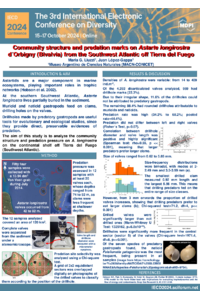
Póster.pdf
Dynamics of Lingulodinium polyedra development in the Bulgarian part of Black Sea (1992-2022)
In silico DNA barcoding by the COI gene of Crassostrea virginica in the Atlantic Ocean and Caribbean Sea