Event submissions
Published
This submission belongs to the session S3. Marine Diversity of the event The 3rd International Electronic Conference on Diversity
Published date
14 Oct, 2024
Academic Editor
'%3e%3cpath%20d='M12.6657%2010.9104C12.4185%2010.325%2012.0599%209.79327%2011.6097%209.34482C11.1609%208.89508%2010.6293%208.5365%2010.0442%208.28888C10.0389%208.28626%2010.0337%208.28495%2010.0285%208.28233C10.8446%207.69279%2011.3752%206.73249%2011.3752%205.64904C11.3752%203.8542%209.92103%202.39999%208.1262%202.39999C6.33136%202.39999%204.87715%203.8542%204.87715%205.64904C4.87715%206.73249%205.40774%207.69279%206.22393%208.28364C6.21869%208.28626%206.21345%208.28757%206.20821%208.29019C5.62129%208.5378%205.09463%208.89284%204.64265%209.34613C4.1929%209.79493%203.83432%2010.3266%203.58671%2010.9117C3.34345%2011.4845%203.21226%2012.0987%203.20023%2012.7209C3.19988%2012.7349%203.20233%2012.7488%203.20744%2012.7619C3.21255%2012.7749%203.22022%2012.7867%203.22998%2012.7968C3.23975%2012.8068%203.25142%2012.8147%203.26431%2012.8202C3.2772%2012.8256%203.29105%2012.8284%203.30504%2012.8284H4.09109C4.14874%2012.8284%204.19459%2012.7825%204.1959%2012.7262C4.2221%2011.7148%204.62823%2010.7676%205.34617%2010.0497C6.08899%209.30683%207.0755%208.89808%208.1262%208.89808C9.17689%208.89808%2010.1634%209.30683%2010.9062%2010.0497C11.6242%2010.7676%2012.0303%2011.7148%2012.0565%2012.7262C12.0578%2012.7838%2012.1037%2012.8284%2012.1613%2012.8284H12.9474C12.9613%2012.8284%2012.9752%2012.8256%2012.9881%2012.8202C13.001%2012.8147%2013.0126%2012.8068%2013.0224%2012.7968C13.0322%2012.7867%2013.0398%2012.7749%2013.0449%2012.7619C13.0501%2012.7488%2013.0525%2012.7349%2013.0522%2012.7209C13.0391%2012.0947%2012.9094%2011.4855%2012.6657%2010.9104ZM8.1262%207.9024C7.52486%207.9024%206.9589%207.6679%206.53312%207.24211C6.10733%206.81633%205.87283%206.25037%205.87283%205.64904C5.87283%205.0477%206.10733%204.48174%206.53312%204.05596C6.9589%203.63018%207.52486%203.39567%208.1262%203.39567C8.72753%203.39567%209.29349%203.63018%209.71927%204.05596C10.1451%204.48174%2010.3796%205.0477%2010.3796%205.64904C10.3796%206.25037%2010.1451%206.81633%209.71927%207.24211C9.29349%207.6679%208.72753%207.9024%208.1262%207.9024Z'%20fill='%235D1EE1'/%3e%3c/g%3e%3c/svg%3e) Gioele Capillo
Gioele CapilloCitation
Maria Cecilia Carcedo, Agustin Gabriel Menechella, Milagros Ines Osinaga, Sandra Marcela Fiori, Inter-annual variability of the macrobenthic community in the surf zone of a sandy beach in the SW Atlantic, in Proceedings of The 3rd International Electronic Conference on Diversity, 15 October–17 October 2024, MDPI: Basel, Switzerland
Share
Email
Facebook
Twitter
LinkedIn
Inter-annual variability of the macrobenthic community in the surf zone of a sandy beach in the SW Atlantic
'%3e%3cpath%20d='M12.6647%2010.9104C12.4176%2010.325%2012.0589%209.7933%2011.6088%209.34485C11.16%208.89511%2010.6283%208.53653%2010.0432%208.28891C10.038%208.28629%2010.0327%208.28498%2010.0275%208.28236C10.8437%207.69282%2011.3743%206.73252%2011.3743%205.64907C11.3743%203.85423%209.92005%202.40002%208.12522%202.40002C6.33038%202.40002%204.87618%203.85423%204.87618%205.64907C4.87618%206.73252%205.40677%207.69282%206.22296%208.28367C6.21772%208.28629%206.21248%208.2876%206.20724%208.29022C5.62031%208.53783%205.09365%208.89287%204.64167%209.34616C4.19192%209.79496%203.83334%2010.3266%203.58573%2010.9117C3.34247%2011.4846%203.21128%2012.0987%203.19925%2012.721C3.1989%2012.735%203.20135%2012.7489%203.20646%2012.7619C3.21157%2012.7749%203.21924%2012.7868%203.22901%2012.7968C3.23877%2012.8068%203.25045%2012.8148%203.26334%2012.8202C3.27623%2012.8256%203.29007%2012.8284%203.30406%2012.8284H4.09012C4.14776%2012.8284%204.19362%2012.7825%204.19493%2012.7262C4.22113%2011.7148%204.62726%2010.7676%205.34519%2010.0497C6.08802%209.30686%207.07452%208.89811%208.12522%208.89811C9.17592%208.89811%2010.1624%209.30686%2010.9052%2010.0497C11.6232%2010.7676%2012.0293%2011.7148%2012.0555%2012.7262C12.0568%2012.7839%2012.1027%2012.8284%2012.1603%2012.8284H12.9464C12.9604%2012.8284%2012.9742%2012.8256%2012.9871%2012.8202C13%2012.8148%2013.0117%2012.8068%2013.0214%2012.7968C13.0312%2012.7868%2013.0389%2012.7749%2013.044%2012.7619C13.0491%2012.7489%2013.0515%2012.735%2013.0512%2012.721C13.0381%2012.0947%2012.9084%2011.4856%2012.6647%2010.9104ZM8.12522%207.90243C7.52388%207.90243%206.95792%207.66793%206.53214%207.24215C6.10636%206.81636%205.87185%206.2504%205.87185%205.64907C5.87185%205.04773%206.10636%204.48177%206.53214%204.05599C6.95792%203.63021%207.52388%203.3957%208.12522%203.3957C8.72655%203.3957%209.29252%203.63021%209.7183%204.05599C10.1441%204.48177%2010.3786%205.04773%2010.3786%205.64907C10.3786%206.2504%2010.1441%206.81636%209.7183%207.24215C9.29252%207.66793%208.72655%207.90243%208.12522%207.90243Z'%20fill='%235D1EE1'/%3e%3c/g%3e%3c/svg%3e)
Maria Cecilia Carcedo 1
Agustin Gabriel Menechella 1
Milagros Ines Osinaga 2
Sandra Marcela Fiori 1
1. Instituto Argentino de Oceanografía, Universidad Nacional del Sur, CONICET, IADO, (Florida 8000), Bahía Blanca, Argentina
Departamento de Biología, Bioquímica y Farmacia, Universidad Nacional del Sur (San Juan 670), Bahía Blanca, Argentina
2. Instituto Argentino de Oceanografía, Universidad Nacional del Sur, CONICET, IADO, (Florida 8000), Bahía Blanca, Argentina
Abstract
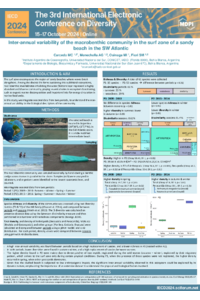
The surf zone encompasses the region of sandy beaches where waves break along the shore. The benthic invertebrates inhabiting the water/bottom layer in this ecosystem represent a highly abundant and diverse community. Despite some efforts, more information is still needed on inter-annual variability. In this study, we integrate data from two periods, 2009 and 2015, to understand the variability in the biological descriptors of the community on a sandy beach in Argentina (39°00’S, 61°57’W) in the SW Atlantic. Samples (n = 3) were collected seasonally by hand-towing a benthic sledge across transects parallel to the shore. A total of 62 species were collected; arthropods represented 55% and were mainly peracarid crustaceans. Differences in total density were registered between years (p<0.05), with ~39 ind/m2 in 2009 (higher density in spring, p<0.05) and ~14500 ind/m2 in 2015 (higher density during autumn/winter, p<0.05). These differences were due to dense patches of two mysids, Arthromysis magellanica and Neomysis americana, registered in 2015 during the cold season, which can be explained by their migratory pattern, as they only arrive in the surf zone under certain physical conditions. Differences in species richness were found between years (15 in 2009 and 42 in 2015; p<0.05), with a high dissimilarity (>0.60%), given by both species turnover and nestedness. Changes in species richness were also detected between seasons: higher richness was registered in spring during 2009 (p<0.05), without differences between seasons during 2015 (p>0.05). The dissimilarity between seasons was also high (2009: >0.70%; 2015: >0.60%), mostly explained by the turnover component during both years. Given that the studied beach is subjected to low anthropogenic impact, the significant interannual variability observed in this ecosystem could be explained by its dynamic nature, emphasizing the importance of an extensive dataset to understand the physical and biological factors involved.
Keywords
sandy beach
surf zone
macrobenthos
diversity
seasons
Poster
Carcedo sciforum-097229.pdf
The Influence of Depth on the Structure and Functioning of Benthic Communities on an Exposed Sandy Shore in the SW Atlantic
COMPARATIVE EVALUATION OF THE FEEDING HABITS OF SEA ANEMONES (CNIDARIA; ACTINIARIA)