Event submissions
Published
This submission belongs to the session S3. Marine Diversity of the event The 3rd International Electronic Conference on Diversity
Published date
14 Oct, 2024
Academic Editor
'%3e%3cpath%20d='M12.6657%2010.9104C12.4185%2010.325%2012.0599%209.79327%2011.6097%209.34482C11.1609%208.89508%2010.6293%208.5365%2010.0442%208.28888C10.0389%208.28626%2010.0337%208.28495%2010.0285%208.28233C10.8446%207.69279%2011.3752%206.73249%2011.3752%205.64904C11.3752%203.8542%209.92103%202.39999%208.1262%202.39999C6.33136%202.39999%204.87715%203.8542%204.87715%205.64904C4.87715%206.73249%205.40774%207.69279%206.22393%208.28364C6.21869%208.28626%206.21345%208.28757%206.20821%208.29019C5.62129%208.5378%205.09463%208.89284%204.64265%209.34613C4.1929%209.79493%203.83432%2010.3266%203.58671%2010.9117C3.34345%2011.4845%203.21226%2012.0987%203.20023%2012.7209C3.19988%2012.7349%203.20233%2012.7488%203.20744%2012.7619C3.21255%2012.7749%203.22022%2012.7867%203.22998%2012.7968C3.23975%2012.8068%203.25142%2012.8147%203.26431%2012.8202C3.2772%2012.8256%203.29105%2012.8284%203.30504%2012.8284H4.09109C4.14874%2012.8284%204.19459%2012.7825%204.1959%2012.7262C4.2221%2011.7148%204.62823%2010.7676%205.34617%2010.0497C6.08899%209.30683%207.0755%208.89808%208.1262%208.89808C9.17689%208.89808%2010.1634%209.30683%2010.9062%2010.0497C11.6242%2010.7676%2012.0303%2011.7148%2012.0565%2012.7262C12.0578%2012.7838%2012.1037%2012.8284%2012.1613%2012.8284H12.9474C12.9613%2012.8284%2012.9752%2012.8256%2012.9881%2012.8202C13.001%2012.8147%2013.0126%2012.8068%2013.0224%2012.7968C13.0322%2012.7867%2013.0398%2012.7749%2013.0449%2012.7619C13.0501%2012.7488%2013.0525%2012.7349%2013.0522%2012.7209C13.0391%2012.0947%2012.9094%2011.4855%2012.6657%2010.9104ZM8.1262%207.9024C7.52486%207.9024%206.9589%207.6679%206.53312%207.24211C6.10733%206.81633%205.87283%206.25037%205.87283%205.64904C5.87283%205.0477%206.10733%204.48174%206.53312%204.05596C6.9589%203.63018%207.52486%203.39567%208.1262%203.39567C8.72753%203.39567%209.29349%203.63018%209.71927%204.05596C10.1451%204.48174%2010.3796%205.0477%2010.3796%205.64904C10.3796%206.25037%2010.1451%206.81633%209.71927%207.24211C9.29349%207.6679%208.72753%207.9024%208.1262%207.9024Z'%20fill='%235D1EE1'/%3e%3c/g%3e%3c/svg%3e) Paulo Vale
Paulo ValeCitation
Laura Schejter, Esteban Gaitán, Mariela Pavón Novarin, The Value of By-Catch: Can We Use The Commercial Species Stock Assessment Cruises for The Study of Non-Target Species? The Case of Sponges, in Proceedings of The 3rd International Electronic Conference on Diversity, 15 October–17 October 2024, MDPI: Basel, Switzerland
Share
Email
Facebook
Twitter
LinkedIn
The Value of By-Catch: Can We Use The Commercial Species Stock Assessment Cruises for The Study of Non-Target Species? The Case of Sponges

Laura Schejter 1
'%3e%3cpath%20d='M12.6647%2010.9104C12.4176%2010.325%2012.0589%209.7933%2011.6088%209.34485C11.16%208.89511%2010.6283%208.53653%2010.0432%208.28891C10.038%208.28629%2010.0327%208.28498%2010.0275%208.28236C10.8437%207.69282%2011.3743%206.73252%2011.3743%205.64907C11.3743%203.85423%209.92005%202.40002%208.12522%202.40002C6.33038%202.40002%204.87618%203.85423%204.87618%205.64907C4.87618%206.73252%205.40677%207.69282%206.22296%208.28367C6.21772%208.28629%206.21248%208.2876%206.20724%208.29022C5.62031%208.53783%205.09365%208.89287%204.64167%209.34616C4.19192%209.79496%203.83334%2010.3266%203.58573%2010.9117C3.34247%2011.4846%203.21128%2012.0987%203.19925%2012.721C3.1989%2012.735%203.20135%2012.7489%203.20646%2012.7619C3.21157%2012.7749%203.21924%2012.7868%203.22901%2012.7968C3.23877%2012.8068%203.25045%2012.8148%203.26334%2012.8202C3.27623%2012.8256%203.29007%2012.8284%203.30406%2012.8284H4.09012C4.14776%2012.8284%204.19362%2012.7825%204.19493%2012.7262C4.22113%2011.7148%204.62726%2010.7676%205.34519%2010.0497C6.08802%209.30686%207.07452%208.89811%208.12522%208.89811C9.17592%208.89811%2010.1624%209.30686%2010.9052%2010.0497C11.6232%2010.7676%2012.0293%2011.7148%2012.0555%2012.7262C12.0568%2012.7839%2012.1027%2012.8284%2012.1603%2012.8284H12.9464C12.9604%2012.8284%2012.9742%2012.8256%2012.9871%2012.8202C13%2012.8148%2013.0117%2012.8068%2013.0214%2012.7968C13.0312%2012.7868%2013.0389%2012.7749%2013.044%2012.7619C13.0491%2012.7489%2013.0515%2012.735%2013.0512%2012.721C13.0381%2012.0947%2012.9084%2011.4856%2012.6647%2010.9104ZM8.12522%207.90243C7.52388%207.90243%206.95792%207.66793%206.53214%207.24215C6.10636%206.81636%205.87185%206.2504%205.87185%205.64907C5.87185%205.04773%206.10636%204.48177%206.53214%204.05599C6.95792%203.63021%207.52388%203.3957%208.12522%203.3957C8.72655%203.3957%209.29252%203.63021%209.7183%204.05599C10.1441%204.48177%2010.3786%205.04773%2010.3786%205.64907C10.3786%206.2504%2010.1441%206.81636%209.7183%207.24215C9.29252%207.66793%208.72655%207.90243%208.12522%207.90243Z'%20fill='%235D1EE1'/%3e%3c/g%3e%3c/svg%3e)
Esteban Gaitán 1
Mariela Pavón Novarin 1
1. Instituto Nacional de Investigacion y Desarrollo Pesquero, Mar del Plata, Buenos Aires Province
Abstract
In this study, we present the contribution of sponges to benthic communities in three different regions of the Argentine continental shelf and slope, between 34º and 55ºS and between 47 and 551 m, according to their richness, occurence frequence, biomass and density from by-catch data of stock assessment cruises performed by the Instituto Nacional de Investigación y Desarrollo Pesquero (INIDEP). The invertebrate by-catch was recorded during five stock assessment cruises of the Argentine hake (Merluccius hubbsi) and the longtail hake (Macruronus magellanicus) in 262 hauls. Sponges were recorded as components of the invertebrate’s by-catch in 49% of the studied sites (133 hauls). Their contribution of biomass to the benthic community sampled varied among areas (north, central and south), as well as between sites within the same region. However, on average, sponges constituted 18,01% of the benthic community (47,91 kg/mn2, in terms of density), reaching more than 90% of the by-catch and more than 1000 kg/mn2 in some particular sites. In total, 34 sponge taxa were recorded. Tedania spp., Clathria (C.) microxa and Callyspongidae (Siphonochalina fortis + Callyspongia sp.) were the only taxa recorded in the three sampled areas, while Mycale (Aegogropila) magellanica, a common species from Argentina, was present only among the North and the South regions. Sixty percent (60%) of the sponge species were recorded in only one or two sites. The North region is probably the better-known region regarding sponge fauna, and it had the most common species. However, the samples of several taxa recorded in the South and Central regions (i.e. Hadromerida, Phakellia spp., Amphilectus sp., Dragmacidon sp., Asbestopluma sp.) will require more detailed taxonomic studies, as these species may contribute to our understanding of Argentina's sponge biodiversity and richness by providing valuable information on rare species or even constituting new species to science.
Keywords
Porifera
non-target species
richness
Argentina
Poster
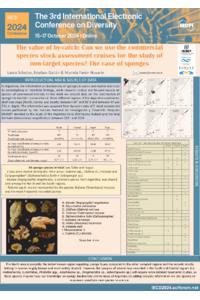
sciforum-095381 IECD poster formato congreso.pdf
COMPARATIVE EVALUATION OF THE FEEDING HABITS OF SEA ANEMONES (CNIDARIA; ACTINIARIA)
An Analysis of the structure and dynamics of pioneer benthic communities in Terra Nova Bay (Ross Sea, Antarctica) using the Autonomous Reef Monitoring Structures (ARMSs)