Event submissions
Published
This submission belongs to the session S3. Marine Diversity of the event The 3rd International Electronic Conference on Diversity
Published date
14 Oct, 2024
Academic Editor
'%3e%3cpath%20d='M12.6657%2010.9104C12.4185%2010.325%2012.0599%209.79327%2011.6097%209.34482C11.1609%208.89508%2010.6293%208.5365%2010.0442%208.28888C10.0389%208.28626%2010.0337%208.28495%2010.0285%208.28233C10.8446%207.69279%2011.3752%206.73249%2011.3752%205.64904C11.3752%203.8542%209.92103%202.39999%208.1262%202.39999C6.33136%202.39999%204.87715%203.8542%204.87715%205.64904C4.87715%206.73249%205.40774%207.69279%206.22393%208.28364C6.21869%208.28626%206.21345%208.28757%206.20821%208.29019C5.62129%208.5378%205.09463%208.89284%204.64265%209.34613C4.1929%209.79493%203.83432%2010.3266%203.58671%2010.9117C3.34345%2011.4845%203.21226%2012.0987%203.20023%2012.7209C3.19988%2012.7349%203.20233%2012.7488%203.20744%2012.7619C3.21255%2012.7749%203.22022%2012.7867%203.22998%2012.7968C3.23975%2012.8068%203.25142%2012.8147%203.26431%2012.8202C3.2772%2012.8256%203.29105%2012.8284%203.30504%2012.8284H4.09109C4.14874%2012.8284%204.19459%2012.7825%204.1959%2012.7262C4.2221%2011.7148%204.62823%2010.7676%205.34617%2010.0497C6.08899%209.30683%207.0755%208.89808%208.1262%208.89808C9.17689%208.89808%2010.1634%209.30683%2010.9062%2010.0497C11.6242%2010.7676%2012.0303%2011.7148%2012.0565%2012.7262C12.0578%2012.7838%2012.1037%2012.8284%2012.1613%2012.8284H12.9474C12.9613%2012.8284%2012.9752%2012.8256%2012.9881%2012.8202C13.001%2012.8147%2013.0126%2012.8068%2013.0224%2012.7968C13.0322%2012.7867%2013.0398%2012.7749%2013.0449%2012.7619C13.0501%2012.7488%2013.0525%2012.7349%2013.0522%2012.7209C13.0391%2012.0947%2012.9094%2011.4855%2012.6657%2010.9104ZM8.1262%207.9024C7.52486%207.9024%206.9589%207.6679%206.53312%207.24211C6.10733%206.81633%205.87283%206.25037%205.87283%205.64904C5.87283%205.0477%206.10733%204.48174%206.53312%204.05596C6.9589%203.63018%207.52486%203.39567%208.1262%203.39567C8.72753%203.39567%209.29349%203.63018%209.71927%204.05596C10.1451%204.48174%2010.3796%205.0477%2010.3796%205.64904C10.3796%206.25037%2010.1451%206.81633%209.71927%207.24211C9.29349%207.6679%208.72753%207.9024%208.1262%207.9024Z'%20fill='%235D1EE1'/%3e%3c/g%3e%3c/svg%3e) Gioele Capillo
Gioele CapilloCitation
Jesús Fernández-Gutiérrez, Marcos Rubal, Raúl Marín-Aragón, Fran Ramil, Puri Veiga, Salinity drives the structure of bryozoan and entoproct assemblage in recreational marinas of North Portuguese coast, in Proceedings of The 3rd International Electronic Conference on Diversity, 15 October–17 October 2024, MDPI: Basel, Switzerland
Share
Email
Facebook
Twitter
LinkedIn
Salinity drives the structure of bryozoan and entoproct assemblage in recreational marinas of North Portuguese coast
'%3e%3cpath%20d='M12.6647%2010.9104C12.4176%2010.325%2012.0589%209.7933%2011.6088%209.34485C11.16%208.89511%2010.6283%208.53653%2010.0432%208.28891C10.038%208.28629%2010.0327%208.28498%2010.0275%208.28236C10.8437%207.69282%2011.3743%206.73252%2011.3743%205.64907C11.3743%203.85423%209.92005%202.40002%208.12522%202.40002C6.33038%202.40002%204.87618%203.85423%204.87618%205.64907C4.87618%206.73252%205.40677%207.69282%206.22296%208.28367C6.21772%208.28629%206.21248%208.2876%206.20724%208.29022C5.62031%208.53783%205.09365%208.89287%204.64167%209.34616C4.19192%209.79496%203.83334%2010.3266%203.58573%2010.9117C3.34247%2011.4846%203.21128%2012.0987%203.19925%2012.721C3.1989%2012.735%203.20135%2012.7489%203.20646%2012.7619C3.21157%2012.7749%203.21924%2012.7868%203.22901%2012.7968C3.23877%2012.8068%203.25045%2012.8148%203.26334%2012.8202C3.27623%2012.8256%203.29007%2012.8284%203.30406%2012.8284H4.09012C4.14776%2012.8284%204.19362%2012.7825%204.19493%2012.7262C4.22113%2011.7148%204.62726%2010.7676%205.34519%2010.0497C6.08802%209.30686%207.07452%208.89811%208.12522%208.89811C9.17592%208.89811%2010.1624%209.30686%2010.9052%2010.0497C11.6232%2010.7676%2012.0293%2011.7148%2012.0555%2012.7262C12.0568%2012.7839%2012.1027%2012.8284%2012.1603%2012.8284H12.9464C12.9604%2012.8284%2012.9742%2012.8256%2012.9871%2012.8202C13%2012.8148%2013.0117%2012.8068%2013.0214%2012.7968C13.0312%2012.7868%2013.0389%2012.7749%2013.044%2012.7619C13.0491%2012.7489%2013.0515%2012.735%2013.0512%2012.721C13.0381%2012.0947%2012.9084%2011.4856%2012.6647%2010.9104ZM8.12522%207.90243C7.52388%207.90243%206.95792%207.66793%206.53214%207.24215C6.10636%206.81636%205.87185%206.2504%205.87185%205.64907C5.87185%205.04773%206.10636%204.48177%206.53214%204.05599C6.95792%203.63021%207.52388%203.3957%208.12522%203.3957C8.72655%203.3957%209.29252%203.63021%209.7183%204.05599C10.1441%204.48177%2010.3786%205.04773%2010.3786%205.64907C10.3786%206.2504%2010.1441%206.81636%209.7183%207.24215C9.29252%207.66793%208.72655%207.90243%208.12522%207.90243Z'%20fill='%235D1EE1'/%3e%3c/g%3e%3c/svg%3e)
Jesús Fernández-Gutiérrez 1,2,3

Marcos Rubal 2
Raúl Marín-Aragón 1,3
Fran Ramil 4

Puri Veiga 1
1. Interdisciplinary Centre of Marine and Environmental Research (CIIMAR), University of Porto, Novo Edifício do Terminal de Cruzeiros do Porto de Leixões, Avenida General Norton de Matos, 4450-208, Matosinhos, Portugal.
2. Centre of Molecular and Environmental Biology (CBMA/ARNET), Department of Biology, University of Minho, 4710-057, Braga, Portugal.
3. Department of Biology, Faculty of Sciences, University of Porto, Rua do Campo Alegre s/n, 4169-007 Porto, Portugal.
4. CIM-UVigo – Centro de Investigación Mariña, Facultade de Ciencias do Mar, Universidade de Vigo, E-36310 Vigo, Spain.
Abstract
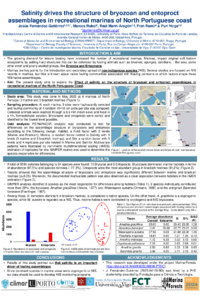
Artificial structures such as marinas have increased in recent years due to the growing demand of recreational boating. Marinas modify the original environmental conditions and are thus considered a great stressor to native communities. Nevertheless, piles and floating pontoons provide new habitats that are prone to be colonized by fouling species. Bryozoans and entoprocts are common members of fouling communities that are frequently overlooked given their small size, particularly in the case of entoprocts. Furthermore, little is known about the influence of salinity on the assemblage structure of these two phyla. To improve this knowledge gap, as part of the project ‘Marina-Forests’ (http://doi.org/10.54499/2022.06806.PTDC), fouling animals associated with floating pontoons were studied in 6 recreational (3 coastal and 3 estuarine) marinas of North Portugal. At each marina, 3 sites were haphazardly selected and the fouling community of 4 random 10×10 cm grids per site was scrapped. Collected animals were washed through a 0.5 mm mesh sieve, fixed in a 4% formaldehyde solution, bryozoans and entoprocts were sorted and identified to the lowest level possible. PERMANOVA test was conducted to explore the effect of salinity on the assemblage structure of bryozoans and entoprocts and SIMPER routine to determine the species responsible for differences.
A total of 15 bryozoan species (621 colonies) and 7 entoproct species (1443 colonies) were found. Results showed that the assemblage structure of bryozoans and entoprocts was significantly different between coastal and estuarine marinas. The most important taxa responsible for differences were more abundant on coastal marinas except for the entoproct Barentsia benedeni and the bryozoans Amathia imbricata and Conopeum seurati that were more abundant in estuarine marinas.
Results of this study show that salinity is an important driver of fouling assemblages. In view of many fouling species are invasive, our data also provide useful information to support decision-makers.
Keywords
Bryozoa
Entoprocta
Fouling assemblages
Recreational Marinas
Diversity
Salinity
Floating pontoons
Poster
Poster sciforum-097173.pdf
Current knowledge status on myctophids’ diversity in the Southwest Atlantic Ocean
New Records of Invasive Calcareous Sponge (Porifera, Calcarea) Heteropia glomerosa on the Coast of São Paulo, Brazil