Event submissions
Published
This submission belongs to the session S4. Microbial Diversity and Culture Collections of the event The 3rd International Electronic Conference on Diversity
Published date
14 Oct, 2024
Academic Editor
'%3e%3cpath%20d='M12.6657%2010.9104C12.4185%2010.325%2012.0599%209.79327%2011.6097%209.34482C11.1609%208.89508%2010.6293%208.5365%2010.0442%208.28888C10.0389%208.28626%2010.0337%208.28495%2010.0285%208.28233C10.8446%207.69279%2011.3752%206.73249%2011.3752%205.64904C11.3752%203.8542%209.92103%202.39999%208.1262%202.39999C6.33136%202.39999%204.87715%203.8542%204.87715%205.64904C4.87715%206.73249%205.40774%207.69279%206.22393%208.28364C6.21869%208.28626%206.21345%208.28757%206.20821%208.29019C5.62129%208.5378%205.09463%208.89284%204.64265%209.34613C4.1929%209.79493%203.83432%2010.3266%203.58671%2010.9117C3.34345%2011.4845%203.21226%2012.0987%203.20023%2012.7209C3.19988%2012.7349%203.20233%2012.7488%203.20744%2012.7619C3.21255%2012.7749%203.22022%2012.7867%203.22998%2012.7968C3.23975%2012.8068%203.25142%2012.8147%203.26431%2012.8202C3.2772%2012.8256%203.29105%2012.8284%203.30504%2012.8284H4.09109C4.14874%2012.8284%204.19459%2012.7825%204.1959%2012.7262C4.2221%2011.7148%204.62823%2010.7676%205.34617%2010.0497C6.08899%209.30683%207.0755%208.89808%208.1262%208.89808C9.17689%208.89808%2010.1634%209.30683%2010.9062%2010.0497C11.6242%2010.7676%2012.0303%2011.7148%2012.0565%2012.7262C12.0578%2012.7838%2012.1037%2012.8284%2012.1613%2012.8284H12.9474C12.9613%2012.8284%2012.9752%2012.8256%2012.9881%2012.8202C13.001%2012.8147%2013.0126%2012.8068%2013.0224%2012.7968C13.0322%2012.7867%2013.0398%2012.7749%2013.0449%2012.7619C13.0501%2012.7488%2013.0525%2012.7349%2013.0522%2012.7209C13.0391%2012.0947%2012.9094%2011.4855%2012.6657%2010.9104ZM8.1262%207.9024C7.52486%207.9024%206.9589%207.6679%206.53312%207.24211C6.10733%206.81633%205.87283%206.25037%205.87283%205.64904C5.87283%205.0477%206.10733%204.48174%206.53312%204.05596C6.9589%203.63018%207.52486%203.39567%208.1262%203.39567C8.72753%203.39567%209.29349%203.63018%209.71927%204.05596C10.1451%204.48174%2010.3796%205.0477%2010.3796%205.64904C10.3796%206.25037%2010.1451%206.81633%209.71927%207.24211C9.29349%207.6679%208.72753%207.9024%208.1262%207.9024Z'%20fill='%235D1EE1'/%3e%3c/g%3e%3c/svg%3e) Samantha Karunarathna
Samantha KarunarathnaCitation
Antonio Peña-Fernández, Raoul Emeric Guetiya Wadoum, María de los Ángeles Peña, Umar Anjum, Exploring the presence of human-related microsporidian spores in lizards from Bombali District, Sierra Leone, in Proceedings of The 3rd International Electronic Conference on Diversity, 15 October–17 October 2024, MDPI: Basel, Switzerland
Share
Email
Facebook
Twitter
LinkedIn
Exploring the presence of human-related microsporidian spores in lizards from Bombali District, Sierra Leone

Antonio Peña-Fernández 1,2
'%3e%3cpath%20d='M12.6647%2010.9104C12.4176%2010.325%2012.0589%209.7933%2011.6088%209.34485C11.16%208.89511%2010.6283%208.53653%2010.0432%208.28891C10.038%208.28629%2010.0327%208.28498%2010.0275%208.28236C10.8437%207.69282%2011.3743%206.73252%2011.3743%205.64907C11.3743%203.85423%209.92005%202.40002%208.12522%202.40002C6.33038%202.40002%204.87618%203.85423%204.87618%205.64907C4.87618%206.73252%205.40677%207.69282%206.22296%208.28367C6.21772%208.28629%206.21248%208.2876%206.20724%208.29022C5.62031%208.53783%205.09365%208.89287%204.64167%209.34616C4.19192%209.79496%203.83334%2010.3266%203.58573%2010.9117C3.34247%2011.4846%203.21128%2012.0987%203.19925%2012.721C3.1989%2012.735%203.20135%2012.7489%203.20646%2012.7619C3.21157%2012.7749%203.21924%2012.7868%203.22901%2012.7968C3.23877%2012.8068%203.25045%2012.8148%203.26334%2012.8202C3.27623%2012.8256%203.29007%2012.8284%203.30406%2012.8284H4.09012C4.14776%2012.8284%204.19362%2012.7825%204.19493%2012.7262C4.22113%2011.7148%204.62726%2010.7676%205.34519%2010.0497C6.08802%209.30686%207.07452%208.89811%208.12522%208.89811C9.17592%208.89811%2010.1624%209.30686%2010.9052%2010.0497C11.6232%2010.7676%2012.0293%2011.7148%2012.0555%2012.7262C12.0568%2012.7839%2012.1027%2012.8284%2012.1603%2012.8284H12.9464C12.9604%2012.8284%2012.9742%2012.8256%2012.9871%2012.8202C13%2012.8148%2013.0117%2012.8068%2013.0214%2012.7968C13.0312%2012.7868%2013.0389%2012.7749%2013.044%2012.7619C13.0491%2012.7489%2013.0515%2012.735%2013.0512%2012.721C13.0381%2012.0947%2012.9084%2011.4856%2012.6647%2010.9104ZM8.12522%207.90243C7.52388%207.90243%206.95792%207.66793%206.53214%207.24215C6.10636%206.81636%205.87185%206.2504%205.87185%205.64907C5.87185%205.04773%206.10636%204.48177%206.53214%204.05599C6.95792%203.63021%207.52388%203.3957%208.12522%203.3957C8.72655%203.3957%209.29252%203.63021%209.7183%204.05599C10.1441%204.48177%2010.3786%205.04773%2010.3786%205.64907C10.3786%206.2504%2010.1441%206.81636%209.7183%207.24215C9.29252%207.66793%208.72655%207.90243%208.12522%207.90243Z'%20fill='%235D1EE1'/%3e%3c/g%3e%3c/svg%3e)
Raoul Emeric Guetiya Wadoum 3

María de los Ángeles Peña 4
Umar Anjum 2
1. Department of Surgery, Medical and Social Sciences, Faculty of Medicine and Health Sciences, University of Alcalá, Ctra. Madrid-Barcelona, Km. 33.600, 28871 Alcalá de Henares, Madrid, Spain.
2. Leicester School of Allied Health Sciences, De Montfort University, Leicester, LE1 9BH, UK.
3. Department of Public Health, Microbiology and immunology, Ernest Bai Koroma University of Science and Technology, Makeni, Sierra Leone.
4. Departamento de Ciencias Biomédicas, Universidad de Alcalá, Crta. Madrid-Barcelona Km, 33.6, 28871 Alcalá de Henares, Madrid, Spain
Abstract
Our investigation into the presence of human-related microsporidia in lizard feces is not only a scientific endeavour, but a crucial study with potential implications for public health. While these species have been found in various vertebrates, their zoonotic potential remains poorly understood. Thus, previous studies have detected spores related to Encephalitozoon spp. in lizards' feces from Baltimore Zoo (the US), specifically in the lizard Shinisaurus crocodilurus. Although they did not develop systemic infections, the presence of spores of Encephalitozoon may represent a source of infection. To determine the presence of opportunistic microsporidia species (Enterocytozoon bieneusi and Encephalitozoon spp. [E. intestinalis, E. hellem, and E. cuniculi]) in lizard feces from different urban/rural areas in Bombali District, Sierra Leone, we undertook a rigorous process of investigation. DNA was extracted from nineteen lizard fecal droppings collected in 2019 from different locations, including built-up areas in Makeni city and a rural/leisure area in the village of Mankneh, using the Fast-Prep for Soil® kit. A SYBR Green real-time PCR revealed that none of the samples monitored were positive for any of the four human-related microsporidia species studied. Although this finding implies a low risk for humans from direct/indirect exposure to microsporidian spores that are potentially present in lizards’ feces, the carrier state and potential environmental contamination, as well as human exposure, cannot be excluded. Owing to the fact that lizards are very common in Sierra Leone, such as the species of Tarentola parvicarinata (a wall gecko), we recommend further molecular analysis for the detection of other important microsporidian species that have previously been detected in reptiles, such as Pleistophora spp., which could also affect humans. The need for further studies is also highlighted by the fact that we have reported some circulation of these microsporidia species in wild and domestic animals in Sierra Leone.
Keywords
Makeni
Sierra Leone
microsporidia
animal faeces
lizards.
Poster
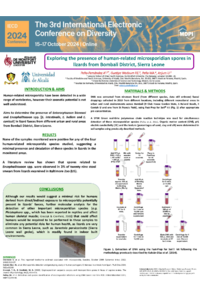
IECD 2024 Sierra Leone micros lizards_APF.pdf
Wind-Induced Changes in Zooplankton Diversity in a Temperate Sandy Beach Surf Zone: A preliminary methodology using Neutral red staining
Yeast microbiome of Avicennia officinalis: Differences in its taxonomic and functional composition among the plant compartments