Event submissions
Published
This submission belongs to the session S4. Microbial Diversity and Culture Collections of the event The 3rd International Electronic Conference on Diversity
Published date
14 Oct, 2024
Academic Editor
'%3e%3cpath%20d='M12.6657%2010.9104C12.4185%2010.325%2012.0599%209.79327%2011.6097%209.34482C11.1609%208.89508%2010.6293%208.5365%2010.0442%208.28888C10.0389%208.28626%2010.0337%208.28495%2010.0285%208.28233C10.8446%207.69279%2011.3752%206.73249%2011.3752%205.64904C11.3752%203.8542%209.92103%202.39999%208.1262%202.39999C6.33136%202.39999%204.87715%203.8542%204.87715%205.64904C4.87715%206.73249%205.40774%207.69279%206.22393%208.28364C6.21869%208.28626%206.21345%208.28757%206.20821%208.29019C5.62129%208.5378%205.09463%208.89284%204.64265%209.34613C4.1929%209.79493%203.83432%2010.3266%203.58671%2010.9117C3.34345%2011.4845%203.21226%2012.0987%203.20023%2012.7209C3.19988%2012.7349%203.20233%2012.7488%203.20744%2012.7619C3.21255%2012.7749%203.22022%2012.7867%203.22998%2012.7968C3.23975%2012.8068%203.25142%2012.8147%203.26431%2012.8202C3.2772%2012.8256%203.29105%2012.8284%203.30504%2012.8284H4.09109C4.14874%2012.8284%204.19459%2012.7825%204.1959%2012.7262C4.2221%2011.7148%204.62823%2010.7676%205.34617%2010.0497C6.08899%209.30683%207.0755%208.89808%208.1262%208.89808C9.17689%208.89808%2010.1634%209.30683%2010.9062%2010.0497C11.6242%2010.7676%2012.0303%2011.7148%2012.0565%2012.7262C12.0578%2012.7838%2012.1037%2012.8284%2012.1613%2012.8284H12.9474C12.9613%2012.8284%2012.9752%2012.8256%2012.9881%2012.8202C13.001%2012.8147%2013.0126%2012.8068%2013.0224%2012.7968C13.0322%2012.7867%2013.0398%2012.7749%2013.0449%2012.7619C13.0501%2012.7488%2013.0525%2012.7349%2013.0522%2012.7209C13.0391%2012.0947%2012.9094%2011.4855%2012.6657%2010.9104ZM8.1262%207.9024C7.52486%207.9024%206.9589%207.6679%206.53312%207.24211C6.10733%206.81633%205.87283%206.25037%205.87283%205.64904C5.87283%205.0477%206.10733%204.48174%206.53312%204.05596C6.9589%203.63018%207.52486%203.39567%208.1262%203.39567C8.72753%203.39567%209.29349%203.63018%209.71927%204.05596C10.1451%204.48174%2010.3796%205.0477%2010.3796%205.64904C10.3796%206.25037%2010.1451%206.81633%209.71927%207.24211C9.29349%207.6679%208.72753%207.9024%208.1262%207.9024Z'%20fill='%235D1EE1'/%3e%3c/g%3e%3c/svg%3e) Samantha Karunarathna
Samantha KarunarathnaCitation
Ankur Kumari, Parvati Sharma, Yash Pal, Anuradha Bhardwaj, Prashant Singh, Diversity of Enterococcus Strains in Raw Donkey Milk: Evaluating Their Technological Attributes and Safety Profiles, in Proceedings of The 3rd International Electronic Conference on Diversity, 15 October–17 October 2024, MDPI: Basel, Switzerland
Share
Email
Facebook
Twitter
LinkedIn
Diversity of Enterococcus Strains in Raw Donkey Milk: Evaluating Their Technological Attributes and Safety Profiles
'%3e%3cpath%20d='M12.6647%2010.9104C12.4176%2010.325%2012.0589%209.7933%2011.6088%209.34485C11.16%208.89511%2010.6283%208.53653%2010.0432%208.28891C10.038%208.28629%2010.0327%208.28498%2010.0275%208.28236C10.8437%207.69282%2011.3743%206.73252%2011.3743%205.64907C11.3743%203.85423%209.92005%202.40002%208.12522%202.40002C6.33038%202.40002%204.87618%203.85423%204.87618%205.64907C4.87618%206.73252%205.40677%207.69282%206.22296%208.28367C6.21772%208.28629%206.21248%208.2876%206.20724%208.29022C5.62031%208.53783%205.09365%208.89287%204.64167%209.34616C4.19192%209.79496%203.83334%2010.3266%203.58573%2010.9117C3.34247%2011.4846%203.21128%2012.0987%203.19925%2012.721C3.1989%2012.735%203.20135%2012.7489%203.20646%2012.7619C3.21157%2012.7749%203.21924%2012.7868%203.22901%2012.7968C3.23877%2012.8068%203.25045%2012.8148%203.26334%2012.8202C3.27623%2012.8256%203.29007%2012.8284%203.30406%2012.8284H4.09012C4.14776%2012.8284%204.19362%2012.7825%204.19493%2012.7262C4.22113%2011.7148%204.62726%2010.7676%205.34519%2010.0497C6.08802%209.30686%207.07452%208.89811%208.12522%208.89811C9.17592%208.89811%2010.1624%209.30686%2010.9052%2010.0497C11.6232%2010.7676%2012.0293%2011.7148%2012.0555%2012.7262C12.0568%2012.7839%2012.1027%2012.8284%2012.1603%2012.8284H12.9464C12.9604%2012.8284%2012.9742%2012.8256%2012.9871%2012.8202C13%2012.8148%2013.0117%2012.8068%2013.0214%2012.7968C13.0312%2012.7868%2013.0389%2012.7749%2013.044%2012.7619C13.0491%2012.7489%2013.0515%2012.735%2013.0512%2012.721C13.0381%2012.0947%2012.9084%2011.4856%2012.6647%2010.9104ZM8.12522%207.90243C7.52388%207.90243%206.95792%207.66793%206.53214%207.24215C6.10636%206.81636%205.87185%206.2504%205.87185%205.64907C5.87185%205.04773%206.10636%204.48177%206.53214%204.05599C6.95792%203.63021%207.52388%203.3957%208.12522%203.3957C8.72655%203.3957%209.29252%203.63021%209.7183%204.05599C10.1441%204.48177%2010.3786%205.04773%2010.3786%205.64907C10.3786%206.2504%2010.1441%206.81636%209.7183%207.24215C9.29252%207.66793%208.72655%207.90243%208.12522%207.90243Z'%20fill='%235D1EE1'/%3e%3c/g%3e%3c/svg%3e)
Ankur Kumari 1
Parvati Sharma 2
Yash Pal 3
Anuradha Bhardwaj 4
Prashant Singh 5
1. Zoology Department, Government College Hisar
2. Chaudhary Bansi Lal University, Bhiwani, Haryana
3. DIVISION OF ANIMAL PHYSIOLOGY & REPRODUCTION, Central Institute for Research on Buffaloes
Sirsa Rd, Hisar, Haryana 125001
4. Biochemistry-Biotechnology lab, National Research Centre on Equines, Hisar
5. Department of Biochemistry, National Dairy Research Institute, Karnal
Abstract
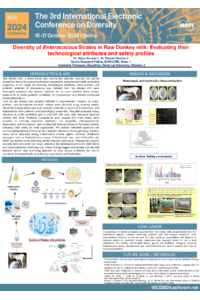
Raw donkey milk, a lesser-known but nutritionally valuable resource, has gained recognition for its unique composition and potential health benefits. It is within this context that the diversity, technological attributes, safety considerations, and probiotic potential of enterococci from raw donkey milk are explored. This study aimed to determine whether these isolates could be potential probiotics in donkey milk. A total of 25 Gram-positive, catalase-negative bacteria were obtained from twenty raw milk samples collected from a donkey species from Southern-Western Haryana, utilizing selective microbiological media. All isolates underwent identification through both phenotypic and molecular techniques and were subjected to a comprehensive assessment of their technological and probiotic properties. To assess their viability as starter or adjunct cultures, the isolates were evaluated for their susceptibility to antibiotics, absence of virulence factors, and absence of hemolytic activity, and the safety analysis of these isolates revealed that the majority exhibited susceptibility to clinically important antibiotics, such as vancomycin. Overall, the findings of this study suggest that the Enterococci strains that are present in raw donkey milk are unlikely to pose a significant risk to human health. Additionally, they display noteworthy technological characteristics such as high antibacterial efficacy against Staphylococcus aureus, Pseudomonas, Escherichia coli, etc. It was possible to enhance the antibacterial activities against these pathogenic strains by using various induction techniques and use them as potential probiotics in fermented food products.
Keywords
Keywords: Donkey milk
Probiotics
Enterococcus
gram positive and antibacterial activity.
Poster
Dr. ankur IECD poster.pdf
Molecular detection and genetic diversity of Torque teno canis virus in dogs in southern Italy
Genomics reveal hybridization between deeply diverging South American grasshopper species of the genus Orotettix (Orthoptera: Acrididae)