Event submissions
Published
This submission belongs to the session S5. Phylogeny and Evolution of the event The 3rd International Electronic Conference on Diversity
Published date
14 Oct, 2024
Academic Editor
'%3e%3cpath%20d='M12.6657%2010.9104C12.4185%2010.325%2012.0599%209.79327%2011.6097%209.34482C11.1609%208.89508%2010.6293%208.5365%2010.0442%208.28888C10.0389%208.28626%2010.0337%208.28495%2010.0285%208.28233C10.8446%207.69279%2011.3752%206.73249%2011.3752%205.64904C11.3752%203.8542%209.92103%202.39999%208.1262%202.39999C6.33136%202.39999%204.87715%203.8542%204.87715%205.64904C4.87715%206.73249%205.40774%207.69279%206.22393%208.28364C6.21869%208.28626%206.21345%208.28757%206.20821%208.29019C5.62129%208.5378%205.09463%208.89284%204.64265%209.34613C4.1929%209.79493%203.83432%2010.3266%203.58671%2010.9117C3.34345%2011.4845%203.21226%2012.0987%203.20023%2012.7209C3.19988%2012.7349%203.20233%2012.7488%203.20744%2012.7619C3.21255%2012.7749%203.22022%2012.7867%203.22998%2012.7968C3.23975%2012.8068%203.25142%2012.8147%203.26431%2012.8202C3.2772%2012.8256%203.29105%2012.8284%203.30504%2012.8284H4.09109C4.14874%2012.8284%204.19459%2012.7825%204.1959%2012.7262C4.2221%2011.7148%204.62823%2010.7676%205.34617%2010.0497C6.08899%209.30683%207.0755%208.89808%208.1262%208.89808C9.17689%208.89808%2010.1634%209.30683%2010.9062%2010.0497C11.6242%2010.7676%2012.0303%2011.7148%2012.0565%2012.7262C12.0578%2012.7838%2012.1037%2012.8284%2012.1613%2012.8284H12.9474C12.9613%2012.8284%2012.9752%2012.8256%2012.9881%2012.8202C13.001%2012.8147%2013.0126%2012.8068%2013.0224%2012.7968C13.0322%2012.7867%2013.0398%2012.7749%2013.0449%2012.7619C13.0501%2012.7488%2013.0525%2012.7349%2013.0522%2012.7209C13.0391%2012.0947%2012.9094%2011.4855%2012.6657%2010.9104ZM8.1262%207.9024C7.52486%207.9024%206.9589%207.6679%206.53312%207.24211C6.10733%206.81633%205.87283%206.25037%205.87283%205.64904C5.87283%205.0477%206.10733%204.48174%206.53312%204.05596C6.9589%203.63018%207.52486%203.39567%208.1262%203.39567C8.72753%203.39567%209.29349%203.63018%209.71927%204.05596C10.1451%204.48174%2010.3796%205.0477%2010.3796%205.64904C10.3796%206.25037%2010.1451%206.81633%209.71927%207.24211C9.29349%207.6679%208.72753%207.9024%208.1262%207.9024Z'%20fill='%235D1EE1'/%3e%3c/g%3e%3c/svg%3e) Samantha Karunarathna
Samantha KarunarathnaCitation
Diego A. Caraballo, Noelia V. Guzmán, Elio R. D. Castillo, María Marta Cigliano, Viviana A. Confalonieri, Genomics reveal hybridization between deeply diverging South American grasshopper species of the genus Orotettix (Orthoptera: Acrididae), in Proceedings of The 3rd International Electronic Conference on Diversity, 15 October–17 October 2024, MDPI: Basel, Switzerland
Share
Email
Facebook
Twitter
LinkedIn
Genomics reveal hybridization between deeply diverging South American grasshopper species of the genus Orotettix (Orthoptera: Acrididae)

Diego A. Caraballo 1
'%3e%3cpath%20d='M12.6647%2010.9104C12.4176%2010.325%2012.0589%209.7933%2011.6088%209.34485C11.16%208.89511%2010.6283%208.53653%2010.0432%208.28891C10.038%208.28629%2010.0327%208.28498%2010.0275%208.28236C10.8437%207.69282%2011.3743%206.73252%2011.3743%205.64907C11.3743%203.85423%209.92005%202.40002%208.12522%202.40002C6.33038%202.40002%204.87618%203.85423%204.87618%205.64907C4.87618%206.73252%205.40677%207.69282%206.22296%208.28367C6.21772%208.28629%206.21248%208.2876%206.20724%208.29022C5.62031%208.53783%205.09365%208.89287%204.64167%209.34616C4.19192%209.79496%203.83334%2010.3266%203.58573%2010.9117C3.34247%2011.4846%203.21128%2012.0987%203.19925%2012.721C3.1989%2012.735%203.20135%2012.7489%203.20646%2012.7619C3.21157%2012.7749%203.21924%2012.7868%203.22901%2012.7968C3.23877%2012.8068%203.25045%2012.8148%203.26334%2012.8202C3.27623%2012.8256%203.29007%2012.8284%203.30406%2012.8284H4.09012C4.14776%2012.8284%204.19362%2012.7825%204.19493%2012.7262C4.22113%2011.7148%204.62726%2010.7676%205.34519%2010.0497C6.08802%209.30686%207.07452%208.89811%208.12522%208.89811C9.17592%208.89811%2010.1624%209.30686%2010.9052%2010.0497C11.6232%2010.7676%2012.0293%2011.7148%2012.0555%2012.7262C12.0568%2012.7839%2012.1027%2012.8284%2012.1603%2012.8284H12.9464C12.9604%2012.8284%2012.9742%2012.8256%2012.9871%2012.8202C13%2012.8148%2013.0117%2012.8068%2013.0214%2012.7968C13.0312%2012.7868%2013.0389%2012.7749%2013.044%2012.7619C13.0491%2012.7489%2013.0515%2012.735%2013.0512%2012.721C13.0381%2012.0947%2012.9084%2011.4856%2012.6647%2010.9104ZM8.12522%207.90243C7.52388%207.90243%206.95792%207.66793%206.53214%207.24215C6.10636%206.81636%205.87185%206.2504%205.87185%205.64907C5.87185%205.04773%206.10636%204.48177%206.53214%204.05599C6.95792%203.63021%207.52388%203.3957%208.12522%203.3957C8.72655%203.3957%209.29252%203.63021%209.7183%204.05599C10.1441%204.48177%2010.3786%205.04773%2010.3786%205.64907C10.3786%206.2504%2010.1441%206.81636%209.7183%207.24215C9.29252%207.66793%208.72655%207.90243%208.12522%207.90243Z'%20fill='%235D1EE1'/%3e%3c/g%3e%3c/svg%3e)
Noelia V. Guzmán 1
Elio R. D. Castillo 2
María Marta Cigliano 3
Viviana A. Confalonieri 1
1. Instituto de Ecología, Genética y Evolución de Buenos Aires (UBA-CONICET), Buenos Aires, Argentina.
2. Instituto de Biología Subtropical IBS, Posadas, Misiones, Argentina.
3. Centro de Estudios Parasitológicos y de Vectores (CEPAVE-CONICET); Museo de La Plata, División Entomología; FCNyM-UNLP, La Plata, Buenos Aires, Argentina
Abstract
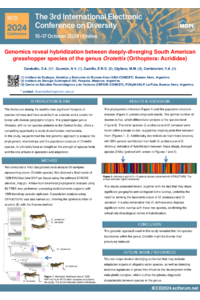
The Andes are among the world's most significant hotspots of species richness and have acted both as a barrier and a conduit for biota with diverse geographic origins. The grasshopper genus Orotettix, with its ten species endemic to the Central Andes, offers a compelling opportunity to study diversification mechanisms. Previous studies have suggested that speciation in Orotettix was primarily allopatric, driven by glacial–interglacial cycles during the late and mid-Pleistocene. However, it has also been suggested that some species, which are distributed almost sympatrically, may have differentiated through sympatric or parapatric speciation due to adaptation along elevation gradients. In this study, we performed the first genomic approach to analyze the phylogenetic relationships and the population structure of Orotettix species, to ultimately have an insight into the strength of species limits and the role of altitude in speciation and adaptation. We conducted a RAD-Seq procedure to analyze 95 samples representing seven Orotettix species. We obtained a final matrix of 1239 RAD-loci (one SNP per locus), and performed a Maximum Likelihood phylogenetic analysis using IQ-TREE and a population analysis using STRUCTURE. We identified a total of five clusters, which differentiate samples at the species level. Notably, the sister species O. andeanus and O. carrascoi were found within a single cluster, suggesting ongoing gene flow between them. Additionally, two individuals were found to have mixed ancestry, with 50% genetic contribution from both O. andeanus and O. dichrous, indicative of hybridization between these deeply diverged species (2 Ma). The results presented herein, together with the fact that they share significant geographic and ecological niche overlap, underline the need for revising the taxonomic status of O. andeanus and O. carrascoi. It is also remarkable that O. dichrous displays significant niche overlap with these two species. These results confirm the critical role of ecological niche in hybridization.
Keywords
Orotettix
RAD-Sequencing
Hybridization
Poster
sciforum-105298 - Poster.pdf
Diversity of Enterococcus Strains in Raw Donkey Milk: Evaluating Their Technological Attributes and Safety Profiles
New species of Parotocinclus (Loricariidae: Hypoptopomatinae) from a tributary of the São Francisco river, Bahia, Brazil