Event submissions
Published
This submission belongs to the session S5. Phylogeny and Evolution of the event The 3rd International Electronic Conference on Diversity
Published date
14 Oct, 2024
Academic Editor
'%3e%3cpath%20d='M12.6657%2010.9104C12.4185%2010.325%2012.0599%209.79327%2011.6097%209.34482C11.1609%208.89508%2010.6293%208.5365%2010.0442%208.28888C10.0389%208.28626%2010.0337%208.28495%2010.0285%208.28233C10.8446%207.69279%2011.3752%206.73249%2011.3752%205.64904C11.3752%203.8542%209.92103%202.39999%208.1262%202.39999C6.33136%202.39999%204.87715%203.8542%204.87715%205.64904C4.87715%206.73249%205.40774%207.69279%206.22393%208.28364C6.21869%208.28626%206.21345%208.28757%206.20821%208.29019C5.62129%208.5378%205.09463%208.89284%204.64265%209.34613C4.1929%209.79493%203.83432%2010.3266%203.58671%2010.9117C3.34345%2011.4845%203.21226%2012.0987%203.20023%2012.7209C3.19988%2012.7349%203.20233%2012.7488%203.20744%2012.7619C3.21255%2012.7749%203.22022%2012.7867%203.22998%2012.7968C3.23975%2012.8068%203.25142%2012.8147%203.26431%2012.8202C3.2772%2012.8256%203.29105%2012.8284%203.30504%2012.8284H4.09109C4.14874%2012.8284%204.19459%2012.7825%204.1959%2012.7262C4.2221%2011.7148%204.62823%2010.7676%205.34617%2010.0497C6.08899%209.30683%207.0755%208.89808%208.1262%208.89808C9.17689%208.89808%2010.1634%209.30683%2010.9062%2010.0497C11.6242%2010.7676%2012.0303%2011.7148%2012.0565%2012.7262C12.0578%2012.7838%2012.1037%2012.8284%2012.1613%2012.8284H12.9474C12.9613%2012.8284%2012.9752%2012.8256%2012.9881%2012.8202C13.001%2012.8147%2013.0126%2012.8068%2013.0224%2012.7968C13.0322%2012.7867%2013.0398%2012.7749%2013.0449%2012.7619C13.0501%2012.7488%2013.0525%2012.7349%2013.0522%2012.7209C13.0391%2012.0947%2012.9094%2011.4855%2012.6657%2010.9104ZM8.1262%207.9024C7.52486%207.9024%206.9589%207.6679%206.53312%207.24211C6.10733%206.81633%205.87283%206.25037%205.87283%205.64904C5.87283%205.0477%206.10733%204.48174%206.53312%204.05596C6.9589%203.63018%207.52486%203.39567%208.1262%203.39567C8.72753%203.39567%209.29349%203.63018%209.71927%204.05596C10.1451%204.48174%2010.3796%205.0477%2010.3796%205.64904C10.3796%206.25037%2010.1451%206.81633%209.71927%207.24211C9.29349%207.6679%208.72753%207.9024%208.1262%207.9024Z'%20fill='%235D1EE1'/%3e%3c/g%3e%3c/svg%3e) Samantha Karunarathna
Samantha KarunarathnaCitation
Paulo Victor de Moraes Ferreira, Milla Andrade Machado, Ane Nobre Monteiro, Lucas Guilherme da Silva Tembra, Malcolm Andrew Ferguson-Smit, Fengtang Yang, Patricia Mary Caroline O’Brien, Cleusa Yoshiko Nagamachi, Julio Cesar Pieczarka, A neo Z chromosome found in Thamnophilus palliatus (Thamnophilidae, Passariformes), in Proceedings of The 3rd International Electronic Conference on Diversity, 15 October–17 October 2024, MDPI: Basel, Switzerland
Share
Email
Facebook
Twitter
LinkedIn
A neo Z chromosome found in Thamnophilus palliatus (Thamnophilidae, Passariformes)
'%3e%3cpath%20d='M12.6647%2010.9104C12.4176%2010.325%2012.0589%209.7933%2011.6088%209.34485C11.16%208.89511%2010.6283%208.53653%2010.0432%208.28891C10.038%208.28629%2010.0327%208.28498%2010.0275%208.28236C10.8437%207.69282%2011.3743%206.73252%2011.3743%205.64907C11.3743%203.85423%209.92005%202.40002%208.12522%202.40002C6.33038%202.40002%204.87618%203.85423%204.87618%205.64907C4.87618%206.73252%205.40677%207.69282%206.22296%208.28367C6.21772%208.28629%206.21248%208.2876%206.20724%208.29022C5.62031%208.53783%205.09365%208.89287%204.64167%209.34616C4.19192%209.79496%203.83334%2010.3266%203.58573%2010.9117C3.34247%2011.4846%203.21128%2012.0987%203.19925%2012.721C3.1989%2012.735%203.20135%2012.7489%203.20646%2012.7619C3.21157%2012.7749%203.21924%2012.7868%203.22901%2012.7968C3.23877%2012.8068%203.25045%2012.8148%203.26334%2012.8202C3.27623%2012.8256%203.29007%2012.8284%203.30406%2012.8284H4.09012C4.14776%2012.8284%204.19362%2012.7825%204.19493%2012.7262C4.22113%2011.7148%204.62726%2010.7676%205.34519%2010.0497C6.08802%209.30686%207.07452%208.89811%208.12522%208.89811C9.17592%208.89811%2010.1624%209.30686%2010.9052%2010.0497C11.6232%2010.7676%2012.0293%2011.7148%2012.0555%2012.7262C12.0568%2012.7839%2012.1027%2012.8284%2012.1603%2012.8284H12.9464C12.9604%2012.8284%2012.9742%2012.8256%2012.9871%2012.8202C13%2012.8148%2013.0117%2012.8068%2013.0214%2012.7968C13.0312%2012.7868%2013.0389%2012.7749%2013.044%2012.7619C13.0491%2012.7489%2013.0515%2012.735%2013.0512%2012.721C13.0381%2012.0947%2012.9084%2011.4856%2012.6647%2010.9104ZM8.12522%207.90243C7.52388%207.90243%206.95792%207.66793%206.53214%207.24215C6.10636%206.81636%205.87185%206.2504%205.87185%205.64907C5.87185%205.04773%206.10636%204.48177%206.53214%204.05599C6.95792%203.63021%207.52388%203.3957%208.12522%203.3957C8.72655%203.3957%209.29252%203.63021%209.7183%204.05599C10.1441%204.48177%2010.3786%205.04773%2010.3786%205.64907C10.3786%206.2504%2010.1441%206.81636%209.7183%207.24215C9.29252%207.66793%208.72655%207.90243%208.12522%207.90243Z'%20fill='%235D1EE1'/%3e%3c/g%3e%3c/svg%3e)
Paulo Victor de Moraes Ferreira 1
Milla Andrade Machado 1
Ane Nobre Monteiro 2
Lucas Guilherme da Silva Tembra 1

Malcolm Andrew Ferguson-Smit 3
Fengtang Yang 3
Patricia Mary Caroline O’Brien 3
Cleusa Yoshiko Nagamachi 2
Julio Cesar Pieczarka 2
1. Laboratório de Citogenética, Centro de Estudos Avançados da Biodiversidade –
CEABIO, ICB, UFPA
2. Laboratório de Citogenética, Centro de Estudos Avançados da Biodiversidade –
CEABIO, ICB, UFPA.
3. Cambridge Resource Centre for Comparative Genomics, Department of Veterinary Medicine, University of Cambridge, Cambridge, UK
Abstract
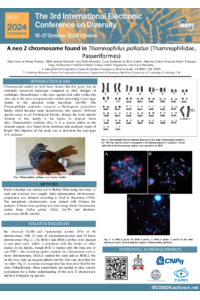
Chromosomal studies in birds have shown that this group has an extremely conserved karyotype compared to other lineages of vertebrates. Passeriformes is the most species-rich order within this class and is the most cytogenetically studied, presenting a karyotype similar to the ancestral avian karyotype (2n=80). The Antbirds (Thamnophilidae) comprise a Neotropical passeriform family, which includes many insectivorous bird species. Different species occur in all Neotropical biomes, though the local species richness of this family is far higher in tropical forest sites. Thamnophilus palliatus is a species native to the Amazon region, also found on the northeast and southeast coasts of Brazil. The objective of this study was to determine the karyotype of T. palliatus. Field collection was carried out in Belém/Pará using mist nets. A male and a female were caught. After euthanization, chromosomal preparation was obtained according to Ford and Hamerton (1956), then the metaphasic chromosomes were stained with Giemsa for analysis. Chromosome painting was performed using whole chromosome probes from Gallus gallus (GGA, 2n=78) and Burhinus oedicnemus (BOE, 2n=42). As a result, we observed a 2n=80 and fundamental number (FN) of 84 chromosomes, with 10 pairs of macrochromosomes and 70 micro chromosomes. The BOE-1 and BOE-2 probes marked in two pairs each, which is consistent with the results of other studies in this family, though BOE-2 marked only the long arm of pair THP-1; the remaining probes marked one chromosome each or micro-chromosomes. GGA-Z marked the same pair as BOE-2, but on the short arm, it marked an unusual pattern for the first time described for this order. A similar rearrangement has been described for the order Psittaciformes. More experiments are needed in other populations of this species for a better understanding of this new Z chromosome and how it is impacting the species.
Keywords
Chromosome painting
Passeriformes
Amazon biodiversity
Neo-Z
Poster
Poster_Paulo_Victor_de_Moraes_Ferreira.pdf
Chromosomal rearrangements drive diversity in tree rats of the genus Oecomys (Rodentia, Sigmodontinae, Oryzomyini)
First karyotypic description of Echimys chrysurus Zimmermann, 1780 (Rodentia, Echimyidae, Echimyinae) from the Amazon and chromosomal patterns among Echimyidae lineages