Event submissions
Published
This submission belongs to the session S3. Marine Diversity of the event The 3rd International Electronic Conference on Diversity
Published date
15 Oct, 2024
Academic Editor
'%3e%3cpath%20d='M12.6657%2010.9104C12.4185%2010.325%2012.0599%209.79327%2011.6097%209.34482C11.1609%208.89508%2010.6293%208.5365%2010.0442%208.28888C10.0389%208.28626%2010.0337%208.28495%2010.0285%208.28233C10.8446%207.69279%2011.3752%206.73249%2011.3752%205.64904C11.3752%203.8542%209.92103%202.39999%208.1262%202.39999C6.33136%202.39999%204.87715%203.8542%204.87715%205.64904C4.87715%206.73249%205.40774%207.69279%206.22393%208.28364C6.21869%208.28626%206.21345%208.28757%206.20821%208.29019C5.62129%208.5378%205.09463%208.89284%204.64265%209.34613C4.1929%209.79493%203.83432%2010.3266%203.58671%2010.9117C3.34345%2011.4845%203.21226%2012.0987%203.20023%2012.7209C3.19988%2012.7349%203.20233%2012.7488%203.20744%2012.7619C3.21255%2012.7749%203.22022%2012.7867%203.22998%2012.7968C3.23975%2012.8068%203.25142%2012.8147%203.26431%2012.8202C3.2772%2012.8256%203.29105%2012.8284%203.30504%2012.8284H4.09109C4.14874%2012.8284%204.19459%2012.7825%204.1959%2012.7262C4.2221%2011.7148%204.62823%2010.7676%205.34617%2010.0497C6.08899%209.30683%207.0755%208.89808%208.1262%208.89808C9.17689%208.89808%2010.1634%209.30683%2010.9062%2010.0497C11.6242%2010.7676%2012.0303%2011.7148%2012.0565%2012.7262C12.0578%2012.7838%2012.1037%2012.8284%2012.1613%2012.8284H12.9474C12.9613%2012.8284%2012.9752%2012.8256%2012.9881%2012.8202C13.001%2012.8147%2013.0126%2012.8068%2013.0224%2012.7968C13.0322%2012.7867%2013.0398%2012.7749%2013.0449%2012.7619C13.0501%2012.7488%2013.0525%2012.7349%2013.0522%2012.7209C13.0391%2012.0947%2012.9094%2011.4855%2012.6657%2010.9104ZM8.1262%207.9024C7.52486%207.9024%206.9589%207.6679%206.53312%207.24211C6.10733%206.81633%205.87283%206.25037%205.87283%205.64904C5.87283%205.0477%206.10733%204.48174%206.53312%204.05596C6.9589%203.63018%207.52486%203.39567%208.1262%203.39567C8.72753%203.39567%209.29349%203.63018%209.71927%204.05596C10.1451%204.48174%2010.3796%205.0477%2010.3796%205.64904C10.3796%206.25037%2010.1451%206.81633%209.71927%207.24211C9.29349%207.6679%208.72753%207.9024%208.1262%207.9024Z'%20fill='%235D1EE1'/%3e%3c/g%3e%3c/svg%3e) Gioele Capillo
Gioele CapilloCitation
Natalia Demchenko, Elena Rybakova, Antonina Kremenetskaia, New data on the amphipod fauna of the hydrothermally active submarine Piip Volcano (Bering Sea), in Proceedings of The 3rd International Electronic Conference on Diversity, 15 October–17 October 2024, MDPI: Basel, Switzerland
Share
Email
Facebook
Twitter
LinkedIn
New data on the amphipod fauna of the hydrothermally active submarine Piip Volcano (Bering Sea)
'%3e%3cpath%20d='M12.6647%2010.9104C12.4176%2010.325%2012.0589%209.7933%2011.6088%209.34485C11.16%208.89511%2010.6283%208.53653%2010.0432%208.28891C10.038%208.28629%2010.0327%208.28498%2010.0275%208.28236C10.8437%207.69282%2011.3743%206.73252%2011.3743%205.64907C11.3743%203.85423%209.92005%202.40002%208.12522%202.40002C6.33038%202.40002%204.87618%203.85423%204.87618%205.64907C4.87618%206.73252%205.40677%207.69282%206.22296%208.28367C6.21772%208.28629%206.21248%208.2876%206.20724%208.29022C5.62031%208.53783%205.09365%208.89287%204.64167%209.34616C4.19192%209.79496%203.83334%2010.3266%203.58573%2010.9117C3.34247%2011.4846%203.21128%2012.0987%203.19925%2012.721C3.1989%2012.735%203.20135%2012.7489%203.20646%2012.7619C3.21157%2012.7749%203.21924%2012.7868%203.22901%2012.7968C3.23877%2012.8068%203.25045%2012.8148%203.26334%2012.8202C3.27623%2012.8256%203.29007%2012.8284%203.30406%2012.8284H4.09012C4.14776%2012.8284%204.19362%2012.7825%204.19493%2012.7262C4.22113%2011.7148%204.62726%2010.7676%205.34519%2010.0497C6.08802%209.30686%207.07452%208.89811%208.12522%208.89811C9.17592%208.89811%2010.1624%209.30686%2010.9052%2010.0497C11.6232%2010.7676%2012.0293%2011.7148%2012.0555%2012.7262C12.0568%2012.7839%2012.1027%2012.8284%2012.1603%2012.8284H12.9464C12.9604%2012.8284%2012.9742%2012.8256%2012.9871%2012.8202C13%2012.8148%2013.0117%2012.8068%2013.0214%2012.7968C13.0312%2012.7868%2013.0389%2012.7749%2013.044%2012.7619C13.0491%2012.7489%2013.0515%2012.735%2013.0512%2012.721C13.0381%2012.0947%2012.9084%2011.4856%2012.6647%2010.9104ZM8.12522%207.90243C7.52388%207.90243%206.95792%207.66793%206.53214%207.24215C6.10636%206.81636%205.87185%206.2504%205.87185%205.64907C5.87185%205.04773%206.10636%204.48177%206.53214%204.05599C6.95792%203.63021%207.52388%203.3957%208.12522%203.3957C8.72655%203.3957%209.29252%203.63021%209.7183%204.05599C10.1441%204.48177%2010.3786%205.04773%2010.3786%205.64907C10.3786%206.2504%2010.1441%206.81636%209.7183%207.24215C9.29252%207.66793%208.72655%207.90243%208.12522%207.90243Z'%20fill='%235D1EE1'/%3e%3c/g%3e%3c/svg%3e)
Natalia Demchenko 1
Elena Rybakova 2
Antonina Kremenetskaia 2
1. A.V. Zhirmunsky National Scientific Center of Marine Biology of FEB RAS, Vladivostok, Russia
2. Shirshov Institute of Oceanology, Russian Academy of Sciences, Moscow, Russia
Abstract
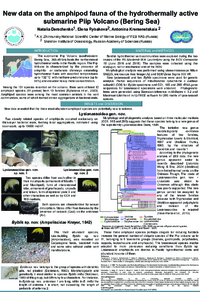
The submarine Piip Volcano (southwestern Bering Sea, 55◦445N, 167◦263E, 368–495m) hosts the northernmost hydrothermal vents in the Pacific region. Benthic hydrothermal vent communities were explored during the two cruises of the RV Akademik M.A. Lavrentyev using the ROV Comanche 18 (June 2016 and 2018). The samples were collected using the slurp-gun, net or mechanical arm of the ROV. Among the 131 species recorded on the volcano, there were at least 12 amphipod species (11 genera) from 10 families. Amphipod species were among the most common animals in the vent communities, some of which formed dense aggregations in bacterial mats. New data revealed that the three most abundant amphipod species are potentially new to science. Two closely related species of amphipods occurred exclusively on thick-layer bacterial mats, forming local aggregations, which was determined using a laser-scale up to 10000 ind/m2. The morphology and phylogenetic analysis based on three molecular markers (CO1, 16S and 28S) suggest that these species belong to a new genus of the superfamily Lysianassoidea Dana, 1849. They differ from each other in their mouthparts (arming of Mx1), form of interantennal lobe, armament of gnathopods, uropods, form of epimeral plate 3, form of telson and other characteristics, as well as by their CO1 and 16S markers. The third species, tube-building Byblis sp. (Ampeliscidae), was recorded on Calyptogena beds, bacterial mats and some sites without visible vent manifestations. These three amphipod species, which perhaps obligate for reducing habitats, increase the general number of obligate species of the volcano to eleven, belonging to six taxonomic groups (bivalves, gastropods, polychaetes, isopods, leptostracans and amphipods). The lysianassoid species possibly adapted to more pronounced reducing conditions than Byblis sp. Lisianassoid amphipods are diverse in Pacific hydrothermal vents and abundant in some of them. The relationships between amphipod faunas of the Piip Volcano and other hydrothermal vents of the northwestern Pacific are discussed. This research was supported by the Russian Science Foundation (grant 24-27-00242).
Keywords
amphipoda
Lysianassoidea
Ampeliscidae
hydrothermal vents
Piip Volcano
Poster
sciforum-097247_IECD2024-044560.pdf
First karyotypic description of Echimys chrysurus Zimmermann, 1780 (Rodentia, Echimyidae, Echimyinae) from the Amazon and chromosomal patterns among Echimyidae lineages
Neglected genetic resources: gathered food plants in the urban markets of North-West Morocco