Event submissions
Published
This submission belongs to the session S3. Marine Diversity of the event The 3rd International Electronic Conference on Diversity
Published date
15 Oct, 2024
Academic Editor
'%3e%3cpath%20d='M12.6657%2010.9104C12.4185%2010.325%2012.0599%209.79327%2011.6097%209.34482C11.1609%208.89508%2010.6293%208.5365%2010.0442%208.28888C10.0389%208.28626%2010.0337%208.28495%2010.0285%208.28233C10.8446%207.69279%2011.3752%206.73249%2011.3752%205.64904C11.3752%203.8542%209.92103%202.39999%208.1262%202.39999C6.33136%202.39999%204.87715%203.8542%204.87715%205.64904C4.87715%206.73249%205.40774%207.69279%206.22393%208.28364C6.21869%208.28626%206.21345%208.28757%206.20821%208.29019C5.62129%208.5378%205.09463%208.89284%204.64265%209.34613C4.1929%209.79493%203.83432%2010.3266%203.58671%2010.9117C3.34345%2011.4845%203.21226%2012.0987%203.20023%2012.7209C3.19988%2012.7349%203.20233%2012.7488%203.20744%2012.7619C3.21255%2012.7749%203.22022%2012.7867%203.22998%2012.7968C3.23975%2012.8068%203.25142%2012.8147%203.26431%2012.8202C3.2772%2012.8256%203.29105%2012.8284%203.30504%2012.8284H4.09109C4.14874%2012.8284%204.19459%2012.7825%204.1959%2012.7262C4.2221%2011.7148%204.62823%2010.7676%205.34617%2010.0497C6.08899%209.30683%207.0755%208.89808%208.1262%208.89808C9.17689%208.89808%2010.1634%209.30683%2010.9062%2010.0497C11.6242%2010.7676%2012.0303%2011.7148%2012.0565%2012.7262C12.0578%2012.7838%2012.1037%2012.8284%2012.1613%2012.8284H12.9474C12.9613%2012.8284%2012.9752%2012.8256%2012.9881%2012.8202C13.001%2012.8147%2013.0126%2012.8068%2013.0224%2012.7968C13.0322%2012.7867%2013.0398%2012.7749%2013.0449%2012.7619C13.0501%2012.7488%2013.0525%2012.7349%2013.0522%2012.7209C13.0391%2012.0947%2012.9094%2011.4855%2012.6657%2010.9104ZM8.1262%207.9024C7.52486%207.9024%206.9589%207.6679%206.53312%207.24211C6.10733%206.81633%205.87283%206.25037%205.87283%205.64904C5.87283%205.0477%206.10733%204.48174%206.53312%204.05596C6.9589%203.63018%207.52486%203.39567%208.1262%203.39567C8.72753%203.39567%209.29349%203.63018%209.71927%204.05596C10.1451%204.48174%2010.3796%205.0477%2010.3796%205.64904C10.3796%206.25037%2010.1451%206.81633%209.71927%207.24211C9.29349%207.6679%208.72753%207.9024%208.1262%207.9024Z'%20fill='%235D1EE1'/%3e%3c/g%3e%3c/svg%3e) Paulo Vale
Paulo ValeCitation
Daria Sergeevna Balycheva, Anastasiia Andreevna Blaginina, Ekaterina Sergeevna Miroshnichenko, Larisa Ivanovna Ryabushko, Sophia Stepanovna Barinova, Importance of studying regional biodiversity of benthic marine diatoms and cyanobacteria for bioindication of organic pollution in marine environments, in Proceedings of The 3rd International Electronic Conference on Diversity, 15 October–17 October 2024, MDPI: Basel, Switzerland
Share
Email
Facebook
Twitter
LinkedIn
Importance of studying regional biodiversity of benthic marine diatoms and cyanobacteria for bioindication of organic pollution in marine environments

Daria Sergeevna Balycheva 1
'%3e%3cpath%20d='M12.6647%2010.9104C12.4176%2010.325%2012.0589%209.7933%2011.6088%209.34485C11.16%208.89511%2010.6283%208.53653%2010.0432%208.28891C10.038%208.28629%2010.0327%208.28498%2010.0275%208.28236C10.8437%207.69282%2011.3743%206.73252%2011.3743%205.64907C11.3743%203.85423%209.92005%202.40002%208.12522%202.40002C6.33038%202.40002%204.87618%203.85423%204.87618%205.64907C4.87618%206.73252%205.40677%207.69282%206.22296%208.28367C6.21772%208.28629%206.21248%208.2876%206.20724%208.29022C5.62031%208.53783%205.09365%208.89287%204.64167%209.34616C4.19192%209.79496%203.83334%2010.3266%203.58573%2010.9117C3.34247%2011.4846%203.21128%2012.0987%203.19925%2012.721C3.1989%2012.735%203.20135%2012.7489%203.20646%2012.7619C3.21157%2012.7749%203.21924%2012.7868%203.22901%2012.7968C3.23877%2012.8068%203.25045%2012.8148%203.26334%2012.8202C3.27623%2012.8256%203.29007%2012.8284%203.30406%2012.8284H4.09012C4.14776%2012.8284%204.19362%2012.7825%204.19493%2012.7262C4.22113%2011.7148%204.62726%2010.7676%205.34519%2010.0497C6.08802%209.30686%207.07452%208.89811%208.12522%208.89811C9.17592%208.89811%2010.1624%209.30686%2010.9052%2010.0497C11.6232%2010.7676%2012.0293%2011.7148%2012.0555%2012.7262C12.0568%2012.7839%2012.1027%2012.8284%2012.1603%2012.8284H12.9464C12.9604%2012.8284%2012.9742%2012.8256%2012.9871%2012.8202C13%2012.8148%2013.0117%2012.8068%2013.0214%2012.7968C13.0312%2012.7868%2013.0389%2012.7749%2013.044%2012.7619C13.0491%2012.7489%2013.0515%2012.735%2013.0512%2012.721C13.0381%2012.0947%2012.9084%2011.4856%2012.6647%2010.9104ZM8.12522%207.90243C7.52388%207.90243%206.95792%207.66793%206.53214%207.24215C6.10636%206.81636%205.87185%206.2504%205.87185%205.64907C5.87185%205.04773%206.10636%204.48177%206.53214%204.05599C6.95792%203.63021%207.52388%203.3957%208.12522%203.3957C8.72655%203.3957%209.29252%203.63021%209.7183%204.05599C10.1441%204.48177%2010.3786%205.04773%2010.3786%205.64907C10.3786%206.2504%2010.1441%206.81636%209.7183%207.24215C9.29252%207.66793%208.72655%207.90243%208.12522%207.90243Z'%20fill='%235D1EE1'/%3e%3c/g%3e%3c/svg%3e)
Anastasiia Andreevna Blaginina 2
Ekaterina Sergeevna Miroshnichenko 2
Larisa Ivanovna Ryabushko 2

Sophia Stepanovna Barinova 3
1. A.O. Kovalevsky Institute of Biology of the Southern Seas of RAS, 299011 Sevastopol, Russia
2. A.O. Kovalevsky Institute of Biology of the Southern Seas of RAS
3. Institute of Evolution, University of Haifa, Haifa, Israel
Abstract
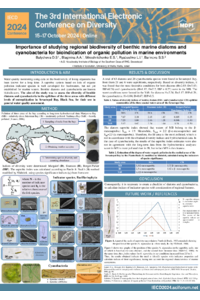
Water quality monitoring using data on the biodiversity of living organisms has been employed for a long time. A saprobic system based on lists of organic pollution indicator species has been developed for freshwaters, but one has not yet been established for marine waters. Benthic diatoms and cyanobacteria are known bioindicators. The aim of this study was to assess the diversity of benthic diatoms and cyanobacteria in the epilithon of the three areas with different levels of eutrophication in Sevastopol Bay, Black Sea, for their use in general water quality assessment. The pollution of three areas of the bay was determined according to long-term hydrochemical data, as follows: Martynova Bay (MB)—relatively clean, Inkerman Bay (IB)—moderately polluted, Yuzhnaya Bay (YuB)—heavily polluted. The following indices of diversity were determined: Margalef (D), Shannon (H), Berger–Parker (IBP). The saprobic index was calculated according to Pantle and Buck's (S) method modified by Sládeček, using species significance indices (s) from the literature.
A total of 63 diatoms and 20 cyanobacteria species were found in Sevastopol Bay; among them, 21 and 6 were saprobionts, respectively. Based on diversity indices, it was found that the most favorable conditions for both diatoms (H=2.65; D=7.67; IBP=0.28) and cyanobacteria (H=1.83; D=2.2; IBP = 0.25) were in MB. The worst conditions were formed in the YuB: for diatoms, H=2.24; D=5.17; IBP=0.28; for cyanobacteria, H=1.04; D=0.67; IBP=0.5.
The diatom saprobic index showed that waters of MB are β-mesosaprobic: SMB = 1.9. Meanwhile, SYuB = 2.2 (β-α-mesosaprobic) and SIB=2.5 (α-mesosaprobic). Therefore, the IB area is the most polluted, which is not in accordance with the obtained diversity indices and hydrochemical data. For cyanobacteria, the results of the estimations were also not consistent. Consequently, it is necessary to create a checklist of diatoms and cyanobacteria to calculate indices of indicator species with consideration of regional features.
Keywords
Bioindication
diatoms
cyanobacteria
marine diversity
indicator species
organic pollution
saprobic index
Poster
Balycheva IECD 2024 poster.pdf
Heterologous Expression and Characterization of Cobetia amphilecti KMM 296 Alkaline Phosphatase in Nicotiana spp.
Estimation of ploidy level and associated traits signifying the positive impacts of genome size increase on leaf anatomical traits of Morus spp.