Event submissions
Published
This submission belongs to the session S6. Plant Diversity of the event The 3rd International Electronic Conference on Diversity
Published date
15 Oct, 2024
Academic Editor
'%3e%3cpath%20d='M12.6657%2010.9104C12.4185%2010.325%2012.0599%209.79327%2011.6097%209.34482C11.1609%208.89508%2010.6293%208.5365%2010.0442%208.28888C10.0389%208.28626%2010.0337%208.28495%2010.0285%208.28233C10.8446%207.69279%2011.3752%206.73249%2011.3752%205.64904C11.3752%203.8542%209.92103%202.39999%208.1262%202.39999C6.33136%202.39999%204.87715%203.8542%204.87715%205.64904C4.87715%206.73249%205.40774%207.69279%206.22393%208.28364C6.21869%208.28626%206.21345%208.28757%206.20821%208.29019C5.62129%208.5378%205.09463%208.89284%204.64265%209.34613C4.1929%209.79493%203.83432%2010.3266%203.58671%2010.9117C3.34345%2011.4845%203.21226%2012.0987%203.20023%2012.7209C3.19988%2012.7349%203.20233%2012.7488%203.20744%2012.7619C3.21255%2012.7749%203.22022%2012.7867%203.22998%2012.7968C3.23975%2012.8068%203.25142%2012.8147%203.26431%2012.8202C3.2772%2012.8256%203.29105%2012.8284%203.30504%2012.8284H4.09109C4.14874%2012.8284%204.19459%2012.7825%204.1959%2012.7262C4.2221%2011.7148%204.62823%2010.7676%205.34617%2010.0497C6.08899%209.30683%207.0755%208.89808%208.1262%208.89808C9.17689%208.89808%2010.1634%209.30683%2010.9062%2010.0497C11.6242%2010.7676%2012.0303%2011.7148%2012.0565%2012.7262C12.0578%2012.7838%2012.1037%2012.8284%2012.1613%2012.8284H12.9474C12.9613%2012.8284%2012.9752%2012.8256%2012.9881%2012.8202C13.001%2012.8147%2013.0126%2012.8068%2013.0224%2012.7968C13.0322%2012.7867%2013.0398%2012.7749%2013.0449%2012.7619C13.0501%2012.7488%2013.0525%2012.7349%2013.0522%2012.7209C13.0391%2012.0947%2012.9094%2011.4855%2012.6657%2010.9104ZM8.1262%207.9024C7.52486%207.9024%206.9589%207.6679%206.53312%207.24211C6.10733%206.81633%205.87283%206.25037%205.87283%205.64904C5.87283%205.0477%206.10733%204.48174%206.53312%204.05596C6.9589%203.63018%207.52486%203.39567%208.1262%203.39567C8.72753%203.39567%209.29349%203.63018%209.71927%204.05596C10.1451%204.48174%2010.3796%205.0477%2010.3796%205.64904C10.3796%206.25037%2010.1451%206.81633%209.71927%207.24211C9.29349%207.6679%208.72753%207.9024%208.1262%207.9024Z'%20fill='%235D1EE1'/%3e%3c/g%3e%3c/svg%3e) Mario A. Pagnotta
Mario A. PagnottaCitation
RAJU MONDAL, Prashanth A. Sangannavar, Dr. V. Nishitha Naik, Dr. Yogesh Mishra, Estimation of ploidy level and associated traits signifying the positive impacts of genome size increase on leaf anatomical traits of Morus spp., in Proceedings of The 3rd International Electronic Conference on Diversity, 15 October–17 October 2024, MDPI: Basel, Switzerland
Share
Email
Facebook
Twitter
LinkedIn
Estimation of ploidy level and associated traits signifying the positive impacts of genome size increase on leaf anatomical traits of Morus spp.

RAJU MONDAL 1
'%3e%3cpath%20d='M12.6647%2010.9104C12.4176%2010.325%2012.0589%209.7933%2011.6088%209.34485C11.16%208.89511%2010.6283%208.53653%2010.0432%208.28891C10.038%208.28629%2010.0327%208.28498%2010.0275%208.28236C10.8437%207.69282%2011.3743%206.73252%2011.3743%205.64907C11.3743%203.85423%209.92005%202.40002%208.12522%202.40002C6.33038%202.40002%204.87618%203.85423%204.87618%205.64907C4.87618%206.73252%205.40677%207.69282%206.22296%208.28367C6.21772%208.28629%206.21248%208.2876%206.20724%208.29022C5.62031%208.53783%205.09365%208.89287%204.64167%209.34616C4.19192%209.79496%203.83334%2010.3266%203.58573%2010.9117C3.34247%2011.4846%203.21128%2012.0987%203.19925%2012.721C3.1989%2012.735%203.20135%2012.7489%203.20646%2012.7619C3.21157%2012.7749%203.21924%2012.7868%203.22901%2012.7968C3.23877%2012.8068%203.25045%2012.8148%203.26334%2012.8202C3.27623%2012.8256%203.29007%2012.8284%203.30406%2012.8284H4.09012C4.14776%2012.8284%204.19362%2012.7825%204.19493%2012.7262C4.22113%2011.7148%204.62726%2010.7676%205.34519%2010.0497C6.08802%209.30686%207.07452%208.89811%208.12522%208.89811C9.17592%208.89811%2010.1624%209.30686%2010.9052%2010.0497C11.6232%2010.7676%2012.0293%2011.7148%2012.0555%2012.7262C12.0568%2012.7839%2012.1027%2012.8284%2012.1603%2012.8284H12.9464C12.9604%2012.8284%2012.9742%2012.8256%2012.9871%2012.8202C13%2012.8148%2013.0117%2012.8068%2013.0214%2012.7968C13.0312%2012.7868%2013.0389%2012.7749%2013.044%2012.7619C13.0491%2012.7489%2013.0515%2012.735%2013.0512%2012.721C13.0381%2012.0947%2012.9084%2011.4856%2012.6647%2010.9104ZM8.12522%207.90243C7.52388%207.90243%206.95792%207.66793%206.53214%207.24215C6.10636%206.81636%205.87185%206.2504%205.87185%205.64907C5.87185%205.04773%206.10636%204.48177%206.53214%204.05599C6.95792%203.63021%207.52388%203.3957%208.12522%203.3957C8.72655%203.3957%209.29252%203.63021%209.7183%204.05599C10.1441%204.48177%2010.3786%205.04773%2010.3786%205.64907C10.3786%206.2504%2010.1441%206.81636%209.7183%207.24215C9.29252%207.66793%208.72655%207.90243%208.12522%207.90243Z'%20fill='%235D1EE1'/%3e%3c/g%3e%3c/svg%3e)
Prashanth A. Sangannavar 2
Dr. V. Nishitha Naik 1
Dr. Yogesh Mishra 3
1. CSB-Central Sericultural Germplasm Resources Centre (CSGRC), Hosur, Tamil Nady 635 109, India
2. Central Silk Board, Bengaluru, Karnataka 560068, India
3. Department of Botany, Center of Advanced Study in Botany, Banaras Hindu University, Varanasi India-221005
Abstract
One of the fundamental aspects of evolutionary biology is understanding genome organization and its functional aspects that directly or indirectly act in concert with the adaptability of any organism. The evolution of chromosome size, number, and structure, as well as changes in DNA composition, suggest the high plasticity of nuclear genomes at the chromosomal level. Hence, chromosomal information on chromosomal complements bears significant importance in plant breeding and genetic studies, including genome analysis. Regardless of the prime focus on the mulberry crop, the understanding of its ploidy variation and ploidy-associated traits is lacking, which hinders the development of strategies for its systematic improvement and conservation. In the present research, with the execution of classical cytology, the chromosome numbers of 20 mulberry accessions (Morus spp.) have been estimated using shoot tip meristems. Chromosomal complements accounted for definitive intraspecific variation at ploidy levels such as diploid (2n=2x=28), triploid (2n=3x=42), tetraploid (2n=4x=56), and hexaploid (2n=6x=84) among the studied species (M. alba, M. australis, M. bombycis, M. cathayana, M. indica, M. laevigata, M. latifolia, M. macroura, M. rotundiloba, and M. serrata). Additionally, flow cytometry analysis was performed for the validation of chromosomal data. To identify ploidy-associated traits, different functional traits were studied. Principal component analysis (PCA) and heat map analysis indicate the positive impact of genome duplication on leaf anatomical traits. Further consideration of below-ground traits will require in-depth understanding. Moreover, the present outcomes of intraspecific ploidy variation and identified ploidy-associated traits provide a platform and open windows for frontier omics approaches to improve the mulberry crop in the near future.
Keywords
Mulberry
cytology
chromosome number
flow cytometry
ploidy-associated traits
Poster
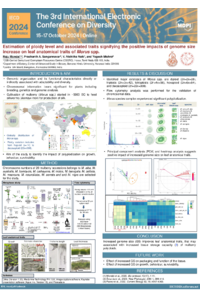
Mondal Raju_3rd IECD.pdf
Importance of studying regional biodiversity of benthic marine diatoms and cyanobacteria for bioindication of organic pollution in marine environments
Predictive Models of the Species Diversity and Biomass of the Herb Layer During Changes in the Stands of Dark Coniferous Forests