Event submissions
Published
This submission belongs to the session 3. Biomedical Biomaterials of the event The 1st International Online Conference on Bioengineering
Published date
15 Oct, 2024
Academic Editor
'%3e%3cpath%20d='M12.6657%2010.9104C12.4185%2010.325%2012.0599%209.79327%2011.6097%209.34482C11.1609%208.89508%2010.6293%208.5365%2010.0442%208.28888C10.0389%208.28626%2010.0337%208.28495%2010.0285%208.28233C10.8446%207.69279%2011.3752%206.73249%2011.3752%205.64904C11.3752%203.8542%209.92103%202.39999%208.1262%202.39999C6.33136%202.39999%204.87715%203.8542%204.87715%205.64904C4.87715%206.73249%205.40774%207.69279%206.22393%208.28364C6.21869%208.28626%206.21345%208.28757%206.20821%208.29019C5.62129%208.5378%205.09463%208.89284%204.64265%209.34613C4.1929%209.79493%203.83432%2010.3266%203.58671%2010.9117C3.34345%2011.4845%203.21226%2012.0987%203.20023%2012.7209C3.19988%2012.7349%203.20233%2012.7488%203.20744%2012.7619C3.21255%2012.7749%203.22022%2012.7867%203.22998%2012.7968C3.23975%2012.8068%203.25142%2012.8147%203.26431%2012.8202C3.2772%2012.8256%203.29105%2012.8284%203.30504%2012.8284H4.09109C4.14874%2012.8284%204.19459%2012.7825%204.1959%2012.7262C4.2221%2011.7148%204.62823%2010.7676%205.34617%2010.0497C6.08899%209.30683%207.0755%208.89808%208.1262%208.89808C9.17689%208.89808%2010.1634%209.30683%2010.9062%2010.0497C11.6242%2010.7676%2012.0303%2011.7148%2012.0565%2012.7262C12.0578%2012.7838%2012.1037%2012.8284%2012.1613%2012.8284H12.9474C12.9613%2012.8284%2012.9752%2012.8256%2012.9881%2012.8202C13.001%2012.8147%2013.0126%2012.8068%2013.0224%2012.7968C13.0322%2012.7867%2013.0398%2012.7749%2013.0449%2012.7619C13.0501%2012.7488%2013.0525%2012.7349%2013.0522%2012.7209C13.0391%2012.0947%2012.9094%2011.4855%2012.6657%2010.9104ZM8.1262%207.9024C7.52486%207.9024%206.9589%207.6679%206.53312%207.24211C6.10733%206.81633%205.87283%206.25037%205.87283%205.64904C5.87283%205.0477%206.10733%204.48174%206.53312%204.05596C6.9589%203.63018%207.52486%203.39567%208.1262%203.39567C8.72753%203.39567%209.29349%203.63018%209.71927%204.05596C10.1451%204.48174%2010.3796%205.0477%2010.3796%205.64904C10.3796%206.25037%2010.1451%206.81633%209.71927%207.24211C9.29349%207.6679%208.72753%207.9024%208.1262%207.9024Z'%20fill='%235D1EE1'/%3e%3c/g%3e%3c/svg%3e) Rossana Madrid
Rossana MadridCitation
Raja Saadan, Aziz Ihammi, Mohamed Chigr, Ahmed Fatimi, Review on the formulation of cellulose-based hydrogels and their biomedical applications, in Proceedings of The 1st International Online Conference on Bioengineering, 16 October–18 October 2024, MDPI: Basel, Switzerland
Share
Email
Facebook
Twitter
LinkedIn
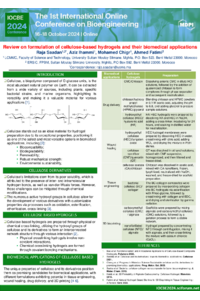
Review on the formulation of cellulose-based hydrogels and their biomedical applications
'%3e%3cpath%20d='M12.6647%2010.9104C12.4176%2010.325%2012.0589%209.7933%2011.6088%209.34485C11.16%208.89511%2010.6283%208.53653%2010.0432%208.28891C10.038%208.28629%2010.0327%208.28498%2010.0275%208.28236C10.8437%207.69282%2011.3743%206.73252%2011.3743%205.64907C11.3743%203.85423%209.92005%202.40002%208.12522%202.40002C6.33038%202.40002%204.87618%203.85423%204.87618%205.64907C4.87618%206.73252%205.40677%207.69282%206.22296%208.28367C6.21772%208.28629%206.21248%208.2876%206.20724%208.29022C5.62031%208.53783%205.09365%208.89287%204.64167%209.34616C4.19192%209.79496%203.83334%2010.3266%203.58573%2010.9117C3.34247%2011.4846%203.21128%2012.0987%203.19925%2012.721C3.1989%2012.735%203.20135%2012.7489%203.20646%2012.7619C3.21157%2012.7749%203.21924%2012.7868%203.22901%2012.7968C3.23877%2012.8068%203.25045%2012.8148%203.26334%2012.8202C3.27623%2012.8256%203.29007%2012.8284%203.30406%2012.8284H4.09012C4.14776%2012.8284%204.19362%2012.7825%204.19493%2012.7262C4.22113%2011.7148%204.62726%2010.7676%205.34519%2010.0497C6.08802%209.30686%207.07452%208.89811%208.12522%208.89811C9.17592%208.89811%2010.1624%209.30686%2010.9052%2010.0497C11.6232%2010.7676%2012.0293%2011.7148%2012.0555%2012.7262C12.0568%2012.7839%2012.1027%2012.8284%2012.1603%2012.8284H12.9464C12.9604%2012.8284%2012.9742%2012.8256%2012.9871%2012.8202C13%2012.8148%2013.0117%2012.8068%2013.0214%2012.7968C13.0312%2012.7868%2013.0389%2012.7749%2013.044%2012.7619C13.0491%2012.7489%2013.0515%2012.735%2013.0512%2012.721C13.0381%2012.0947%2012.9084%2011.4856%2012.6647%2010.9104ZM8.12522%207.90243C7.52388%207.90243%206.95792%207.66793%206.53214%207.24215C6.10636%206.81636%205.87185%206.2504%205.87185%205.64907C5.87185%205.04773%206.10636%204.48177%206.53214%204.05599C6.95792%203.63021%207.52388%203.3957%208.12522%203.3957C8.72655%203.3957%209.29252%203.63021%209.7183%204.05599C10.1441%204.48177%2010.3786%205.04773%2010.3786%205.64907C10.3786%206.2504%2010.1441%206.81636%209.7183%207.24215C9.29252%207.66793%208.72655%207.90243%208.12522%207.90243Z'%20fill='%235D1EE1'/%3e%3c/g%3e%3c/svg%3e)
Raja Saadan 1,2
Aziz Ihammi 1
Mohamed Chigr 1

Ahmed Fatimi 2
1. Laboratory of Molecular Chemistry, Materials and Catalysis (LCMMC), Faculty of Science and Technology (FSTBM), University Sultan Moulay Slimane (USMS), Mghila, P.O. Box 523, Beni Mellal 23000, Morocco
2. Chemical Science and Engineering Research Team (ERSIC), Department of Chemistry, Polydisciplinary Faculty of Beni Mellal (FPBM), Sultan Moulay Slimane University (USMS), P.O. Box 592 Mghila, Beni Mellal 23000, Morocco
Abstract
In recent years, significant advancements have been made in the development of hydrogels as functional biomaterials, drawing increasing attention to their applications in biomedical engineering. Among various biopolymers, cellulose has emerged as an excellent candidate for hydrogel preparation due to its unique properties. As the most abundant natural biopolymer on Earth, cellulose offers advantages such as biocompatibility, biodegradability, renewability, good mechanical strength, and environmental friendliness, making it one of the safest materials available. The limitations of cellulose arise from its difficulty in dissolving due to the presence of inter- and intramolecular hydrogen bonds as well as van der Waals forces. However, this limitation can be addressed by chemically modifying cellulose, primarily through the etherification of hydroxyl groups, to produce various derivatives, including methylcellulose (MC), ethylcellulose (EC), hydroxyethyl methylcellulose (HEMC), hydroxypropyl cellulose (HPC), and sodium carboxymethyl cellulose (CMCNa). Crosslinking represents a vital step in the hydrogel preparation process, as it establishes the 3D structure and enhances physical and mechanical properties. Different crosslinking techniques are employed to produce hydrogels from cellulose and its derivatives, depending on the intended applications. Cellulose-based hydrogels have shown significant potential in biomedical applications, including tissue engineering, wound healing, drug delivery, 3D bioprinting, and more. In this review, we present the formulation of cellulose-based hydrogels and their biomedical applications. Specifically, we connect the latest knowledge in the literature on cellulose-based hydrogels with examples of how these materials have been utilized in biomedical applications. Additionally, we provide context regarding the importance of cellulose-based hydrogels in biomedical engineering, highlighting their unique advantages and promising potential in the field. Furthermore, we summarize the potential benefits of using cellulose-based hydrogels compared to other biomaterials.
Keywords
cellulose
hydrogels
crosslinking
biomaterials
biomedical applications
Poster
097774.pdf
Detection of Cardiovascular Disorders in Patients Supported with Continuous-Flow Left Ventricular Assist Devices by Monitoring Electrical Current Signals
Advancements in Medical Imaging Methods for Body Composition Assessment: A Literature Review