Event submissions
Published
This submission belongs to the session S5. Behavioral Approaches to Healthier Eating of the event The 4th International Electronic Conference on Nutrients
Published date
17 Oct, 2024
Academic Editor
'%3e%3cpath%20d='M12.6657%2010.9104C12.4185%2010.325%2012.0599%209.79327%2011.6097%209.34482C11.1609%208.89508%2010.6293%208.5365%2010.0442%208.28888C10.0389%208.28626%2010.0337%208.28495%2010.0285%208.28233C10.8446%207.69279%2011.3752%206.73249%2011.3752%205.64904C11.3752%203.8542%209.92103%202.39999%208.1262%202.39999C6.33136%202.39999%204.87715%203.8542%204.87715%205.64904C4.87715%206.73249%205.40774%207.69279%206.22393%208.28364C6.21869%208.28626%206.21345%208.28757%206.20821%208.29019C5.62129%208.5378%205.09463%208.89284%204.64265%209.34613C4.1929%209.79493%203.83432%2010.3266%203.58671%2010.9117C3.34345%2011.4845%203.21226%2012.0987%203.20023%2012.7209C3.19988%2012.7349%203.20233%2012.7488%203.20744%2012.7619C3.21255%2012.7749%203.22022%2012.7867%203.22998%2012.7968C3.23975%2012.8068%203.25142%2012.8147%203.26431%2012.8202C3.2772%2012.8256%203.29105%2012.8284%203.30504%2012.8284H4.09109C4.14874%2012.8284%204.19459%2012.7825%204.1959%2012.7262C4.2221%2011.7148%204.62823%2010.7676%205.34617%2010.0497C6.08899%209.30683%207.0755%208.89808%208.1262%208.89808C9.17689%208.89808%2010.1634%209.30683%2010.9062%2010.0497C11.6242%2010.7676%2012.0303%2011.7148%2012.0565%2012.7262C12.0578%2012.7838%2012.1037%2012.8284%2012.1613%2012.8284H12.9474C12.9613%2012.8284%2012.9752%2012.8256%2012.9881%2012.8202C13.001%2012.8147%2013.0126%2012.8068%2013.0224%2012.7968C13.0322%2012.7867%2013.0398%2012.7749%2013.0449%2012.7619C13.0501%2012.7488%2013.0525%2012.7349%2013.0522%2012.7209C13.0391%2012.0947%2012.9094%2011.4855%2012.6657%2010.9104ZM8.1262%207.9024C7.52486%207.9024%206.9589%207.6679%206.53312%207.24211C6.10733%206.81633%205.87283%206.25037%205.87283%205.64904C5.87283%205.0477%206.10733%204.48174%206.53312%204.05596C6.9589%203.63018%207.52486%203.39567%208.1262%203.39567C8.72753%203.39567%209.29349%203.63018%209.71927%204.05596C10.1451%204.48174%2010.3796%205.0477%2010.3796%205.64904C10.3796%206.25037%2010.1451%206.81633%209.71927%207.24211C9.29349%207.6679%208.72753%207.9024%208.1262%207.9024Z'%20fill='%235D1EE1'/%3e%3c/g%3e%3c/svg%3e) Mauro Lombardo
Mauro LombardoCitation
CLAUDIA MILENA ARDILA MELENDEZ, Attenuation of muscle loss and functionality through diet in patients with muscle atrophy-associated inflammation: a bibliographic review, in Proceedings of The 4th International Electronic Conference on Nutrients, 16 October–18 October 2024, MDPI: Basel, Switzerland
Share
Email
Facebook
Twitter
LinkedIn
Attenuation of muscle loss and functionality through diet in patients with muscle atrophy-associated inflammation: a bibliographic review

CLAUDIA MILENA ARDILA MELENDEZ 1
1. Dietitian Nutritionist Universidad Industrial de Santander, ICU Hospital San Juan de Dios Floridablanca, Santander, 681003, Colombia
Abstract
Introduction
Muscle atrophy can be generated by various factors: inflammation, malnutrition, aging, and a pro-inflammatory diet. The latter can lead to muscle wasting by promoting oxidative stress and thus activating the proinflammatory response via pro-inflammatory cytokines such as IL-6 and TNFα, which in turn can trigger insulin resistance, obesity, and type II diabetes, as well as alter muscle regeneration and cause aging. Oxidative stress and the impairment of antioxidant defenses promote an imbalance in homeostasis, leading to muscle atrophy and mitochondrial dysfunction. Bioactive substances can prevent the loss of muscle mass and promote functional recovery.
Objective
To review the association between inflammation and muscle atrophy and how dietary compounds can attenuate muscle loss.
Methods
A bibliographic search was conducted in the Medline, Web of Science, and Scopus databases including articles published in the last 10 years in English and Spanish.
Results
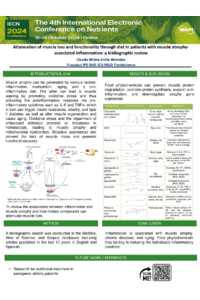
Food phytochemicals can prevent muscle protein degradation, promote protein synthesis, support anti-inflammation, and downregulate atrophy gene expression. Extra virgin olive oil and its phenolic compounds (oleuropein, hydroxytyrosol, and tyrosol) act by eliminating ROS, activating anabolic pathways, and counteracting mitochondrial and inflammatory alterations. DHA prevents palmitate-induced atrophy by inhibiting mitochondrial ROS production. Selenium is associated with a decrease in IL-6, TNF-α, and myostatin; vitamins A, C, and D reduce oxidative stress and the expression of MuRF1 and MAFbx. Curcumin decreases NF-κB, TNF-α, IL-1β, MuRF1, and MAFbx, as well as muscle proteolysis. Resveratrol increases mitochondrial biogenesis and decreases MuRF-1 and mitophagy. Astaxanthin decreases oxidative stress, proteolysis, apoptosis, and ROS. Epicatechin (a cocoa flavonoid) modulates biomarkers such as FoxO1A and MuRF1. S-allylcysteine inhibits TNF-α, IL-6, and myostatin. Tea polyphenols (epigallocatechin-3-gallate, epigallocatechin, epicatechin-3-gallate, epicatechin, gallocatechins, and gallocatechin gallate) decrease MuRF1, MAFbx, and myostatin. Finally, phenolic compounds from pomegranate inhibit oxidative stress, NF-κB, and the ubiquitin–proteasome system, on top of activating Akt/mTOR signaling.
Conclusions
Inflammation is associated with muscle atrophy, chronic diseases, and aging. Food phytochemicals may be key to reducing the individual's inflammatory condition.
Keywords
inflamation
antioxidants
muscular atrophy
phytochemicals
Poster
sciforum-101108-Melendez.pdf
Improved self-microemulsifying system enhances quercetin bioavailability
Fueling Healthy Growth: A Review of Nutrition's Role in Child Development and Chronic Disease