Event submissions
Published
This submission belongs to the session S3. Diet and Chronic Disease Management of the event The 4th International Electronic Conference on Nutrients
Published date
17 Oct, 2024
Academic Editor
'%3e%3cpath%20d='M12.6657%2010.9104C12.4185%2010.325%2012.0599%209.79327%2011.6097%209.34482C11.1609%208.89508%2010.6293%208.5365%2010.0442%208.28888C10.0389%208.28626%2010.0337%208.28495%2010.0285%208.28233C10.8446%207.69279%2011.3752%206.73249%2011.3752%205.64904C11.3752%203.8542%209.92103%202.39999%208.1262%202.39999C6.33136%202.39999%204.87715%203.8542%204.87715%205.64904C4.87715%206.73249%205.40774%207.69279%206.22393%208.28364C6.21869%208.28626%206.21345%208.28757%206.20821%208.29019C5.62129%208.5378%205.09463%208.89284%204.64265%209.34613C4.1929%209.79493%203.83432%2010.3266%203.58671%2010.9117C3.34345%2011.4845%203.21226%2012.0987%203.20023%2012.7209C3.19988%2012.7349%203.20233%2012.7488%203.20744%2012.7619C3.21255%2012.7749%203.22022%2012.7867%203.22998%2012.7968C3.23975%2012.8068%203.25142%2012.8147%203.26431%2012.8202C3.2772%2012.8256%203.29105%2012.8284%203.30504%2012.8284H4.09109C4.14874%2012.8284%204.19459%2012.7825%204.1959%2012.7262C4.2221%2011.7148%204.62823%2010.7676%205.34617%2010.0497C6.08899%209.30683%207.0755%208.89808%208.1262%208.89808C9.17689%208.89808%2010.1634%209.30683%2010.9062%2010.0497C11.6242%2010.7676%2012.0303%2011.7148%2012.0565%2012.7262C12.0578%2012.7838%2012.1037%2012.8284%2012.1613%2012.8284H12.9474C12.9613%2012.8284%2012.9752%2012.8256%2012.9881%2012.8202C13.001%2012.8147%2013.0126%2012.8068%2013.0224%2012.7968C13.0322%2012.7867%2013.0398%2012.7749%2013.0449%2012.7619C13.0501%2012.7488%2013.0525%2012.7349%2013.0522%2012.7209C13.0391%2012.0947%2012.9094%2011.4855%2012.6657%2010.9104ZM8.1262%207.9024C7.52486%207.9024%206.9589%207.6679%206.53312%207.24211C6.10733%206.81633%205.87283%206.25037%205.87283%205.64904C5.87283%205.0477%206.10733%204.48174%206.53312%204.05596C6.9589%203.63018%207.52486%203.39567%208.1262%203.39567C8.72753%203.39567%209.29349%203.63018%209.71927%204.05596C10.1451%204.48174%2010.3796%205.0477%2010.3796%205.64904C10.3796%206.25037%2010.1451%206.81633%209.71927%207.24211C9.29349%207.6679%208.72753%207.9024%208.1262%207.9024Z'%20fill='%235D1EE1'/%3e%3c/g%3e%3c/svg%3e) Jaime Uribarri
Jaime UribarriCitation
Michele Antonelli, Davide Donelli, The Biochemical Properties of Red Garlic: A Narrative Review of Laboratory Studies, in Proceedings of The 4th International Electronic Conference on Nutrients, 16 October–18 October 2024, MDPI: Basel, Switzerland
Share
Email
Facebook
Twitter
LinkedIn
The Biochemical Properties of Red Garlic: A Narrative Review of Laboratory Studies

Michele Antonelli 1

Davide Donelli 2
1. Public Health Department, AUSL-IRCCS of Reggio Emilia (Italy)
2. Cardiology Unit, Parma University Hospital, Parma (Italy)
Abstract
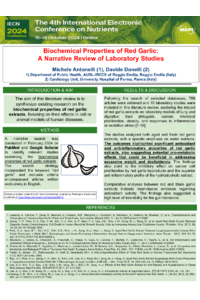
The consumption of garlic (Allium sativum), recognized for its historical medicinal significance, is linked to diverse health benefits: notably, red garlic stands out for its distinct anthocyanin content, contributing to its unique pink-purple clove color. However, despite extensive research on the therapeutic properties of garlic extracts, there remains limited evidence specifically addressing the therapeutic potential of red garlic. A narrative search was conducted in February 2024 on PubMed and Google Scholar to identify relevant studies examining the biochemical properties of red garlic extracts. Following the search of selected databases, 789 articles were retrieved. Ten laboratory studies exploring the impact of red garlic extracts on laboratory models of lung and digestive tract phlogosis, cancer, microbial proliferation, obesity, and responses to inflammation or oxidative stress were included in this literature review. The studies analyzed both aged and fresh red garlic extracts, with a specific emphasis on water extracts. The outcomes highlighted significant antioxidant and anti-inflammatory properties of red garlic extracts, also suggesting potential pro-metabolic effects that could be beneficial in addressing excessive weight and dyslipidemia. The findings also pointed to the inhibitory effect on cancer cell proliferation of red garlic byproducts and the superior anti-inflammatory profile of the hydroalcoholic extract. Comparative analyses between red and black garlic extracts indicate inconclusive evidence regarding antioxidant activity. The findings also suggested a high level of tolerability for the gut microbiota. This literature review aims to provide valuable insights into the therapeutic potential of red garlic extracts and emphasizes the need for further research to fully elucidate their benefits and mechanisms of action.
Keywords
Red garlic
Health
Nutraceuticals
Diet
Laboratory studies
Review
Poster
Red Garlic Properties POSTER (1).pdf
Exploring Behavioural Approaches to Foster Healthier Eating Habits: A Comprehensive Review